Published
Quick answer
The Buddhist teaching on contentment holds that peace comes from wanting less, not having more. Santutthi, contentment, is called the greatest wealth in the Dhammapada.
Key takeaways
- Santutthi (contentment) means fewer wants, not fewer achievements or less effort.
- A Dhammapada verse calls contentment the greatest wealth a person can have.
- Craving, not scarcity itself, is what Buddhism points to as the source of unease.
- Contentment pairs with non-attachment: caring fully while gripping less tightly.
- A short naming-and-breath practice before bed can quiet a mind still reaching for "more."
The Buddhist teaching on contentment holds that lasting ease comes from reducing craving, not from acquiring more — a quality the early texts call santutthi, or "enough-ness." It is less a mood you either have or lack than a skill you can practise, including on a restless night.
What does the Buddhist teaching on contentment actually say?
Santutthi appears throughout the Pali texts as something worth cultivating, the way patience or honesty is cultivated. A well-known verse in the Dhammapada calls contentment the greatest wealth, placing it above health and friendship on a short list of life's real goods. The point is not that wanting nothing is the goal. It is that a mind no longer straining after the next thing is already rich in the way that matters most at the end of a day.
This sits close to what the tradition calls true happiness: a steadiness that does not depend on circumstances lining up first. Contentment in this sense is not resignation, and it is not pretending a difficulty is fine when it isn't. It is closer to arriving somewhere and noticing, for a moment, that you are already there.
Contentment also sits close to the discipline of the Five Precepts, which ask a person to take only what is given rather than what is wanted. A life organized around enough rather than more has less reason to grasp, bend rules, or quietly measure itself against a neighbor's circumstances. Seen this way, santutthi is not only an inner mood but a practical outcome of living within clear ethical boundaries; the restlessness that drives much ordinary unhappiness has fewer places to take root.
Why does craving undermine contentment?
The Four Noble Truths trace ordinary unease back to tanha, usually translated as craving — a persistent reaching for things to be different from how they are. This reaching is not limited to obvious wanting. It shows up as comparison, as a running tally of what is missing, as the small restless check of "is this enough yet" that can keep running long after the lights are off.
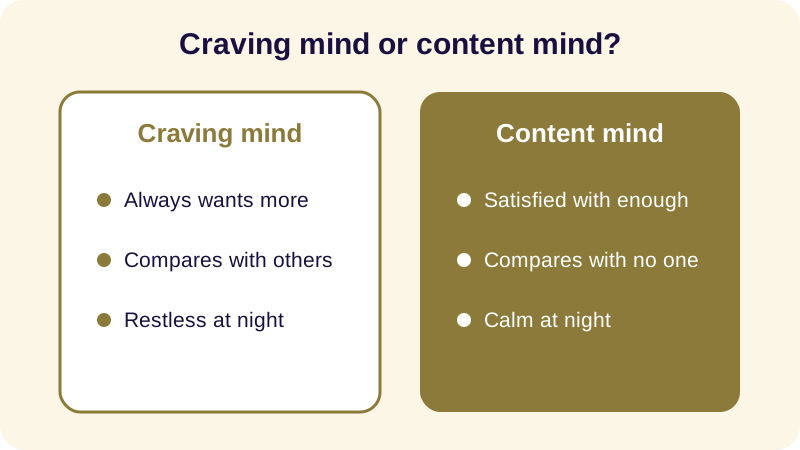
The teaching of dependent origination describes how this pattern perpetuates itself: contact leads to feeling, feeling leads to craving, and craving leads to clinging, which in turn produces more dissatisfaction once the craved thing changes or disappears, as everything eventually does. Seeing this chain clearly does not require accepting an elaborate philosophy. It is enough to notice, in an ordinary evening, how quickly a small want can snowball into a whole imagined future it has not yet earned.
This is why having more rarely settles the itch on its own; the baseline of "not yet enough" can simply shift upward with it. The Middle Way offers a useful frame here: neither austere denial of what you need, nor an endless chase after what you want, but a workable point of enough that a person can actually live inside.
How can you practice contentment before sleep?
Contentment is easiest to practise in small, specific moments rather than as a grand resolution. At night, when the mind often runs through a quiet inventory of what still needs fixing, a short pause to name what is already complete can do more than willing yourself to relax.
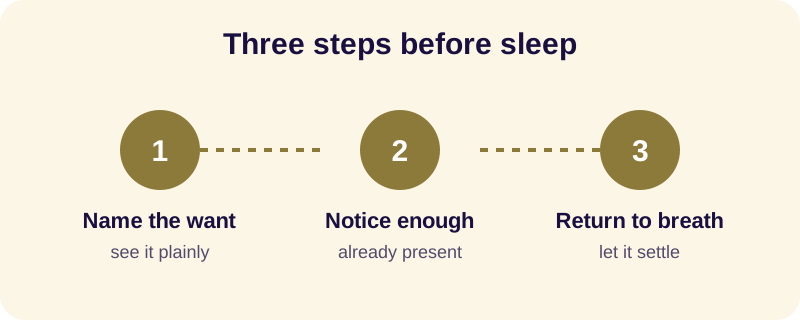
- Name the want. Silently note whatever the mind is reaching for — a reply, a result, a comparison with someone else's evening. Naming it takes some of its charge away.
- Notice what is already enough. A warm bed, a finished day, breath moving on its own. This is not denial of real problems; it is simply widening the frame past the one missing thing.
- Return attention to the breath. Let a few slow breaths be the whole of your attention for a moment, the way a present-moment practice is often taught.
None of these steps requires a quiet house or a special posture. They can be done lying down, eyes already closed, somewhere between the last scroll through a phone and actual sleep. The aim is not to produce contentment on command but to interrupt, briefly, the mind's habit of treating every evening as an unfinished errand.
Is contentment the same as giving up ambition?
This is the most common misreading of the teaching. Contentment is not indifference, and it is not an argument for having no goals. The Noble Eightfold Path includes right effort as one of its factors, which would make little sense alongside a teaching that asked people to stop trying.
What changes is where your sense of being okay is parked. Contentment lets effort continue while unhooking a portion of your peace from whether the effort succeeds tonight, this week, or ever. It works alongside non-attachment: caring fully about an outcome while holding it a little more loosely, so that the holding itself is not what keeps you awake.
In practical terms this might look like finishing a project and still refreshing an inbox for a reply, or replaying a difficult conversation for a better outcome that cannot be retrieved. Contentment does not ask you to stop caring about either one. It only asks whether your evening has to wait on the outcome to feel settled, or whether some portion of settled is already available regardless of how things land tomorrow.
Is there a Buddhist story about contentment?
Many Jataka tales, the birth stories of the Buddha's past lives, return to this same theme from a different angle than a direct teaching does. In the story of the golden deer, a deer king who could have fled to save himself instead steps forward in another's place, settled enough in himself not to grasp at his own safety above everything else.
The story does not frame that restraint as loss. The deer's response reads as a kind of ease, a lack of the frantic self-protection that usually accompanies danger. Stories like this work well as evening listening because they let the idea of contentment arrive as a picture rather than an argument — easier for a tired mind to hold onto at night than a definition is.
A simple way to close the day is to pair a few minutes of this noticing with a slower evening routine, so the mind has somewhere quiet to land before the breath is left to carry on by itself.
Frequently Asked Questions
What is the Buddhist teaching on contentment called?
It is usually called santutthi, a Pali word meaning contentment or being satisfied with what is present. It appears across the early texts as a quality to cultivate, not a passive mood, and a Dhammapada verse names it the greatest form of wealth a person can hold.
Is Buddhist contentment the same as wanting nothing at all?
No. The teaching does not ask you to stop wanting things or stop working toward them. It points at the restless, comparing mind that treats the next acquisition as the only path to ease, and asks whether a steadier baseline is possible right now.
How does craving relate to contentment in Buddhism?
The Four Noble Truths trace ordinary unease to craving, a persistent sense that things should be otherwise. Contentment is what remains when that reaching loosens even slightly, since the mind is no longer measuring the present against an imagined better version of it.
Can practising contentment help with sleep?
Many people find that naming what their mind is still reaching for, then noticing what is already enough, quiets the evening replay of wants and comparisons. It is an ordinary calming practice, not a treatment for insomnia or any medical condition.
Does contentment mean giving up ambition or goals?
No. The tradition pairs contentment with effort rather than against it; the Noble Eightfold Path includes right effort. The difference is whether your sense of being okay depends entirely on the goal landing, or whether some of it is available before the outcome arrives.