Published
Quick answer
A Buddhist evening routine for better sleep is a short, repeated sequence: wind down, settle the body, quiet the mind with a brief teaching or story, then let go into sleep, done in the same order most nights.
Key takeaways
- A Buddhist evening routine for better sleep relies on order and repetition, not length.
- Dimming lights, settling the body, then a short teaching works better than sudden quiet.
- A fixed sequence trains the body to expect sleep, the way a lullaby does for a child.
- Persistent sleep trouble is best discussed with a doctor, not solved by ritual alone.
- A short story or verse can replace scrolling as the last thing before lights out.
A Buddhist evening routine for better sleep is less about doing more and more about doing less: dimming the lights, slowing the breath, and letting one calm story or verse carry your attention away from the day. It borrows a few concrete elements from the tradition — mindfulness, loving-kindness, a short teaching — and arranges them in the same order each night so the body learns what comes next.
None of this is a ritual you must get exactly right, and it is not a substitute for medical care if sleep trouble runs deep. It is simply a short, repeatable sequence, loosely borrowed from monastic evenings, that gives a busy mind somewhere quieter to land before the light goes out.
What does a Buddhist evening routine for better sleep actually look like?
In a monastery, the evening is not an afterthought tacked onto a busy day; it has its own shape. Lamps are lowered at a set time, the day's tasks are closed off rather than left dangling, a short verse or chant is spoken aloud, and then there is silence. The order matters more than any single step — each one signals that the day is closing, the way dusk signals it to birds.
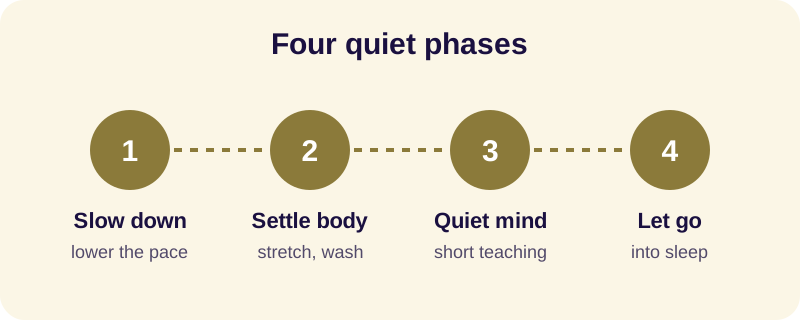
A version you can use at home keeps the same logic without the robes or the bell: fewer tasks as the evening goes on, lower light, a short piece of calm listening or reading, and finally a few minutes of simply lying still with attention on the breath. None of it needs to be elaborate. The point is sequence, not spectacle.
Why does the mind settle when you slow down first?
A racing mind at night is usually a mind still trying to finish something — a conversation replayed, a decision rehearsed, tomorrow half-solved in advance. Rushing straight from a bright, busy evening into "now sleep" asks the mind to drop all of that in an instant, which it cannot easily do. A sequence of calming steps gives it a ramp instead of a cliff.
Each step narrows what the mind has to hold. Dimming the lights removes visual stimulation. A few minutes of slow breathing gives attention one simple object instead of many. A short teaching or a verse from the Dhammapada gives it something to rest on that is not the day's unfinished business. By the time you reach the last step, there is far less for the mind to carry, and a racing mind at night has much less to race about.
A brief practice of metta, loving-kindness, fits naturally near the end of this sequence. Silently wishing yourself and a few other people well is undemanding, has no outcome to chase, and tends to soften whatever irritation or worry the day left behind — a gentler note to end on than scrolling through messages.
How do you build the routine step by step?
You do not need every element every night. A simple version, built from the same logic as the monastic evening, might run like this:
- Pick a fixed starting time, even fifteen minutes earlier than you think you need.
- Dim the lights and put screens away, letting the room itself signal rest.
- Do something physical and unhurried: a short stretch, a warm wash, laying out tomorrow's clothes.
- Sit or lie down for a few minutes of breath awareness, noticing the body settle.
- Read or listen to one short teaching or story — a Dhammapada verse, a Jataka tale, a few lines of metta.
- Bring to mind one thing you're glad happened today, instead of reviewing what went wrong.
- Turn off the light and rest attention on the breath, or on the narrator's voice as you drift.
Some people add the Five Precepts here as a quiet review rather than a checklist — not to grade the day, but to notice it without judgment and set it down. Others prefer a few minutes with the four brahmaviharas, moving briefly through loving-kindness, compassion, shared joy and equanimity before the final stretch of silence.
What should you avoid in the evening?
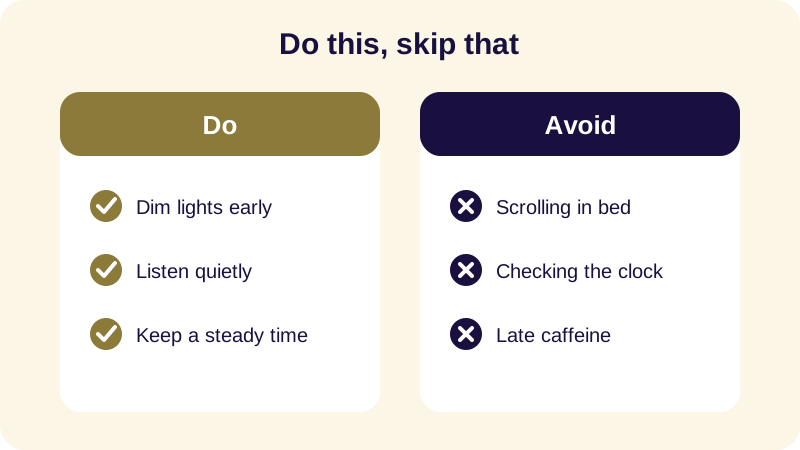
A good routine is often undone by one or two habits that stay in place around it. The most common are bright screens held close to the face, caffeine late in the day, and the habit of checking the clock, all of which keep the mind alert exactly when the routine is trying to settle it.
How can Buddhist stories and sounds support the routine?
The last step of the routine — a short teaching, verse or story — is often the hardest to keep up on your own, simply because reading in dim light or finding the right passage takes effort you may not have at eleven at night. This is where a recorded, slowly narrated story earns its place: you press play and the rest of the sequence happens on its own.
Buddhist bedtime stories work well here precisely because they ask nothing of the listener — no plot to track, no ending to brace for. Pairing a story with soft background sound, such as rain or a singing bowl, fills the silence between sentences so the mind has less room to wander back to the day. If you are weighing which app to use for this last step, a comparison of Buddhist sleep apps can help you decide what actually matters for your routine.
Buddha Story was built around this exact moment in the evening. It narrates Jataka tales, episodes from the life of Siddhartha Gautama, and Dhammapada verses slowly, with a sleep timer that stops the story for you, background playback so the screen can stay dark, and offline listening for nights when the connection is unreliable. None of it is a cure for sleeplessness — it is simply the last, quiet step of a routine you already control.
A morning version of this same logic — starting the day as deliberately as you end it — is covered in a Buddhist morning routine for peace, if the evening habit turns out to be one you want to carry into daylight as well.
Frequently Asked Questions
What is a Buddhist evening routine for better sleep?
It is a short, repeated sequence of winding down before bed: dimming lights, slowing the body with gentle movement or washing, then quieting the mind with a few minutes of breath awareness and a brief teaching or story, in the same order most nights.
How long should the routine take?
There is no fixed length. Fifteen to thirty minutes is enough for most people — a few minutes to settle the body, a few more to listen to a short verse or story, and a few lying quietly before sleep. Consistency matters more than duration.
Do I need to be Buddhist to try this?
No. The routine borrows practical elements — slowing down, a brief teaching, loving-kindness toward yourself and others — that work as plain evening habits whether or not you hold any of the beliefs behind them. No particular belief is required to benefit.
What if I'm still awake after the routine?
Stay with the breath or let a story continue rather than checking the time or your phone. Lying quietly with attention on something simple is still rest for the body, even if sleep takes a while longer to arrive.
Can Buddhist stories replace screen time before bed?
Many people find a short, slowly narrated story a calmer last activity than a screen, since it asks nothing of you and has a gentle, predictable shape. It will not force sleep, but it gives the mind somewhere quieter to rest.