Published
Quick answer
Here is how to practice gratitude the Buddhist way: pair katannuta, recognizing what you received, with mudita, gladness at someone else's good fortune, in a short nightly reflection.
Key takeaways
- Buddhist gratitude (katannuta) means noticing what you received, not just listing good things
- Mudita, one of the four brahmaviharas, is gladness at someone else's good fortune
- A short, concrete nightly reflection works better than a long gratitude list
- The practice settles the mind but is not a treatment for anxiety or insomnia
Here is how to practice gratitude the Buddhist way: through katannuta, recognizing what you were given, paired with mudita, gladness at someone else's good fortune, in a short nightly reflection rather than a long written list. It takes only a few quiet minutes and asks for no particular belief.
What does Buddhist gratitude practice actually involve?
Buddhist traditions do not use the phrase "gratitude journal," but they have an older, plainer version of the same idea. Katannuta means knowing what was done for you. Katavedita means showing that you know it, in word or in deed. Together they describe a mental habit: noticing a benefit you received and tracing it back to where it actually came from, instead of treating your comfort as something you simply deserve.
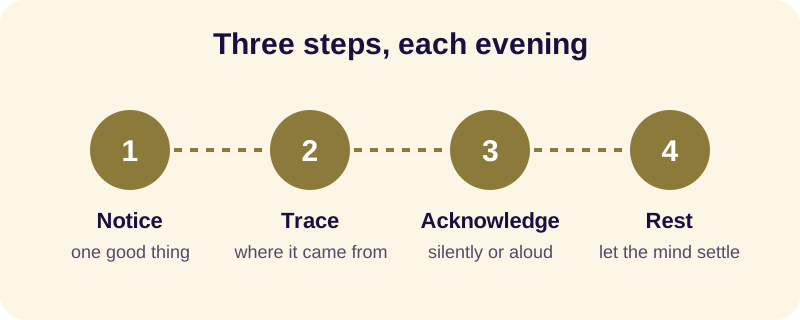
This framing overlaps with dependent origination, the teaching that nothing arises on its own. The warm room, the meal, the ride home — each depended on other people's effort, and most of them you never see. Gratitude, in this light, is less "count your blessings" and more "see how little of your evening you actually built alone." Several Jataka tales dramatize this directly, with characters who remember a kindness long after the person who did it has moved on; the Jataka tales are a good place to hear the theme told as a story instead of a list.
What is mudita, and how does it differ from ordinary gratitude?
Mudita is sympathetic joy — gladness at someone else's good fortune, with no cut of it for yourself. It is one of the four brahmaviharas, alongside loving-kindness, compassion and equanimity, and it points gratitude in a direction most gratitude lists never go: outward, toward other people's luck rather than only your own.
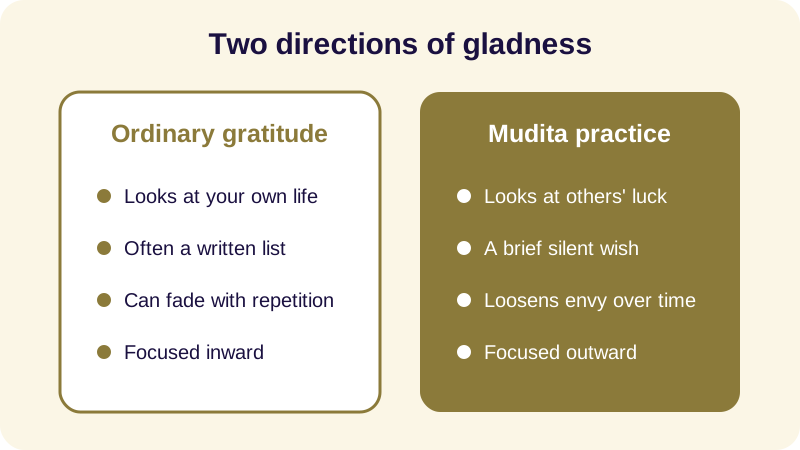
A simple way to hold both at once before sleep: name one good thing that happened to you, then one good thing you heard happened to someone else, even a stranger. The second part is the harder habit to build, and it is also the one that does the most to loosen envy and quiet comparison. If the idea of the four brahmaviharas is new, that overview explains where mudita sits among the others.
How do you build a short evening gratitude habit?
The practice does not need a special posture or a long sitting. It fits into the few minutes most people already spend lying still before they drop off.
See also: The Difference Between Meditation and Mindfulness.
- Settle into bed and let your breathing slow without forcing it.
- Bring to mind one specific thing from today that went well, however small.
- Ask who or what made it possible — a person, a habit, plain luck.
- Silently acknowledge that, in a sentence or two, as if speaking to them.
- Add one good thing you heard happened to someone else, and wish it well.
You can pair this with a few minutes of metta meditation, loving-kindness practice, if you want the reflection to carry further than just the day's events. The two sit naturally together: gratitude looks back at what already happened, metta extends goodwill forward to whoever comes to mind next.
Does gratitude practice really help with sleep, or is that too much to ask?
It helps with one specific thing: it gives a busy mind something finished to think about instead of something unresolved. A racing mind at night is usually still trying to solve a problem — a conversation to rehearse, a decision to finalize. Gratitude reflection is the opposite kind of thought. It is already complete; there is nothing left to fix about something that already went well. That shift, from open loop to closed one, is most of what settles the body for sleep. If a racing mind is the main obstacle most nights, the fuller approach is covered in how to quiet a racing mind at night.
How can the app support a nightly gratitude habit?
Buddha Story narrates the stories and teachings this practice draws on — Jataka tales, episodes from the life of the Buddha, Dhammapada verses and Zen parables — read slowly, for listening in a dark room rather than a commute. Alongside the narrated stories, it offers guided meditation for loving-kindness, body scan and breath awareness, so a gratitude reflection can lead straight into a longer settling practice instead of ending abruptly.
Other features suit the same bedtime routine: relaxing sounds like rain, ocean waves and singing bowls to sit underneath the narration, a sleep timer that stops the story for you rather than leaving it running all night, and offline listening with background playback so the phone can stay locked once you have pressed play. None of it is designed to fix a sleep problem — only to give an ordinary restless evening somewhere calmer to land.
Gratitude, practiced this way, is not about producing a longer list than yesterday. It is a short pair of movements — notice what you were given, be glad for what someone else was given — repeated quietly enough that the mind eventually just does it on its own before sleep.
Frequently Asked Questions
What is the Buddhist word for gratitude?
The closest terms are katannuta, knowing what was done for you, and katavedita, showing that you know it. Together they describe noticing a benefit you received and acknowledging where it came from, rather than treating comfort or help as something you were simply owed.
Is mudita the same as gratitude?
Not quite. Gratitude usually looks at what you received. Mudita, one of the four brahmaviharas, is gladness at someone else's good fortune. The two work well together: one reflection on your own good luck, one on someone else's, before you let the mind settle for sleep.
How long should a Buddhist gratitude practice take before bed?
There is no fixed length. A few quiet minutes recalling one specific thing that went well, and one person who helped, is enough. The point is attention, not duration, so a short, concrete reflection usually works better than a long written list.
Can gratitude practice replace treatment for anxiety or insomnia?
No. It is a simple reflection, not a medical treatment, and it will not cure persistent anxiety or insomnia. If sleeplessness or low mood continues night after night, that belongs with a doctor; the practice is for an ordinary restless evening, not a diagnosed condition.
What if I can't think of anything to be grateful for?
Start smaller than you think you need to. A warm room, a meal, one sentence someone said to you. Buddhist gratitude practice is built on noticing ordinary support you usually overlook, not on finding something impressive to be thankful for.