Published
Quick answer
The Buddhist perspective on stress and worry is that both arise from craving and resistance, not from events themselves. Mindfulness, loving-kindness and the second arrow teaching offer ways to loosen that grip without requiring belief.
Key takeaways
- Stress and worry are traced to craving and resistance, not to the situation itself.
- The second arrow teaching separates an event from the story we add on top of it.
- Mindfulness and loving-kindness loosen worry's grip without asking you to stop thinking.
- Equanimity means caring about an outcome without needing to control it from bed.
- Persistent worry or anxiety belongs with a doctor, not just an evening practice.
The Buddhist perspective on stress and worry is that both grow from resisting what is happening or craving what isn't, not from the situation itself. Seeing that clearly is the first step toward loosening their grip, especially at night.
This is not a technique for making stress disappear from a life — the tradition never promised that. It is a way of seeing the mechanics of worry clearly enough that it stops running the evening.
What does Buddhism say actually causes stress and worry?
The Buddha's first teaching, recorded as the Four Noble Truths, starts with dukkha — usually translated "suffering," though "unsatisfactoriness" is closer: the low, constant friction of things not matching what we want them to be. The second truth locates the cause of that friction not out in the world but in craving, tanha — wanting an uncertain outcome pinned down, wanting a past mistake undone, wanting the body to feel different than it does right now. Worry is what craving sounds like once the lights are off and there is nothing left to do about any of it.
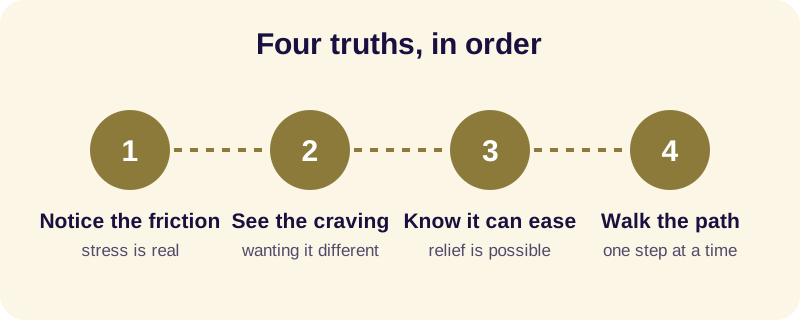
This is a diagnosis, not a complaint about the mind being broken. Craving is an ordinary, workable habit, and the third and fourth truths say plainly that it can ease, and that there is a path — the Noble Eightfold Path — for easing it a step at a time. The chain doesn't stop with craving, either. The teaching on dependent origination traces how one mental event conditions the next: a thought gives rise to a feeling, the feeling to a craving, the craving to clinging, and the clinging to more thought. Worry at night is usually this chain running on its own, with no new information arriving, just the same loop feeding itself.
Why does worry pile on top of itself?
A well-known teaching compares an ordinary painful event to being struck by an arrow: it hurts, and then it is over. What usually happens instead is a second arrow — the story we tell about the first one, replayed, argued with, rehearsed for an audience that isn't there. The original event might last a minute; the worry about it can run for hours.
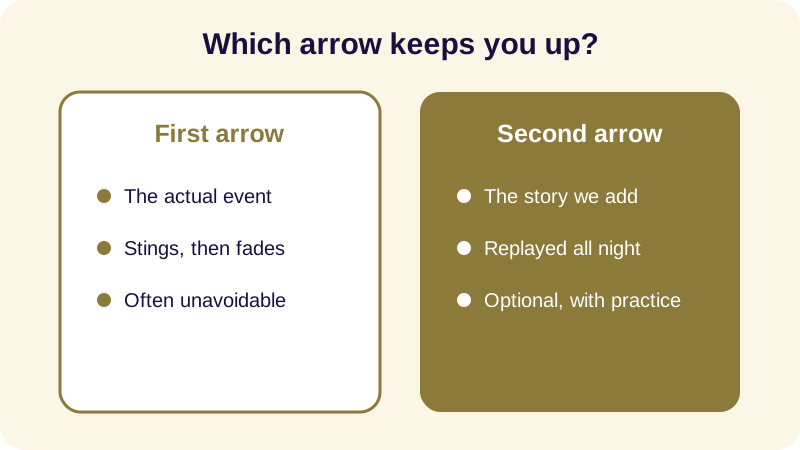
This is the heart of the second arrow story, and it maps directly onto late-night worry. The bill, the comment, the diagnosis, the deadline — that is the first arrow, and it is often genuinely out of your hands at eleven at night. The looping, the catastrophising, the three different endings you rehearse for tomorrow's conversation — that is the second arrow, and it is the part a buddhist view of stress says you have some say over.
What actually calms stress and worry at night?
Three practices show up again and again in the texts, and none of them ask you to stop thinking. Mindfulness asks you to notice the worry and the breath at the same time, rather than disappearing into the worry completely — an approach in the spirit of the Satipatthana Sutta, the discourse on the four foundations of mindfulness, which treats the mind's current state as something to observe plainly rather than fix on the spot. Metta, loving-kindness practice, redirects attention toward warmth for yourself and others, which is hard to do at the same moment as rehearsing an argument. And the Five Precepts — plain commitments around honesty, harmlessness and the rest — quietly reduce the guilt-based worry that comes from a day lived carelessly, which is its own kind of insomnia.
None of this removes craving and suffering in general; Buddhism is honest that the habit runs deep and returns. The aim on any given night is smaller: notice the second arrow before you've fired six more, and come back to the body instead.
Is calming the mind the same as not caring?
No, and this is where the Middle Way matters. The Buddha steered between two extremes — chasing every craving, and punishing the body to be rid of it — and that same balance applies to worry. The goal is not indifference; it is equanimity, one of the four brahmaviharas, which sits alongside loving-kindness, compassion and shared joy rather than replacing them. Equanimity lets you care about an outcome without needing to control it from bed at midnight.
When does worry need more than an evening practice?
A restless night now and then is ordinary. Worry that does not lift, that affects eating, work or relationships, or that tips into anxiety or depression, is a medical matter and belongs with a doctor, not with a bedtime routine. The practices here are suited to the ordinary friction of an ordinary evening; our article on Buddhism and anxiety goes further into where that line sits.
For that ordinary evening, the app narrates stories built around these same teachings — Jataka tales, episodes from the life of Siddhartha Gautama, and verses from the Dhammapada — in English, with a sleep timer that pauses the story and sounds rather than fading them, background playback, and an offline mode for nights when the signal is the least of your worries.
Frequently Asked Questions
What is the Buddhist perspective on stress and worry?
Buddhism locates the cause of stress not in events themselves but in craving and resistance — wanting things to be other than they are. The Four Noble Truths describe this pattern and offer a path for working with it, rather than treating stress as a problem to be eliminated entirely.
Does Buddhism say worry is bad or a moral failing?
No. Worry is treated as an ordinary mental habit, not a flaw in character. The texts describe it plainly and offer practices for working with it, without shame attached. The aim is understanding the pattern, not judging yourself for having it.
What is the second arrow and how does it relate to worry?
The second arrow is the story, replay or rehearsal we add on top of a painful event. The first arrow — the event itself — often cannot be avoided; the second arrow, the worry piled on afterward, is the part that extends suffering and offers room to practice.
Can meditation actually calm worry at night?
Mindfulness and loving-kindness practice can help an ordinary mind settle by giving it somewhere steadier to rest than the loop of worry. They are not a cure and work gradually, not instantly, and they are not a substitute for medical care when worry is severe or persistent.
When does worry need more than an evening practice?
If worry does not lift, disrupts sleep most nights, or affects eating, work or relationships, it belongs with a doctor rather than a bedtime routine. Evening practices are suited to the ordinary friction of a restless night, not to ongoing anxiety or depression.
