Published
Quick answer
How Buddhism defines true happiness: not as pleasure or getting what you want, but as sukha, a steady ease built by loosening craving, guided by the Four Noble Truths and the four brahmaviharas.
Key takeaways
- True happiness (sukha) is steadier than pleasure and doesn't depend on getting what you want.
- The Four Noble Truths trace lasting dissatisfaction to craving, not to bad luck or circumstances.
- The four brahmaviharas build a happiness that widens outward instead of guarding itself.
- The Middle Way avoids both chasing every pleasure and denying yourself everything.
- Lasting happiness grows through practice, not a single breakthrough night.
How Buddhism defines true happiness is not about getting everything you want. It names a steadier, uncraving ease — sukha in Pali — that holds up whether or not the night goes smoothly.
This matters beyond philosophy. A lot of what keeps a mind busy at bedtime is the hunt for one more good feeling — one more scroll, one more replay of a win or a slight, one more worry solved in advance — and Buddhist teaching has a clear, old diagnosis for why that hunt never quite satisfies, however many times it is repeated.
What does Buddhism mean by true happiness?
Buddhist teaching separates two kinds of good feeling. One is pleasure (vedana) — the lift of a good meal, a win, praise — which rises and falls with circumstances. The other is sukha, a steadier ease that does not need circumstances to cooperate. Both are real, and Buddhism does not ask anyone to distrust pleasure; it simply notices that chasing it, moment after moment, keeps the mind busy without ever settling it.
See also: Buddhist Teaching on Contentment: Finding Enough.
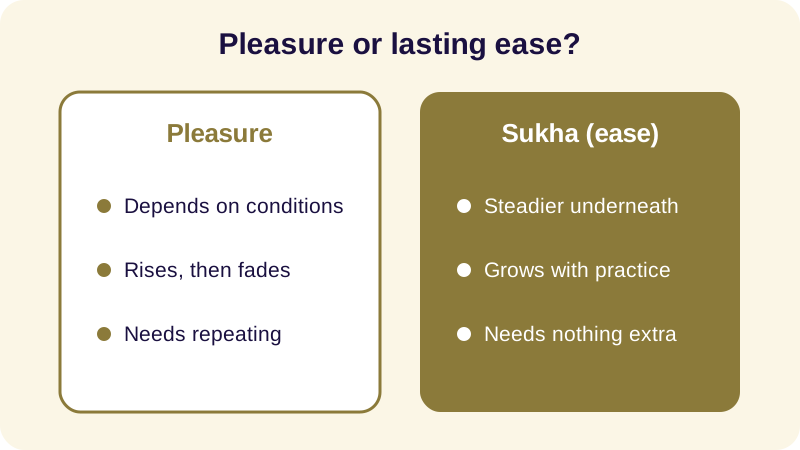
The Four Noble Truths are the Buddha's diagnosis of why pleasure alone never settles the mind for long: ordinary life carries a background unsatisfactoriness, called dukkha; that unsatisfactoriness has a cause; the cause can end; and there is a path — the Noble Eightfold Path — that leads there. True happiness, in this frame, is not one more pleasant experience stacked on the pile. It is what is left over once the chasing itself loosens, which is why it can sound, at first, less exciting than the pleasures it replaces.
Is happiness just the absence of wanting?
Not quite absence — more a change of relationship. The teaching does not ask anyone to stop enjoying a sunset or a good cup of tea. It points at craving (tanha), the restless "give me more of this, make this different, get me away from that," as the real source of dissatisfaction, not the sunset or the tea themselves.
Buddhist teaching has a name for the extra suffering this creates: the second arrow, the pain we add on top of pain by resisting or resenting it. The first arrow — an ache, an inconvenience, a bad day — often cannot be avoided. The second is optional.
This is also where the Middle Way matters. The path is not self-denial — refusing every pleasure as though pleasure were the enemy — and it is not indulgence either. It is a workable middle: enjoy what arises, release it when it passes, and do not stake your peace on holding onto either one.
How do the four brahmaviharas build happiness that lasts?
Buddhism does not leave happiness as a private, internal state. The four brahmaviharas — loving-kindness, compassion, sympathetic joy and equanimity — describe a happiness that widens outward instead of guarding itself. Wishing someone well, feeling glad at someone else's good luck instead of comparing yourself to it: these are treated as trainable skills, not just passing moods.
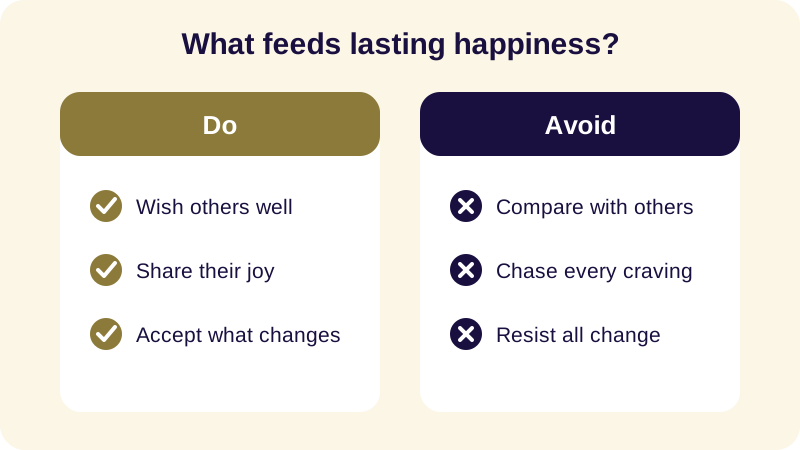
A short loving-kindness meditation before bed is one ordinary way to practice this: a few quiet minutes offering goodwill to yourself, someone you love, someone neutral, and someone difficult. It is less about generating a warm glow and more about interrupting the private, self-referential loop that keeps a mind circling at eleven at night.
What did the Buddha's own life suggest about happiness?
Siddhartha Gautama tried both ends of the spectrum before settling on an answer. He left a life arranged around pleasure, then tried the opposite extreme of near-total self-denial, and found that neither one gave him what he was looking for. Sitting under the Bodhi tree, he arrived at the Middle Way instead, and the Four Noble Truths, Five Precepts and Noble Eightfold Path that followed are, in effect, his working notes on what actually eased a restless mind. People have been testing that account for 2,500 years, which is a long run for an idea that was never about having more.
What can this mean on an ordinary restless night?
Most nights do not call for doctrine, just a smaller shift: noticing that the mind is chasing one more replay or one more worry, and gently choosing ease over the chase instead. Reading a few Dhammapada verses, resting attention on the breath, or quietly wishing a few people well are small rehearsals of the same idea — happiness as something you stop grasping for and start allowing.
None of this is a cure for insomnia or low mood, and a problem that persists is worth raising with a doctor rather than treating as something to meditate away. What a bedtime practice can realistically offer is a gentler last half hour: fewer loose ends to chase, a bit more willingness to let the day close, without needing it to have gone perfectly.
How can the Buddha Story app support this?
The Buddha Story app narrates the texts behind this teaching slowly, in English, for listening in the dark rather than studying by daylight. It carries Jataka tales, episodes from the life of the Buddha, Dhammapada verses and Zen parables, alongside guided stories for sleep.
- Guided meditation for loving-kindness, body scan and breath awareness, for nights when sitting quietly feels more useful than a story.
- A sleep timer (10, 20, 30 or 60 minutes) that pauses the story and sounds for you rather than fading them out.
- A sound mixer for layering a story with rain or other ambient sound.
- Offline Mode and background playback, so a weak signal or a locked screen never interrupts the middle of a story.
- No ads breaking into the narration once it starts.
True happiness, in this telling, was never about arranging one more perfect night. It is a direction you keep turning toward — a little less grasping, a little more goodwill — and an ordinary bedtime is as good a place as any to begin practicing it, one unclenched evening at a time.
Frequently Asked Questions
What does Buddhism mean by true happiness?
Buddhism distinguishes pleasure, which rises and falls with circumstances, from sukha, a steadier ease that does not depend on getting what you want. True happiness is this underlying steadiness, built by loosening craving rather than satisfying it, and pointed to in the Four Noble Truths as the end of restless, repeating dissatisfaction.
Is Buddhist happiness the same as feeling positive all the time?
No. It is closer to equanimity than constant positivity: staying steady while still feeling sadness, disappointment or pain fully, rather than suppressing them. The four brahmaviharas describe a warm, engaged steadiness, not a flat or numb mood that avoids difficult feelings altogether.
What is sukha in Buddhism?
Sukha is a Pali word usually translated as ease, contentment or well-being. It names a kind of happiness that does not depend on circumstances going a particular way, unlike ordinary pleasure, which rises with a good event and fades once that event passes.
Do I have to give up pleasure to be happy in Buddhism?
No. The Middle Way rejects both chasing every pleasure and denying yourself everything. Buddhist teaching does not ask anyone to distrust an enjoyable meal or a good night's rest; it simply notes that pinning your peace on repeating pleasures keeps the mind busy without ever settling it.
Can nightly Buddhist practice make me happier?
A short practice like loving-kindness meditation or reading a calming verse before bed can make the last part of the day gentler and less grasping. It is not a treatment for insomnia or low mood; ongoing sleep or mood problems are worth discussing with a doctor.