Published
Quick answer
The Buddhist teaching on the present moment holds that past and future exist only as thought, so settling the mind means returning attention to the breath or body right now, repeatedly, without force.
Key takeaways
- Worry and regret are thoughts about time, not features of the present moment itself.
- The four foundations of mindfulness train attention on body, feelings, mind and mental events.
- Returning to the breath, over and over, is the practice itself, not a failure of it.
- Present-moment awareness works alongside accepting impermanence rather than fighting against change.
- A racing mind at night is usually time-travelling; the fix is simply noticing and returning.
The Buddhist teaching on the present moment holds that suffering grows mostly in two places — replaying the past and rehearsing the future — so training attention to rest in what is actually happening now is close to the whole of the practice. At night, that single shift can be the difference between lying awake and drifting off.
This is not a lifestyle slogan. It is a specific instruction found in the earliest Buddhist texts, including the Satipatthana Sutta, where attention is trained on the body, feelings, states of mind and mental events, one at a time, as they actually are right now rather than as memory or imagination describes them.
What does the Buddhist teaching on the present moment actually say?
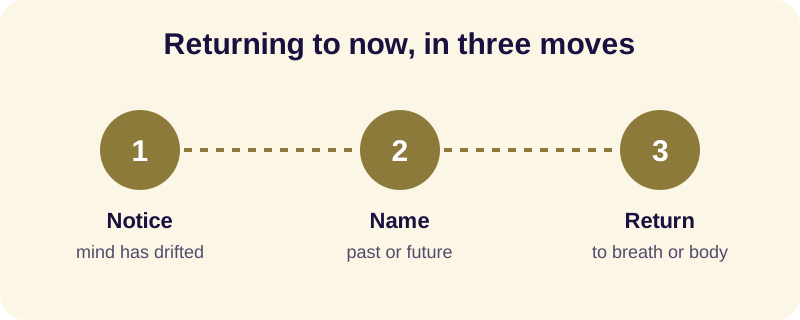
The core instruction is plain: notice what is actually present — breath, sound, the weight of the body on the mattress — rather than the story the mind is telling about yesterday or tomorrow. The present moment itself never contains worry; it only contains sensation. Worry is always a thought about something that has already happened or might happen.
This is also where the teaching connects to the Four Noble Truths: dissatisfaction arises from clinging, and clinging almost always clings to a version of the past or an imagined future rather than to what is actually here. Seeing that clearly, even briefly, loosens the grip without any argument or willpower being required.
Why does the mind keep leaving the present moment at night?
Lying still with nothing to do is exactly when an unoccupied mind goes looking for a problem to solve — a conversation to replay, a decision to re-check, a worry to finish rehearsing. The body is resting, but the mind treats stillness as an invitation to catch up on unfinished thinking. If this pattern feels familiar most nights, it is worth reading about how to quiet a racing mind at night, which covers what actually helps and what tends to make it worse.
Part of the difficulty is that past and future both feel urgent and real, while the present moment feels almost too ordinary to hold attention. But the past is only ever accessed as a memory happening now, and the future only ever as an imagined scene happening now. Recognizing this — gently, not as a debate to win — is often enough to loosen the pull of both.
What practices actually train attention to stay present?
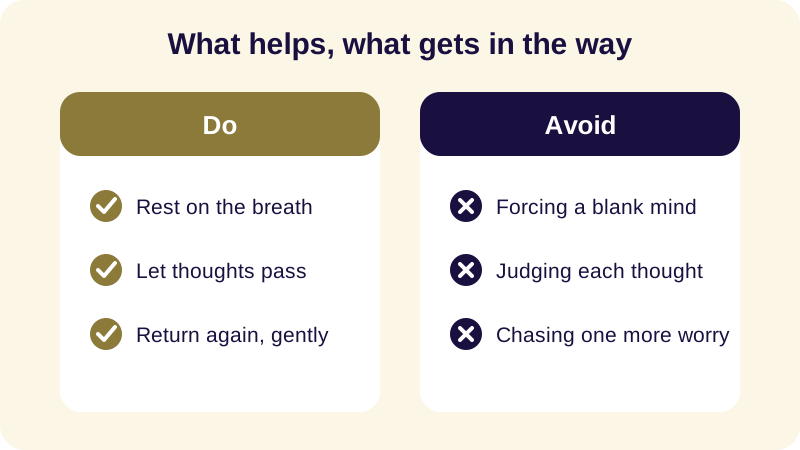
Breath awareness is the simplest starting point: resting attention on the sensation of air moving in and out, without controlling it. A body scan works the same way, moving attention slowly through each part of the body and noticing sensation rather than thought. Both are covered in more detail in our guide to meditation for beginners.
Walking meditation offers the same training in a moving body, which some people find easier than sitting still — see what happens during walking meditation for a plain description of the steps. And metta (loving-kindness) practice keeps attention present by giving it something warm to rest on, rather than something neutral: see our guide to metta meditation for restful sleep.
How does the present moment connect to impermanence and letting go?
The present moment is also the only place where change can actually be observed. Every sensation — the breath, a sound outside, the ache in a shoulder — arises and passes, which is a direct, small-scale demonstration of what the tradition calls anicca, impermanence. Our article on the Buddhist teaching on impermanence goes into this further.
Seeing impermanence up close tends to loosen clinging, because it is hard to grip tightly onto something you can watch changing in real time. This is also where non-attachment connects back to the present moment: letting go is not a dramatic renunciation, it is simply noticing that the thing being gripped — a memory, a plan, a worry — was never solid to begin with. The Middle Way applies here too: the aim is neither forced blankness nor endless rumination, but a steady, relaxed attention that neither grasps nor pushes away.
How can Buddha Story help you practice present-moment awareness at night?
Buddha Story narrates stories and teachings slowly, including Jataka tales, the life of Siddhartha Gautama, and verses from the Dhammapada, which are a gentle way to occupy a mind that would otherwise be time-travelling through regret or planning. The app also includes guided meditation for breath awareness and body scan, both of which are direct ways of practising present-moment attention rather than just reading about it.
A sleep timer stops the narration for you, a sound mixer lets you layer stories with rain or singing bowls, and offline mode with background playback means the practice is not interrupted by a weak signal or a locked screen. None of this is a cure for anything — persistent sleep or anxiety problems belong with a doctor — but for an ordinary restless evening, returning attention to a slow voice in the dark is one practical way to practise what the present moment teaching actually asks for.
If the idea of training attention this way is new, the Dhammapada verses for a restless mind are a short, concrete place to start — a few lines to rest on instead of the usual loop of yesterday and tomorrow.
Frequently Asked Questions
What is the Buddhist teaching on the present moment?
It is the instruction, found in texts like the Satipatthana Sutta, to rest attention on what is actually happening now — breath, body, sound, feeling — rather than on memories of the past or plans for the future, since most suffering is generated by those two mental habits.
Is living in the moment the same as Buddhist mindfulness?
They overlap but are not identical. Mindfulness is a specific, trained skill of noticing the present clearly and without judgment, including noticing unpleasant things. Loosely living in the moment can mean impulsiveness; mindful presence includes steady, kind attention to whatever is actually here.
Why does Buddhism focus so much on the present moment?
Because the past can only be remembered and the future can only be imagined — both happen as thought, right now. Training attention to recognize this directly reduces the time spent rehearsing regret or anxiety, which is where most restlessness, including nighttime restlessness, actually comes from.
How can I practice present-moment awareness before sleep?
Lie still and rest attention on the breath moving in and out, or on the weight of the body against the mattress. When a thought about tomorrow or yesterday pulls attention away, simply notice it and return to the breath, without scolding yourself for drifting.
