Published
Quick answer
The Buddhist teaching on non attachment says suffering comes from clinging, not from having people or things in life. Non-attachment means engaging fully while holding outcomes loosely, so the mind grips less tightly, especially at night.
Key takeaways
- Non-attachment means holding life loosely, not refusing to care about it.
- Clinging (upadana) to people, outcomes or comfort is what the teaching says causes suffering.
- Non-attachment differs from indifference: it allows full engagement without grasping.
- Practising it at night loosens the mind's grip on unfinished worries.
- The Four Noble Truths trace suffering back to craving, which non-attachment addresses directly.
The Buddhist teaching on non attachment holds that suffering grows less from what happens to us than from how tightly we grip it. It does not ask you to stop loving people or caring about outcomes — only to hold them with an open hand instead of a clenched one.
What does the Buddhist teaching on non attachment actually mean?
Non-attachment is not about owning nothing or feeling nothing. It describes a way of relating to experience: holding people, plans, and even your own opinions loosely enough that their presence pleases you and their loss does not undo you. The word the early texts use for the thing being released is upadana — clinging, the act of grasping at something as if it could be made permanent.
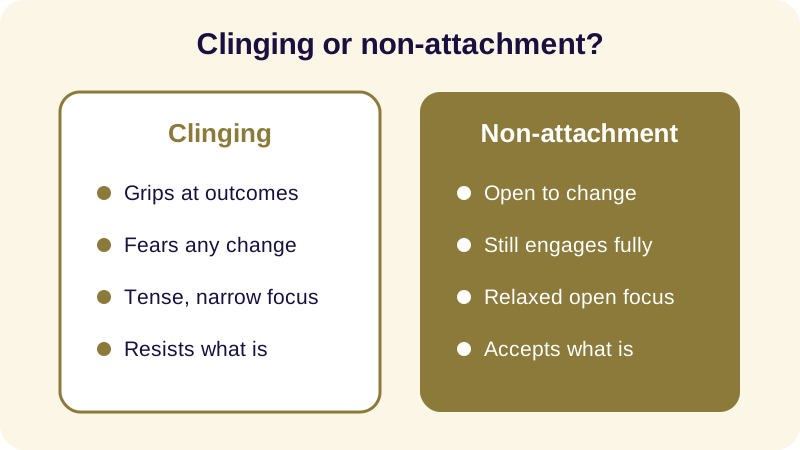
The teaching sits close to dependent origination, which traces how one condition gives rise to the next: craving leads to clinging, and clinging leads to becoming attached to an outcome that may never arrive. Seen this way, non-attachment is not a mood to adopt. It is a description of how suffering is built, link by link, and where a person can choose to stop adding links.
Why does clinging cause suffering, according to the Buddha?
The Four Noble Truths put it directly: there is suffering, there is a cause of suffering, and that cause is craving — the wanting of things to be other than they are. Craving leads to clinging, and clinging to anything that changes is a setup for disappointment, because everything changes. This is the teaching on impermanence in plain terms: a held breath eventually has to be let out, and a held moment eventually has to be let go.
This is also why impermanence and non-attachment are taught together so often. Impermanence describes the fact; non-attachment describes the skill of living comfortably with that fact instead of fighting it every time something ends — a relationship, a plan for tomorrow, even a single good night's sleep.
Is non-attachment the same as not caring?
No, and this is the point people new to the teaching miss most often. Indifference withdraws from life to avoid being hurt by it. Non-attachment stays fully in the middle of life — loving a person, doing good work, hoping for a kind outcome — while releasing the demand that it turn out exactly one way. The four brahmaviharas, the heart qualities of loving-kindness, compassion, shared joy and equanimity, are often described as warm, engaged states held without grasping: care that does not require a particular ending to remain care.
A useful comparison is the raft in one of the Buddha's own parables: you use the raft to cross the river, and once across, you set it down rather than carrying it on your back forever out of attachment to what helped you. The story about letting go tells this parable in full, and it is one of the clearest short illustrations of non-attachment in the canon: even a good thing becomes a burden once you cannot put it down.
How does non-attachment calm a racing mind at night?
Lying awake, the thoughts that keep circling are usually a form of clinging: to a need for the day to have gone differently, to certainty about tomorrow, to a feeling that sleep has to arrive on schedule or something has gone wrong. The mind is gripping an outcome it cannot control, and the gripping itself is what keeps the body tense.
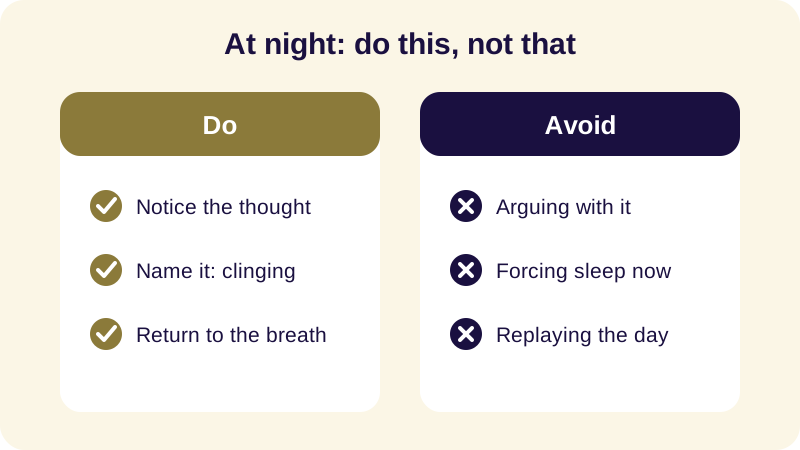
The practice here is small and unglamorous. When a thought about tomorrow starts to pull hard, you notice it, name it plainly — "clinging," or simply "wanting this to be settled" — and let attention return to the breath or to something steady, like mindfulness of the body in the dark. Nothing is pushed away. The thought can keep existing; it simply does not need to be held onto for the night to continue.
If racing thoughts or sleeplessness are a nightly pattern rather than an occasional one, that is a conversation for a doctor, not something this teaching is meant to treat. Non-attachment is a way of relating to an ordinary wound-up evening, not a remedy for insomnia or anxiety.
How do I start practising non attachment tonight?
You do not need a formal sit or any special posture to begin. A few minutes before sleep is enough.
- Notice one thing you are gripping. It might be how tomorrow should go, or a conversation you cannot stop replaying.
- Name it plainly. "This is clinging" is enough — no judgement needed, just a clear label.
- Loosen, don't force. Let the breath out a little longer than usual, as if the exhale were setting something down.
- Return attention to something steady. The breath, the weight of the body on the bed, or a slow story are all good places to rest.
Over time this becomes less of an exercise and more of a habit: noticing the grip earlier, each night, before it has pulled very hard. The Dhammapada returns to this idea often, in short verses built around the same observation — that the mind, left untrained, grips at everything, and that training it is mostly a matter of noticing and releasing, over and over, without drama.
Letting go of attachment is not a single dramatic moment but a quiet habit practised one evening at a time. The next time bedtime thoughts grip hard, a slow narrated story or a guided meditation can give attention somewhere steadier to rest than its own looping worries.
Frequently Asked Questions
What is the Buddhist teaching on non attachment in simple terms?
It is the idea that suffering comes less from what happens to us than from how tightly we grip it. Non-attachment means caring about people and outcomes while holding them loosely enough that change, loss or disappointment does not have to flatten you.
Is non-attachment the same as not caring about anything?
No. Non-attachment is not emotional distance. It lets you love fully, work hard and feel joy, while releasing the demand that things stay a certain way. Indifference withdraws from life; non-attachment stays fully present but stops gripping it.
Why does Buddhism say clinging causes suffering?
Because everything changes. Clinging to a person, plan or feeling as if it will last sets up a collision with impermanence. When the thing changes, as it always does, the grip itself produces the pain, more than the change ever could.
How can non-attachment help with a racing mind at night?
Many nighttime thoughts are a form of clinging: to a need for certainty, control or a finished day. Noticing that grip, naming it gently, and returning attention to the breath loosens it, which can settle the body even before the mind quiets fully.
Can non-attachment practice replace treatment for anxiety or insomnia?
No. It is a way of relating to an ordinary restless evening, not a treatment. If sleeplessness or anxiety persists most nights, that is worth discussing with a doctor; this teaching works alongside care like that, not instead of it.