Published
Quick answer
The buddhist teaching on suffering and acceptance says pain is part of life, but most extra suffering comes from resisting what's already happening. Accepting it plainly, without approving or giving up, eases that added weight.
Key takeaways
- Dukkha, the first noble truth, covers ordinary friction, not only crisis.
- Acceptance means seeing clearly what's present, not approving or giving up.
- Resisting a feeling often hurts more than the feeling itself.
- Equanimity is a steady presence with a feeling, not indifference to it.
- Persistent distress at night is a matter for a doctor, not practice alone.
The buddhist teaching on suffering and acceptance starts with a plain observation: pain is part of being alive, and most of our extra suffering comes from how hard we fight that fact.
This article looks at what the Buddha actually taught about suffering, why acceptance is so often misread as resignation, and how both ideas are useful on an ordinary restless night — not as a cure for anxiety or insomnia, but as a way of meeting what is already there instead of piling more on top of it.
What does the Buddhist teaching on suffering actually say?
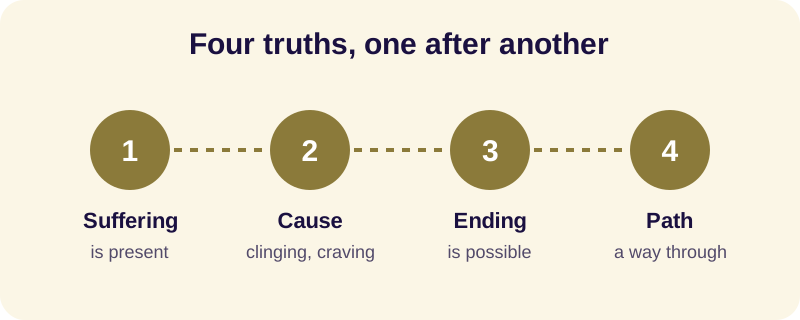
The starting point is the Four Noble Truths, the teaching the Buddha gave after his awakening under the Bodhi tree. The first truth names dukkha — usually translated "suffering," though it covers something broader: the background unease of a life where nothing stays fixed, from a stubbed toe to a bitter disappointment. The second truth says this unease has a cause, usually craving or clinging to how we wish things were. The third says the cause can end. The fourth lays out a path for doing so, the Noble Eightfold Path.
Notice what dukkha is not. It is not a claim that life is only misery, or that enjoyment is an illusion to distrust. It describes a pattern: we want permanence from things that change, and that gap between wanting and reality is where suffering tends to live. Seeing the pattern clearly — in a sore back, a hard day, a sleepless hour — is already most of the work, long before anything is "solved."
Is acceptance in Buddhism the same as giving up?
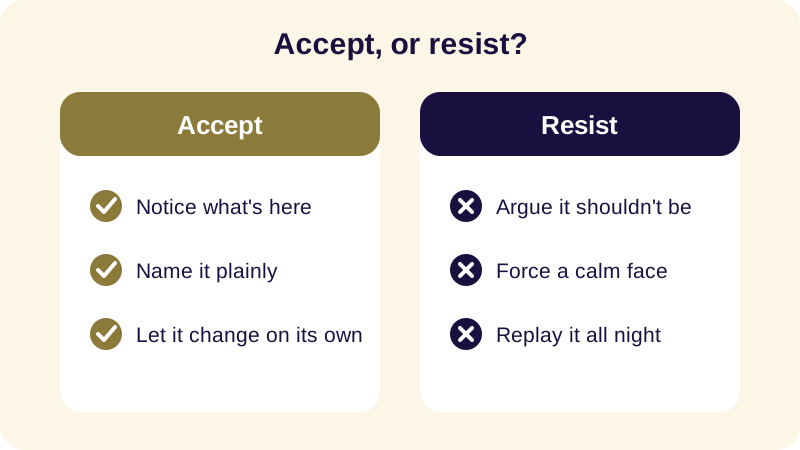
No, and this is the most common misreading of the word. Acceptance here means seeing clearly what is actually present — a feeling, a sensation, a circumstance — without the extra layer of arguing that it shouldn't be happening. It does not mean approving of harm, staying passive about a problem you could act on, or pretending discomfort is fine when it isn't. The Middle Way is the same idea applied more broadly: neither straining against experience nor collapsing into it, but meeting it steadily, from the middle.
Suffering and the arrow you add yourself
A well-known teaching compares an unwanted event to being struck by an arrow — painful, but over quickly. What often follows is a second arrow we fire at ourselves: the story, the resistance, the three a.m. replay of why it shouldn't have happened. Acceptance is not about avoiding the first arrow. It is about not adding the second one. This idea comes up often in discussions of how Buddhism helps with anxiety, because so much of worry is exactly this — pain multiplied by resistance to the pain itself.
How can acceptance help a mind that won't settle at night?
Most racing-mind nights are not really about the original problem. They are about the mind's refusal to let the problem stay unsolved until morning. The buddhist teaching on suffering and acceptance offers a different instruction: stop trying to fix it from bed, and instead notice what is actually happening in the body and mind right now — tight shoulders, a fast heartbeat, a looping thought — without treating any of it as an emergency that needs handling at midnight.
This is close to what mindfulness for sleep practices do in a more structured way, and it overlaps with the four brahmaviharas, especially equanimity — a steady presence with a feeling that lets it be there without feeding it further. None of this guarantees fast sleep, and nights that stay difficult are not a sign of doing the practice wrong.
What is a simple way to practise acceptance before sleep?
One simple approach borrows from basic mindfulness and from verses in the Dhammapada: name what is present, in plain words, without adding a verdict about whether it is good or bad.
- Notice one physical sensation — warmth, tension, the weight of the blanket — and name it silently.
- Notice one thought passing through, and label it "thinking" rather than following it further.
- Say inwardly, "this is here," without deciding whether it is good or bad.
- Let the breath continue on its own while you keep noticing, rather than trying to steer it.
The story of Kisa Gotami, who searched for a cure for her grief until she understood that loss touches every household, illustrates exactly this shift — from fighting a fact to carrying it quietly. It is told in full alongside the parable of the raft in the piece on letting go, another image for not clinging past the point of usefulness.
Does accepting suffering mean nothing will change?
No — acceptance and change are not opposites here. The Buddhist teaching on impermanence is part of the same picture: everything that arises also passes, including the discomfort you are accepting tonight. Accepting a feeling fully is often what allows it to move, where fighting it tends to keep it stuck in place. This is different from forced positivity; it is closer to simply not standing in the way of what is already happening.
Over time, many people find that dukkha and acceptance change the texture of an ordinary evening more than any single relaxation trick does. The mind still gets tired, still gets tense, still has nights that don't go smoothly. What shifts is how much extra gets piled on top of that.
The app narrates teachings and stories that circle these same themes — the Dhammapada, Jataka tales, episodes from the life of Siddhartha Gautama — slowly, for listening at night rather than studying at a desk, alongside guided meditation for breath awareness and a sleep timer that stops the audio on its own.
Frequently Asked Questions
What is the Buddhist teaching on suffering?
It starts with the Four Noble Truths: life includes dukkha, an underlying unease; this unease has a cause, usually craving for things to be different; the cause can end; and there is a path for doing so. It is a description of a pattern, not a claim that life is only misery.
Is accepting suffering the same as being passive?
No. Acceptance means seeing clearly what is actually happening without the extra argument that it shouldn't be. It does not mean approving of harm or staying still in the face of a real problem you could act on. It is a starting point for clear action, not a substitute for it.
What is the idea of a 'second arrow'?
It describes how an unwanted event is one arrow, but the resistance, story and replay we add afterward is a second, self-inflicted one. Acceptance does not stop the first arrow from landing; it is about not firing the second one at yourself on top of it.
Can this teaching actually help me fall asleep?
It won't force sleep, but noticing a racing thought or tense body without fighting it often lowers the extra agitation that keeps you awake. Many people find it calmer than trying to argue themselves into rest, though it is not a guaranteed or fast fix.
What if my suffering or sleeplessness doesn't ease with practice?
Then it belongs with a doctor, not with more effort at practice. Occasional sleepless or difficult nights are ordinary; persistent anxiety, low mood or insomnia deserve proper care, and this teaching is meant to sit alongside that, not replace it.