Published
Quick answer
The difference between Jataka tales and Zen koans is purpose: Jataka tales are finished moral stories about the Buddha's past lives, while Zen koans are short paradoxical questions meant to stop logical thinking rather than teach a lesson.
Key takeaways
- Jataka tales are narrative fables with a clear moral; Zen koans are short riddles with no resolvable answer.
- Jataka tales come from the Pali Buddhist canon and describe the Buddha's past lives.
- Zen koans belong to the Chan and Zen tradition and are used to exhaust logical thinking.
- A Jataka tale settles the mind with a finished story; a koan unsettles it on purpose.
- Both can be heard slowly at night, but they ask different things of a tired mind.
The difference between Jataka tales and Zen koans comes down to what each one asks of a sleepy mind: a Jataka tale tells a finished story with a moral, while a Zen koan is a short riddle built to stop you from reasoning your way to an answer. Both get called "Buddhist wisdom stories," but they were never meant to do the same job.
Where does each kind of story come from?
Jataka tales come from the Pali Jataka collection, a body of stories describing the Buddha's past lives long before he was born as Siddhartha Gautama. Each tale casts the future Buddha as an animal, a merchant, a king or a hermit, working out a lesson in patience, generosity or courage well before his awakening under the Bodhi tree.
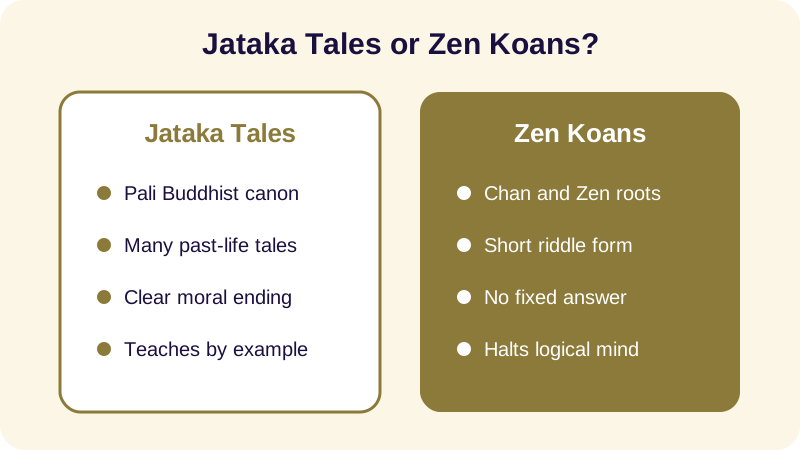
Zen koans come from a much later and very different tradition: Chan Buddhism in China, carried forward into Japanese Zen. Instead of a narrative, a koan is usually a brief question or exchange, something like asking what a single hand sounds like when it claps alone. There is no single fixed count of koans the way the Jataka has a settled number of tales; koans were gathered into various case collections over centuries, and each one is meant to be sat with rather than read straight through.
What does a Jataka tale actually look like?
A typical Jataka tale has a clear shape: a problem arises, a bodhisattva figure meets it with patience or sacrifice, and the story closes by naming which character was the Buddha in a former life. The Golden Deer and the Hare in the Moon both follow this pattern, and each one resolves into a stated lesson rather than a puzzle.
This finished quality is part of the jataka tale meaning: the story is not meant to leave you guessing. It builds a small tension, resolves it, then tells you plainly what the resolution means. For a complete list of these stories by number and theme, see our list of Jataka tales, or start with the Jataka tales overview.
What does a Zen koan actually look like?
A koan usually is not a story at all. It is a short, often strange question or exchange, like asking for the sound of one hand clapping, or the face you had before your parents were born. The Zen stories on this site gather several of these short exchanges along with their quiet meaning.
The zen koan meaning is not something you are handed at the end, the way a Jataka tale hands you a moral. A koan is built to exhaust ordinary logical thinking rather than reward it, so that something other than the analytical mind is asked to respond. One well-known example, the empty cup story, makes a related point more gently: a mind already full of answers has no room left to receive anything new. For the wider picture of the tradition these come from, see our guide to Zen Buddhism in simple terms.
Jataka Tales vs Zen Koans: Which Helps You Sleep?
A Jataka tale is usually the gentler choice for a tired mind at night, because it behaves the way a bedtime story behaves: beginning, middle, a settled end. A koan does the opposite on purpose — it opens a question and refuses to close it, which can be exactly the sort of thing that keeps a mind turning instead of letting go.
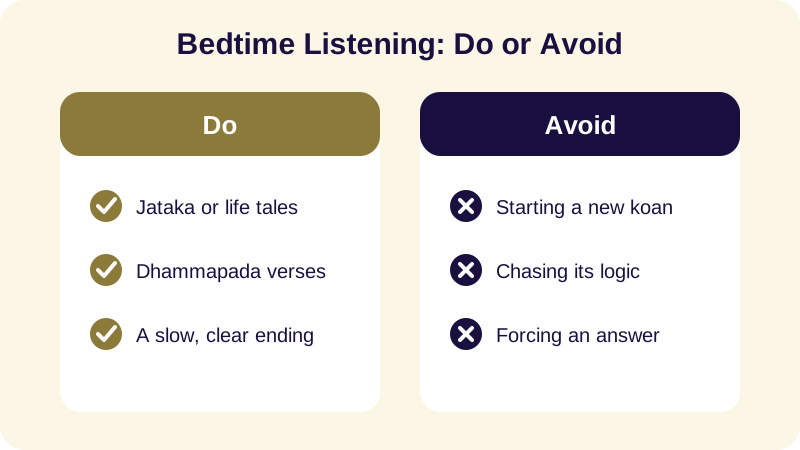
None of this means koans are bad; they simply have a different job. A koan is a tool for focused sitting, often used in daylight with a teacher present, not a lullaby. A Jataka tale, a verse from the Dhammapada, or an episode from the life of the Buddha is built to be followed loosely, half-asleep, without needing to solve anything.
| Feature | Jataka Tales | Zen Koans |
|---|---|---|
| Form | A full story with characters | A short question or exchange |
| Tradition | Pali Buddhist canon | Chan and Zen schools |
| Ending | A stated moral | No fixed answer |
| Effect on the mind | Settles and resolves | Unsettles on purpose |
| Best time to use | Evening, half-asleep | Focused daytime sitting |
Can You Listen to Both Before Sleep?
Yes, and many people do, but it helps to know what you are reaching for. If you want a complete wind-down with a beginning and an end, a Jataka tale or a passage from the life of the Buddha is the better fit; our guide to Buddhist stories for sleep goes through the main options.
The app narrates both traditions — slow readings of Jataka tales, episodes from the life of the Buddha, Dhammapada verses and Zen parables — with a sleep timer that pauses the story and sounds once it ends, rather than trailing off. If you do listen to a koan at night, treat it as a question to simply hold rather than solve before you drift off. For a broader look at apps built around this kind of listening, see our Buddhist sleep apps guide.
Persistent sleeplessness is worth raising with a doctor rather than solving with any story. On an ordinary restless evening, though, the choice is simple: reach for a Jataka tale when you want an ending, and save the koan for a day when you want a question to carry around.
Frequently Asked Questions
What is the main difference between Jataka tales and Zen koans?
Jataka tales are finished narratives about the Buddha's past lives, each one closing with a clear moral once the dilemma resolves. Zen koans are short, often paradoxical questions or exchanges from the Chan and Zen tradition, built to stop ordinary logical thinking rather than hand you a tidy lesson at the end.
What is the jataka tale meaning behind the moral ending?
A Jataka tale's meaning sits in its ending: the story names which character the Buddha was in that former life, and the moral grows directly out of what that character chose to do. The ending is meant to be understood, not puzzled over.
What is the zen koan meaning if there is no clear answer?
A koan is not meant to be solved the way a riddle is solved. Its meaning lies in what happens to the mind while sitting with it: ordinary reasoning runs out, and something other than analysis is asked to respond instead.
Are Zen koans considered Buddhist stories the same way Jataka tales are?
Koans come from a real Buddhist tradition, Chan and Zen Buddhism, so in that sense yes. But they are not narrative tales like the Jataka; they are closer to a teaching device used in meditation than a story with a beginning and an end.
Is it better to listen to a Jataka tale or a Zen koan before bed?
For most people, a Jataka tale or a similar finished story is the gentler choice at night, because it has a clear beginning and end. A koan is designed to stay open, which can keep a mind working rather than letting it settle.
