Published
Quick answer
The difference between meditation and mindfulness: mindfulness is a quality of present-moment attention, while meditation is the formal, set-aside practice that trains it and other qualities.
Key takeaways
- Mindfulness is a quality of attention; meditation is the formal practice that trains it.
- You can be mindful anytime, while eating or walking, without ever sitting to meditate.
- Meditation covers many techniques, including breath awareness, body scans and loving-kindness.
- Right Mindfulness is one factor of the Noble Eightfold Path, not a synonym for meditation.
- A short formal meditation often settles a racing mind faster than informal mindfulness alone.
The difference between meditation and mindfulness comes down to this: mindfulness is a quality of attention, and meditation is the formal practice that trains it. One is a way of noticing; the other is the time you set aside to practice noticing on purpose.
The two words get used almost interchangeably online, which is part of why the question keeps coming up. In the Buddhist tradition they are related but distinct: one is a mental skill, the other is a container of practices that includes it, along with several others.
What exactly is mindfulness?
Mindfulness is paying attention to what is actually happening, right now, without immediately judging it or pushing it away. In Pali this quality is called sati, and the Buddha described it at length in the Satipatthana Sutta, the discourse on the four foundations of mindfulness, covering the body, feelings, states of mind and mental qualities. It is also the seventh factor of the Noble Eightfold Path, known there as Right Mindfulness.
Mindfulness does not require sitting still or closing your eyes. You can be mindful while washing a dish, walking to the car, or lying in bed listening to your own breath. It is less a technique than a way of showing up to an ordinary moment, this breath, this sound, this ache in the shoulder, instead of running the usual commentary about it. For a closer look at how this is defined in the texts, see our piece on Right Mindfulness.
What exactly is meditation?
Meditation is the deliberate, set-aside practice of training attention and the heart, usually in a seated or lying posture, for a defined stretch of time. It is a broad category; the word often translated as meditation is bhavana, which literally means "cultivation." Mindfulness is one thing you can cultivate this way, but it is not the only one.
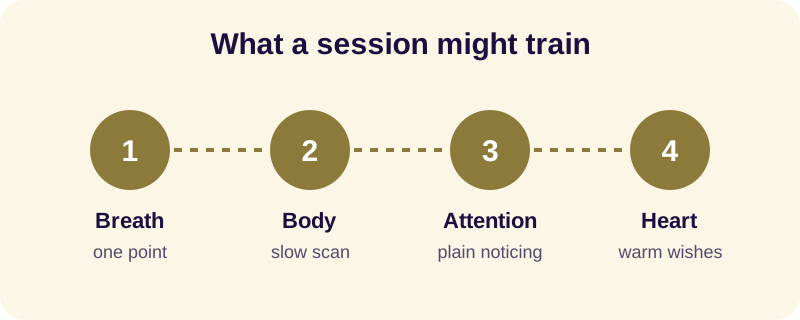
A session might rest attention on the breath, move slowly through the body the way a beginner's body scan does, or direct warmth toward yourself and others the way loving-kindness meditation does. Mindfulness meditation, watching the breath or body non-judgmentally, is simply one well-known member of this family, not the whole family.
Is mindfulness a type of meditation?
Yes and no, and that ambiguity is where most of the confusion comes from. Mindfulness is a mental quality you can bring to almost anything, including meditation; mindfulness meditation is the name for a specific formal technique that trains that quality directly, by sitting with the breath or body and simply noticing. So mindfulness can be the object of a meditation session, the method of it, and also something you carry around afterward, off the cushion.
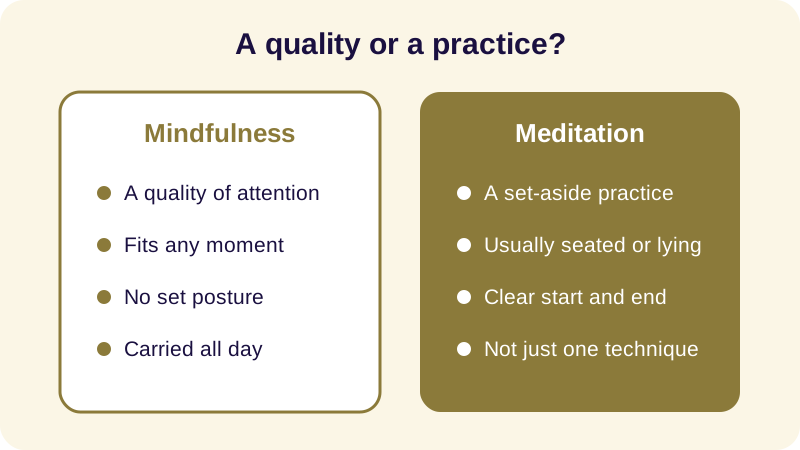
Put differently: you do not need to meditate to be mindful for a moment, but sitting down to meditate is one of the most reliable ways to build the skill so it shows up more easily later, including at two in the morning when the mind is doing its usual rounds.
Can you practice mindfulness without meditating?
Yes. Mindfulness can be practiced informally all day, with no timer and no particular posture: noticing the taste of the first bite of dinner, the feeling of water on your hands, the exact point where worry turns into a story about tomorrow. None of that requires you to have meditated that day at all.
What formal meditation adds is repetition and depth. A few minutes of actually sitting with the breath, undistracted, trains the attention more thoroughly than noticing it in passing between tasks, the way a short daily walk builds more fitness than noticing you climbed some stairs. The two support each other rather than compete.
Which helps more at night, mindfulness or meditation?
For an evening mind that will not stop replaying the day, a short formal meditation is usually more useful than trying to "be mindful" in the abstract, because it gives the mind one specific, undemanding job, follow the breath, scan the body, repeat a phrase of loving-kindness, rather than a vague instruction to relax.
In practice the two blend together at bedtime. You might begin with a minute of simply noticing the breath, mindfulness, informal and unforced, then move into a longer guided body scan or metta meditation, which is the formal practice. If racing thoughts are the main problem rather than the difference between the two words, our guide to quieting a racing mind at night covers that directly.
How does the Buddha Story app fit into either practice?
The Buddha Story app includes both sides of this: guided meditation for loving-kindness, body scan and breath awareness, and narrated stories, Jataka tales, episodes from the life of Siddhartha Gautama, Dhammapada verses and Zen parables, for the nights when a mind wants a story more than an instruction. A sleep timer stops the story and sounds for you instead of letting them run all night, and playback happens in English, on Android, with offline listening once downloaded.
See also: Can Meditation Replace Sleep? The Honest Answer.
Whichever word you reach for, the practical shape stays the same: an unforced noticing of what is actually here, held for as long as you choose to hold it, repeated often enough that it becomes familiar rather than effortful. The names matter less than the sitting down, or the simple noticing, itself.
Frequently Asked Questions
What is the main difference between meditation and mindfulness?
Mindfulness is a quality of non-judgmental, present-moment attention that you can bring to almost anything. Meditation is the formal, set-aside practice, usually seated, used to train that quality and others, such as loving-kindness or breath awareness, over a fixed stretch of time.
Is mindfulness a type of meditation?
It can be both. Mindfulness meditation is a specific formal technique that trains present-moment awareness by sitting with the breath or body. But mindfulness itself is also an everyday quality you can carry into washing dishes or walking, with no meditation required at all.
Can I be mindful without ever meditating?
Yes. Mindfulness can be practiced informally all day, noticing a meal, a breath or a feeling as it arises, without any set-aside sitting practice. Formal meditation simply deepens and steadies that same skill, so it becomes easier to access later, including at night.
Which should I use before bed, mindfulness or meditation?
A short formal meditation, such as a body scan or a few minutes of breath awareness, usually settles a racing mind more reliably than trying to be mindful in the abstract. It gives the mind one simple, specific job to follow instead of a vague instruction to relax.