Published
Quick answer
What are zen koans and why are they confusing? They are brief, paradoxical questions used in Zen practice to stop logical thinking, and the confusion is deliberate — it exhausts reasoning until a quieter, direct kind of attention opens up.
Key takeaways
- Koans are not riddles with a hidden correct answer — the confusion is the exercise itself.
- They work by exhausting logical thinking until the mind drops into direct, wordless attention.
- Famous koans include Mu and the sound of one hand clapping.
- In formal practice a teacher checks a student's response to the same koan over a long time.
- Held gently rather than attacked, a koan can give a racing mind one simple, unsolvable question to rest on.
Zen koans are short, often paradoxical questions or stories that a Zen teacher gives a student to interrupt ordinary reasoning. That is really the whole answer to what are zen koans and why are they confusing — the confusion is not a defect, it is the exercise.
They come out of Chan Buddhism in China and its Japanese form, Zen, where a teacher might ask something like "what is the sound of one hand clapping?" and then simply wait. There is no sentence to recite back correctly. The point is to watch what the mind does once logic runs out of road.
What exactly is a zen koan?
A koan (公案, literally "public case") is usually a brief exchange, question or fragment of story drawn from the records of old Zen teachers. It is handed to a student as something to sit with, in meditation and in daily life, not something to research. A well-known example is Mu: a monk asks whether a dog has Buddha-nature, and the teacher answers "Mu" — a word that refuses to mean either yes or no.
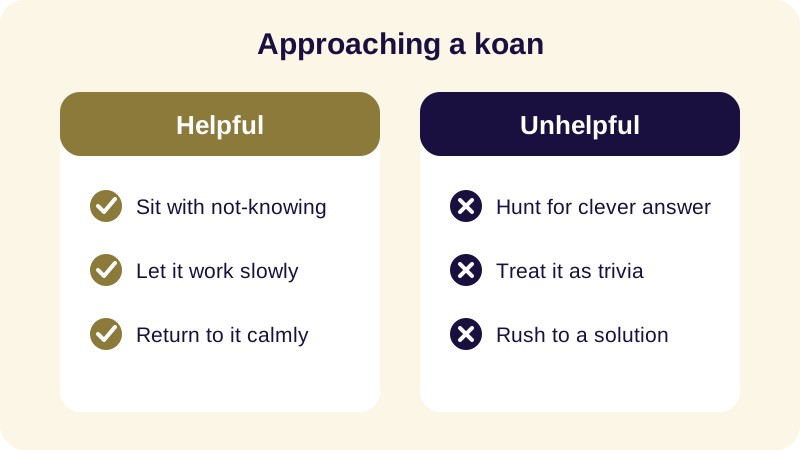
Other famous ones include "what was your original face before your parents were born?" and the koan of Nansen's cat, where a teacher cuts a cat in two to end an argument among monks. None of these are trick questions with a punch line waiting at the end. They are closer to a locked door that isn't meant to open the usual way — the value is in what happens to you while you keep trying the handle.
Why are koans designed to be confusing?
Ordinary thinking works by comparing, categorising and resolving: this fits with that, this is bigger than that, this question has that answer. A koan is built so none of those operations finish. "Does a dog have Buddha-nature" sets up a yes-or-no question, and "Mu" refuses both options, so the usual machinery of the mind spins without catching. Zen teachers sometimes call the resulting state "great doubt" — not anxious doubt, but a thorough, unresolved not-knowing that the mind cannot think its way out of.
This is a deliberate feature of the Zen branch of Buddhism rather than a universal Buddhist method; other traditions lean on different tools entirely. If you're curious how Zen's approach differs from more gradual, step-by-step paths, the difference between Zen and Theravada lays that out, and Zen Buddhism in simple terms covers the basics without the jargon.
How is a koan used in formal practice?
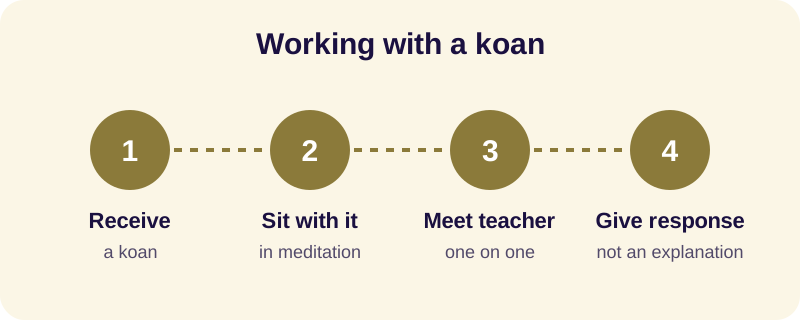
In traditional Zen training, a student is given one koan at a time and sits with it in meditation between private meetings with a teacher. At the meeting, the student offers a response — not an essay explaining the koan, but something that shows how they are actually meeting it. The teacher accepts it, or sends the student back to sit with it further. This can go on for a long stretch of time before a particular koan is set aside.
Outside a formal monastery this whole structure is hard to recreate, and that's fine. Most people who come across koans today meet them as stories to read or hear, think about loosely, and let go of — closer to how short zen stories and their quiet meaning are usually shared than to a strict training method.
What are some famous zen koans?
A handful of koans circulate widely outside Zen circles, usually stripped of their original context:
- Mu — a monk asks if a dog has Buddha-nature; the teacher answers only "Mu," neither yes nor no.
- The sound of one hand clapping — a question with no second sound to complete it.
- Your original face — "what was your face before your parents were born?", pointing past any identity you could name.
- Nansen's cat — a teacher cuts a cat in two to settle an argument among monks, and the koan asks what any of them could have said instead.
Can a koan help a restless mind at night?
A racing mind at bedtime is usually trying to finish something — a decision, a worry, a conversation replayed one more time. A koan offers a strange kind of relief here: instead of one more problem to solve, it hands the mind a question it was never going to solve, and gives it permission to stop trying. Held loosely, that can feel like setting a heavy bag down rather than carrying it one more lap.
This isn't a special trick for insomnia, and a koan won't out-argue genuine anxiety or a medical sleep problem — those belong with a doctor. For an ordinary overactive evening, though, resting with an unsolvable question works on the same principle as slower, gentler practices like mindfulness for sleep or simple breath awareness: give the mind one quiet thing instead of many loud ones.
Where can you hear zen koans narrated for listening at night?
If the idea of a koan appeals more as something to listen to than something to formally train with, Buddha Story narrates Zen parables slowly alongside Jataka tales, episodes from the life of the Buddha, and Dhammapada verses — built for a dark room rather than a desk. A sleep timer stops the story for you instead of running all night, and everything downloads for offline, background listening. If you want a broader entry point first, an app for Zen parables narrated aloud or meditation for beginners are both gentler starting places than diving straight into a koan.
You don't need to solve a koan to get something from it. Let the question sit unanswered, notice what the mind does with that, and let the not-knowing be the whole practice for the night.
Frequently Asked Questions
What does the word koan actually mean?
Koan comes from a Chinese term meaning roughly "public case," originally a legal record. In Zen it came to mean a brief exchange, question or story from an old teacher's life, used later as a tool to train a student's attention rather than to record a verdict.
Is there a correct answer to a zen koan?
Not in the way a math problem has one. A teacher is listening for how fully a student has let go of calculating an answer and responded from direct experience instead. Two very different responses can both be accepted; a clever sentence copied from a book almost never is.
Why do koans feel impossible to understand?
Because they are built to be. A koan usually pairs two ideas that cannot both be true in ordinary logic, so the reasoning mind keeps failing. That failure is not a sign you are doing it wrong — it is the method working as intended.
How long does someone work on a single koan?
There is no fixed length. A student may sit with the same koan across many private meetings with a teacher, returning again and again, until a response finally lands with the kind of clarity the teacher is checking for rather than more clever phrasing.
Are koans part of all Buddhism or only Zen?
Koan practice is specific to Zen (Chan in China, Zen in Japan) and is not found in the Pali Canon or most Theravada teaching. Other Buddhist traditions use different tools — precepts, suttas, breath practice — to work with the same underlying habits of mind.