Published
Quick answer
What is Zen Buddhism in simple terms? It is a school of Buddhism focused on sitting meditation and direct experience over study, rooted in Chan Buddhism and tracing back to the Buddha's enlightenment under the Bodhi tree.
Key takeaways
- Zen Buddhism is the Japanese branch of Chan Buddhism, built on direct experience over study.
- Zazen (seated meditation) and koans are its two main tools for training attention.
- It still teaches the Four Noble Truths, Noble Eightfold Path, and Five Precepts.
- Its plain focus on posture and breath makes it a gentle practice to try before bed.
- Persistent sleep or anxiety problems are best discussed with a doctor, not solved by meditation alone.
What is Zen Buddhism in simple terms? It is a school of Buddhism that trades long explanation for direct experience, reached mainly by sitting still and watching the mind rather than studying ideas about it.
It still rests on the same ground as the rest of Buddhism — the Four Noble Truths, the Noble Eightfold Path, the Five Precepts — but it approaches that ground with fewer words and more sitting. The rest of this article unpacks where it came from, what makes it distinct, and what it actually looks like to try.
Where does Zen Buddhism come from?
Zen is the Japanese name for Chan, a school of Buddhism that took shape when Buddhist teachings reached China and met existing traditions of quiet contemplation already present there. Chan later traveled to Korea, Vietnam, and Japan, taking on local names and small local flavors while keeping the same basic emphasis: sit, watch, and let understanding arrive on its own rather than being assembled from argument.
The tradition traces this emphasis back to Siddhartha Gautama's own awakening under the Bodhi tree. He did not reach that moment by winning a debate or memorizing a doctrine. He reached it by sitting, steadily, until something settled. Zen treats that as the model worth repeating, more than any explanation of what he found there.
What makes Zen different from other Buddhist schools?
Many Buddhist traditions give a lot of attention to texts, cosmology, and ritual alongside meditation. Zen keeps the core teachings — it has not dropped the Five Precepts or the Noble Eightfold Path — but it spends comparatively little time explaining them and a great deal of time practicing in silence.
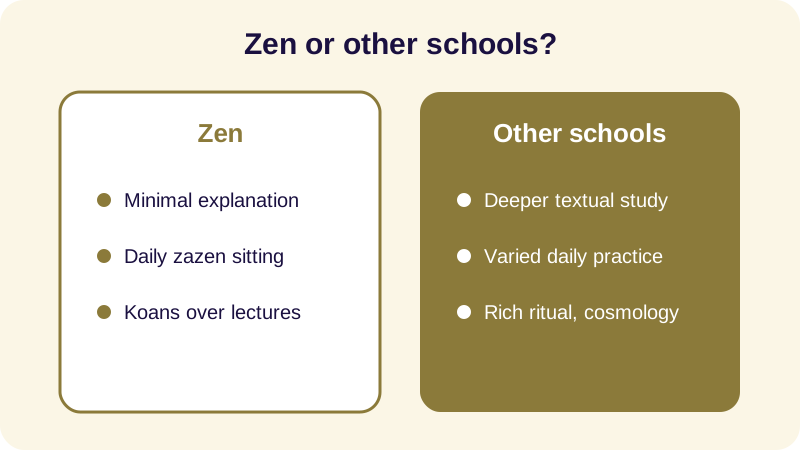
The two tools most associated with Zen are zazen, seated meditation, and koans — short questions or stories a student sits with, such as asking whether a dog has Buddha-nature. A koan cannot be solved by ordinary reasoning. Sitting with one anyway, returning to it session after session, is meant to wear down the habit of thinking a problem into submission, until something opens that was not reached by thought.
See also: What Are Zen Koans and Why Are They Confusing?.
What actually happens when someone practices zazen?
Zazen is less complicated than it sounds. The practitioner sits upright, usually facing a wall or a quiet corner of a room, with the spine steady and the hands resting in the lap. Attention rests loosely on the breath. Thoughts still arise — that never fully stops — but instead of following each one into a story, the sitter notices it and lets it pass, over and over, for as long as the sitting lasts.
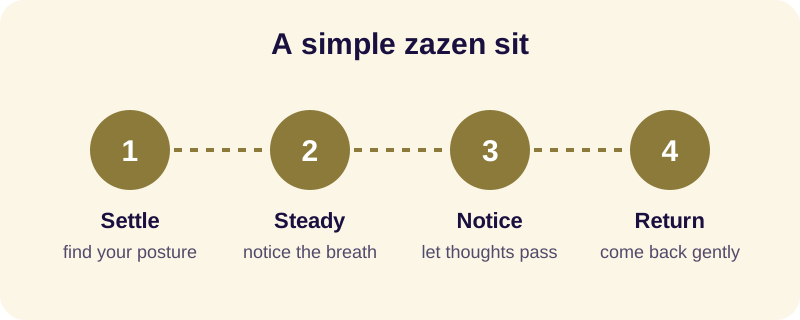
Nothing dramatic is supposed to happen in any single sit. The value builds the way any plain habit builds — through repetition, not through a single breakthrough moment. This is also why Zen centers are known for long periods of sitting done together: the posture and the plainness are the practice, not a means to some separate goal happening elsewhere.
Can Zen Buddhism ease a racing mind at night?
Its plainness is exactly what makes it approachable in bed. There is no technique to master, no visualization to get right, just posture — or in bed, just stillness — and breath. Zen's instruction to notice a thought and let it go, rather than needing to stop thinking altogether, matches what tends to help at night: the goal is not a blank mind, it is not fighting the mind that is already there.
This is not a treatment for insomnia or anxiety, and it should not be mistaken for one. If sleeplessness or worry is a nightly, ongoing problem, that belongs with a doctor rather than a meditation practice. What Zen's approach does offer, gently, is somewhere to put an ordinary restless evening — the kind everyone has sometimes. For more on that specific problem, see mindfulness for sleep or Buddhist meditation for insomnia.
How can I start exploring Zen Buddhism on my own?
Start small and resist turning it into another task to perform well. A few minutes of sitting, done most evenings, teaches more than an hour attempted once. Reading a handful of short zen stories gives a feel for the tradition's tone before attempting zazen itself, since the stories show the attitude in action rather than describing it abstractly.
If seated meditation itself is new territory, a general guide to posture and attention, such as meditation for beginners, is a reasonable place to build the basics before adding Zen's particular emphasis on koans or long sitting. And because Zen is still Buddhism, the wider teachings — the Middle Way, the four brahmaviharas, the Five Precepts — remain just as relevant background, even though Zen rarely dwells on them out loud.
The Buddha Story app carries a version of this quiet, story-first approach into the evening. It narrates Jataka tales, episodes from the life of Siddhartha Gautama, Dhammapada verses, and Zen parables among its 90+ stories, alongside Guided Meditation for breath awareness and body scan. A Sleep Timer stops the narration for you, Offline Mode keeps a story playing without a signal, and background playback lets it continue once the screen goes dark. The app works on Android through Google Play, is narrated in English, and offers a 3-day free trial ahead of a Monthly or Yearly plan, with no ads breaking the quiet.
Frequently Asked Questions
What is Zen Buddhism in simple terms?
Zen Buddhism is a school of Buddhism that favors direct experience over long explanation. Instead of extensive study of texts, it emphasizes sitting meditation, called zazen, and sometimes koans, so that insight comes from practice rather than theory alone.
What is the difference between Zen and other Buddhist schools?
Other Buddhist schools often include more textual study, ritual, and cosmology alongside meditation. Zen keeps the same core teachings, like the Four Noble Truths, but trims explanation down and puts most of its weight on daily sitting practice and direct questioning.
What does zazen mean?
Zazen means seated meditation. The practitioner sits upright, usually facing a wall or open space, keeps attention loosely on the breath and posture, and lets thoughts rise and pass without chasing or suppressing them. It is the central practice of Zen.
Are koans supposed to make sense?
Not in the ordinary way. A koan is a short question or story, like asking whether a dog has Buddha-nature, that cannot be solved by logic. Sitting with it over time is meant to tire out analytical thinking until something shifts.
Can Zen meditation help me sleep?
Its plainness can help an ordinary restless evening: no technique to master, just posture and breath. It is not a treatment for insomnia or anxiety, though, and problems that persist night after night are worth raising with a doctor.