Published · Updated
Quick answer
The Buddhist story about the empty cup is a short Zen tale: a teacher keeps pouring tea past full to show that a mind crammed with opinions can't receive anything new, including calm at night.
Key takeaways
- The story: a cup overflows because it was already full, not because too much tea was poured
- A full mind works the same way at night: no room left for anything new, including rest
- Emptying the cup means setting down opinions and conclusions for a few minutes, not forgetting them
- The story is told in Zen teaching circles as a lesson on openness, not a scripture with a fixed origin
- Pairs naturally with slow, body-based practices like a body scan before sleep
The Buddhist story about the empty cup is a short Zen tale about a visitor whose tea overflows because the cup is already full. It is told to make one plain point: a mind crammed with opinions has no room left for anything new, including sleep.
What happens in the story about the empty cup?
The story is short enough to tell in under a minute. A scholar travels to see a Zen teacher, eager to be told everything there is to know about Zen. The teacher invites him to sit for tea and begins to pour. The cup fills. The teacher keeps pouring. Tea rises over the rim, spills across the saucer, runs onto the table, and still the teacher keeps pouring, calm as ever.
See also: Buddhist Story About a Stubborn Donkey and Its Lesson.
The scholar can't hold his tongue any longer. "Stop," he says. "The cup is full. Nothing more will go in." The teacher sets the pot down and answers, "Like this cup, you are full of your own opinions and conclusions. How can I show you anything until you first empty your cup?"
That's the whole story. There is no battle, no riddle to solve, no dramatic ending — which is part of why it has lasted. It works the way a lot of Zen stories work: a small, ordinary scene that stays with you longer than a long explanation would.
What does the overflowing cup really mean?
The cup is the mind, and the tea is whatever new thing is being offered to it — a teaching, a piece of advice, a different way of seeing a problem you've already decided about. The story isn't criticizing the scholar for knowing things. It's pointing at a simpler mechanical fact: a container that is already full cannot receive more, no matter how good what's being poured is.
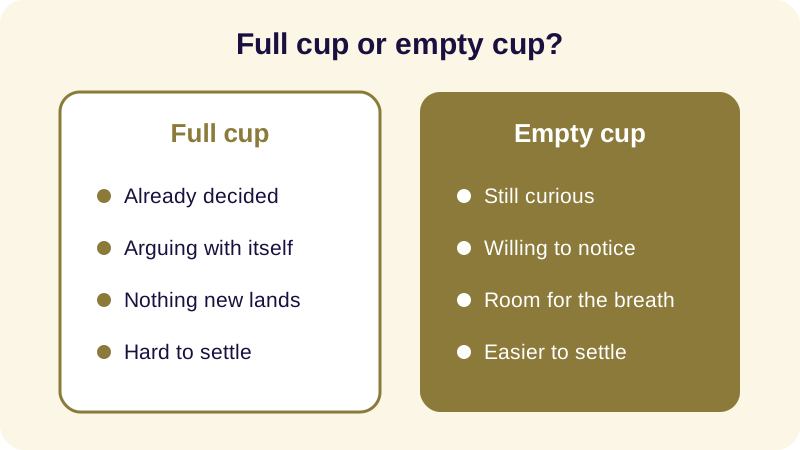
At night this becomes very concrete. The mind that can't fall asleep is usually not empty — it is overfull. It has already reached ten conclusions about tomorrow, replayed three conversations, and decided how it all should have gone differently. There is no space left in the cup for the plain, boring fact of lying still in a dark room. The story suggests that the fix is not to pour in one more thing — one more argument, one more plan — but to set the cup down and let some of it drain first.
How do you empty your cup before bed?
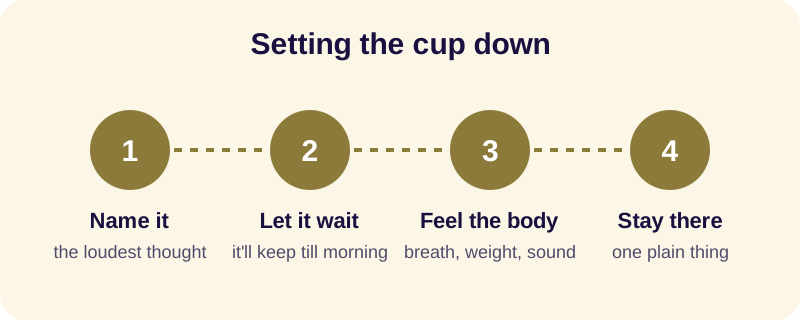
"Emptying the cup" doesn't mean forgetting your day or pretending your problems are solved. It means setting the lid on them for a short while so something else can have a turn. In practice, this looks less like a philosophy and more like a short routine.
- Name the loudest thought, briefly, instead of arguing with it — "work," "money," "that email."
- Tell yourself it will still be there in the morning, which is true.
- Move attention to something physical and immediate: the breath, the mattress against your back, the sounds in the room.
- Stay with that one plain thing for a few minutes rather than switching between several.
If words help more than silence, a few unhurried lines read slowly can do the same job as the physical steps above — they give the overfull mind a single, undemanding thing to follow. The Dhammapada's verses on a restless mind work this way; so does plain mindfulness for sleep, which is really just a longer version of step three above.
Where does this story come from, and is it really Buddhist?
No single ancient scripture records this exact scene with these exact words. It is told and retold in Zen teaching circles as an oral parable, the kind of short story a teacher uses on the spot rather than reads from a book. That doesn't make it any less genuine to the tradition — Zen has always leaned on small, direct anecdotes over long doctrinal explanations, and this one has survived because it works.
It also rhymes with much older material. The idea that fixed views are a burden, not a strength, runs through the earliest Buddhist teachings, including the simple opening observation of the Dhammapada that the mind shapes everything that follows it. The empty cup is a later, homelier way of saying the same thing: check what your mind is already carrying before you decide there's no room for something quieter.
Is emptying the cup the same as a beginner's mind?
They describe the same thing from two directions. "Beginner's mind" names an attitude — staying curious and unfinished rather than expert and settled. The empty cup explains why that attitude matters: a mind that already considers itself finished, full of settled opinions about how tonight is going to go, has nowhere left to put the plain, ordinary experience of actually resting. Approaching the evening with a slightly emptier cup — fewer verdicts about how badly you're sleeping, less argument with the clock — tends to leave more room for sleep to simply happen on its own terms.
None of this is a fix for ongoing insomnia or an anxious mind that won't settle night after night; those are worth taking to a doctor. For an ordinary restless evening, though, the empty cup is a useful small reminder: you don't have to finish every thought before you're allowed to rest. You just have to stop pouring for a while.
Stories like this one are easiest to sit with when they're read slowly rather than silently argued with. The app narrates short Zen tales alongside Jataka tales and verses from the Dhammapada, paced for listening in the dark rather than for taking notes.
Frequently Asked Questions
What is the Buddhist story about the empty cup?
A scholar visits a Zen teacher to learn about Zen. The teacher pours tea into the scholar's cup and keeps pouring after it is full, until tea spills everywhere. When the scholar protests, the teacher explains that, like the cup, the scholar is too full of his own opinions to receive anything new.
What is the moral of the empty cup story?
The moral is that a mind already full of fixed opinions and conclusions has no space left to take in anything new. Setting down what you already think you know, even briefly, is what makes room for a fresh understanding or, at night, for actual rest.
Is the empty cup story from the Buddha himself?
No single ancient text names this exact story. It circulates in Zen teaching circles as an oral parable, likely later than the Buddha's own lifetime, but it carries the same spirit as older teachings on letting go of fixed views.
How do I 'empty my cup' before sleep?
Set aside, for a few minutes, the conclusions you have already reached about today and tomorrow. Notice the breath, the weight of the body, or the sounds in the room instead of continuing to argue a point with yourself. The thoughts can wait; they will still be there tomorrow.
Is emptying the cup the same as beginner's mind?
They point at the same thing from different angles. Beginner's mind describes an attitude of openness and curiosity; the empty cup is the image that explains why that attitude is useful — a mind already full of certainty cannot notice anything it hasn't already decided.
