Published
Quick answer
The difference between Zen and Theravada Buddhism lies in history, scripture and meditation: Theravada follows the Pali Canon through a gradual, step-by-step path, while Zen is a Mahayana school built on zazen and sudden insight.
Key takeaways
- Theravada is older and rooted in the Pali Canon; Zen is a Mahayana school born as Chan Buddhism in China.
- Theravada centers on vipassana and breath awareness; Zen centers on zazen and koans.
- Theravada describes a gradual path; Zen often points toward sudden insight.
- Both share the Four Noble Truths, Five Precepts and the Middle Way as common ground.
- Neither tradition treats insomnia or anxiety; persistent sleep trouble belongs with a doctor.
The difference between Zen and Theravada Buddhism comes down to history, texts and how each approaches meditation. Theravada preserves the earliest surviving teachings in the Pali Canon, while Zen is a Mahayana school built around zazen, seated meditation, and direct attention to the present moment.
What is the core difference between Zen and Theravada Buddhism?
Theravada is the older of the two branches still practiced today, tracing a continuous line back to the teachings recorded after the life of Siddhartha Gautama. Zen began centuries later as Chan Buddhism in China, a branch of the wider Mahayana movement, before travelling on to Japan, Korea and Vietnam under different names.
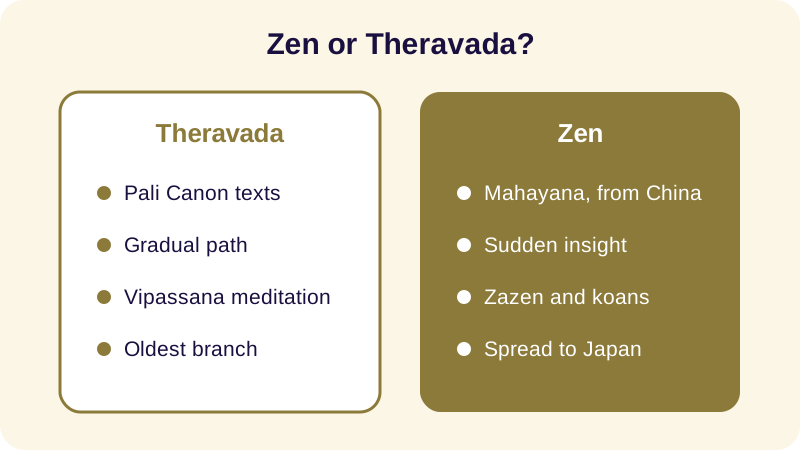
Both traditions accept the Four Noble Truths and the Noble Eightfold Path as the shared foundation of practice. Where they part ways is emphasis. Theravada tends to describe the path as a gradual unfolding of ethics, concentration and wisdom, built up over years of steady effort. Zen often points straight at the nature of mind itself, trusting that insight can arrive all at once, without waiting for every preliminary stage to be checked off.
See also: The Difference Between Meditation and Mindfulness.
| Area | Theravada | Zen |
|---|---|---|
| Origin | Pali Canon, Sri Lanka and Southeast Asia | Chan Buddhism, China, later Japan |
| Core texts | Dhammapada, Jataka tales, Pali suttas | Koan collections, Mahayana sutras |
| Meditation | Vipassana, mindfulness of breathing | Zazen, seated meditation |
| View of awakening | Gradual cultivation over time | Sudden insight into what is already present |
How does meditation practice differ between the two?
Theravada meditation usually starts with the breath. The Satipatthana Sutta describes watching the body, feelings, mind and mental events closely, one layer at a time, which is why vipassana (insight meditation) and mindfulness of breathing are taught as a structured sequence rather than a single loose technique.
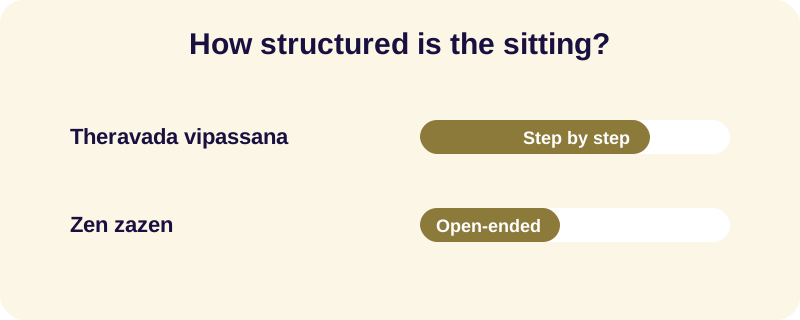
Zen meditation, zazen, looks simpler from the outside: sit upright, face a wall or open space, and let thoughts pass without following them. Many Zen schools add koans, short puzzling questions or stories with no tidy answer, used to tire out the thinking mind until something else opens up. Where Theravada instruction often names the next step, Zen instruction often removes the steps and asks the student to just sit with what is already here.
Neither approach is more "advanced" than the other. A mind that cannot settle on its own often benefits from Theravada's clear sequence of steps. A mind that overthinks every instruction sometimes does better with Zen's plainness. If you are new to either style, a short meditation for beginners guide covers the posture and breath that both traditions share, before any school-specific instruction is added on top.
Do Zen and Theravada share the same stories and scriptures?
They share a root but not a library. Theravada keeps close to the Pali Canon, including the 423 verses of the Dhammapada and the 547 Jataka tales of the Buddha's past lives. Zen, as a Mahayana school, honors the same historical figure and the Five Precepts, but it also developed its own body of short teaching stories, usually called Zen stories, built around a single moment of sudden recognition rather than a moral spelled out at the end.
What they still have in common
Underneath the different vocabulary, both traditions ask the practitioner to look honestly at the mind, to hold the Five Precepts as a basic ethic, and to work with difficult states rather than against them. The four brahmaviharas — loving-kindness, compassion, joy and equanimity — show up in Theravada teaching and in Zen's plain warmth toward ordinary life alike, even when the language around them sounds nothing like each other.
Which tradition suits a racing mind at bedtime?
Either one can help with an ordinary restless evening, though neither is a treatment for a sleep disorder or an anxiety condition, and persistent trouble sleeping is worth raising with a doctor rather than solving with meditation alone. For a mind that keeps listing tomorrow's tasks, Theravada's structured breath awareness or a slow body scan gives it something specific to follow, which is covered in more detail in our piece on Buddhist meditation for insomnia.
For a mind that argues with its own instructions, Zen's plainer approach — sit, breathe, let thoughts pass without chasing them — can be easier to rest in, because there is less to resist against. Both traditions also use story as a gentler way in than direct instruction. A slow-told Jataka tale or Zen parable gives the mind something to follow that is not the day's unfinished business, which is part of why mindfulness for sleep so often borrows from both lineages rather than sticking to one.
The Buddha Story app carries material from both traditions rather than asking you to choose one before bed. It narrates Jataka tales, episodes from the life of the Buddha, Dhammapada verses and Zen parables, alongside relaxing sounds and a sleep timer that stops the story for you, so you can try the gradual Theravada style one night and the plainer Zen style the next and simply notice which one settles your evening more easily.
Frequently Asked Questions
Is Zen a type of Theravada Buddhism?
No. Zen is a school of Mahayana Buddhism that began as Chan Buddhism in China and later spread to Japan, Korea and Vietnam. Theravada is a separate, older branch that preserves the Pali Canon. They share the same historical root but developed along different lines.
Which is older, Zen or Theravada?
Theravada is generally considered the older of the two surviving branches, tracing a continuous line back to the earliest recorded teachings. Zen developed later, emerging centuries afterward in China as Chan Buddhism before it took the form known today in Japan and elsewhere.
Do Zen and Theravada use the same meditation technique?
Not quite. Theravada typically teaches vipassana and mindfulness of breathing as a structured, step-by-step sequence. Zen centers on zazen, open seated meditation, often paired with koans. Both involve sitting still and watching the mind, but the instructions and emphasis differ.
Can I practice both Zen and Theravada at the same time?
Many people do, informally. There is no rule against trying a gradual, breath-focused sitting one week and a plainer, open style of zazen the next. What matters more than the label is whether the practice actually helps you settle.
Does either tradition treat anxiety or insomnia?
No. Both offer calming practices for an ordinary restless mind, but neither is a medical treatment. If sleep trouble or anxiety is persistent, it is worth discussing with a doctor rather than relying on meditation alone.