Published
Quick answer
Buddhist symbols and their meanings point to single ideas in the teaching: the lotus to an unstained mind, the Dharma wheel to the path, the Bodhi tree to awakening, mala beads to steady repetition.
Key takeaways
- Each Buddhist symbol marks one teaching, not a decoration on its own
- The lotus represents a mind that stays clear despite difficult surroundings
- The Dharma wheel's spokes are tied to the Noble Eightfold Path
- The Bodhi tree marks the place where Siddhartha Gautama reached awakening
- Mala beads and mudras support repetition and steadiness in practice
Buddhist symbols and their meanings are easiest to remember once you stop treating them as decoration and see each one as a pointer to a single idea in the teaching. The lotus points to a clear mind, the Dharma wheel to the path itself, the Bodhi tree to awakening, mala beads to steady repetition.
What are the main Buddhist symbols and what do they mean?
A short list of images turns up again and again across Buddhist countries and traditions: the lotus flower, the Dharma wheel (Dharmachakra), the Bodhi tree and its leaf, mala beads, mudras (hand gestures), and the endless knot. Each one is shorthand for an idea from the teaching rather than an ornament chosen for its looks.
Some traditions, especially within Tibetan Buddhism, group a further set known as the eight auspicious symbols: the parasol, golden fish, treasure vase, lotus, conch shell, endless knot, victory banner and the Dharma wheel. Each stands for a different quality associated with an awakened mind, such as protection, fearlessness or abundance. You do not need to memorize the whole set to get something useful from a few.
What does the lotus flower mean in Buddhism?
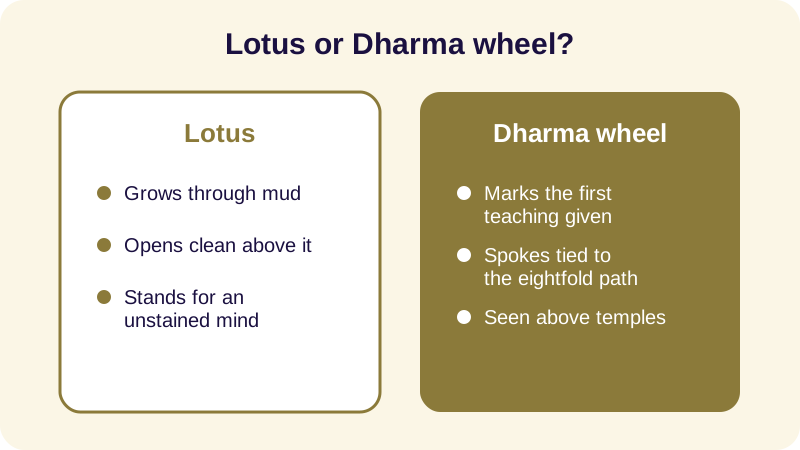
The lotus grows rooted in muddy water, pushes up through it, and opens as a clean flower above the surface untouched by the mud it grew through. That image is used to describe the mind itself: conditions can be difficult, confusing or sorrowful, and the mind can still open clear above them rather than being defined by them.
Different colors carry slightly different emphases in different traditions — white is often linked with purity of mind, pink with the Buddha himself, red with compassion — but the core meaning is consistent wherever the flower appears, carved on temple walls or printed on a prayer flag. It is not a claim that mud does not exist. It is a reminder that the mind is not only its conditions.
What does the Dharma wheel represent?
The Dharma wheel, or Dharmachakra, represents the teaching itself being set into motion and continuing to turn, carried forward from one generation to the next. Its spokes are traditionally tied to the Four Noble Truths and the Noble Eightfold Path, the practical steps the Buddha laid out for working with suffering rather than being ruled by it.
You will see the wheel above temple entrances, on flags, and worked into the architecture of stupas across Buddhist countries. Unlike the lotus, which points at an inner quality, the wheel points at something handed down and shared: a path that others have walked before you and that is still available to walk now.
What do the Bodhi tree, mala beads and mudras symbolize?
The Bodhi tree marks a specific place rather than a general idea: it is where Siddhartha Gautama sat and reached awakening, after which he became known as the Buddha. The story of that night under the tree is one of the oldest and most retold episodes in the tradition, and the heart-shaped Bodhi leaf is used as a standalone symbol of that same moment, appearing on its own wherever a full depiction of the tree would be too much.
Mala beads are a practical tool rather than a decorative one: a loop of beads used to count repeated phrases or breaths during practice, with one larger bead marking where a round begins and ends. Mudras, the formal hand positions seen in Buddhist statues and paintings, each correspond to a specific state or moment — a hand resting palm-up in the lap for meditation, a hand touching the earth for the moment of awakening under the Bodhi tree. Alongside these, mantras use sound the way mudras use the hands and malas use touch: a repeated phrase the mind can rest on instead of wandering.
How can these symbols support a calmer evening?
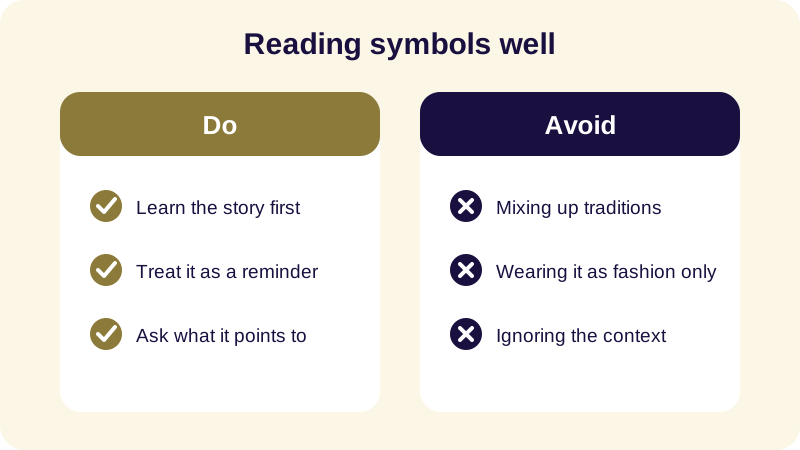
Most of these symbols were never meant to be puzzled over at length; they work more like a bell than a book, a quick cue that brings a whole teaching to mind in a second. Picturing the lotus for a moment before bed — mud below, clear flower above — can do the same quiet work as recalling a line from the Dhammapada: a short, settled thought to replace a longer, restless one.
If a racing mind at night is a familiar problem, symbols are a lighter entry point than a full sitting practice. You do not need to meditate formally to let an image like the Bodhi tree or the Dharma wheel settle a few seconds of attention before sleep. For something longer, a full narrated story built around one of these images — the night under the Bodhi tree, or a Jataka tale that ends in a moment of insight — gives the mind more to follow than a single picture, which is part of why Buddhist stories for sleep work well as a bedtime routine rather than a one-off thought.
None of this is a claim that recognizing a symbol will cure insomnia or fix anxiety; persistent sleep or mental health problems are worth taking to a doctor. What a symbol or a short story can do, on an ordinary restless night, is give the mind one small, familiar, non-urgent thing to rest on instead of the day's unfinished business.
Frequently Asked Questions
What is the most important Buddhist symbol?
There is no single most important symbol, but the Dharma wheel (Dharmachakra) is one of the oldest and most widely used, since it stands for the Buddha's teaching being set in motion for the first time and continuing to turn.
What does the lotus flower symbolize in Buddhism?
The lotus grows up through muddy water and opens clean above the surface. It symbolizes a mind that can stay clear and undisturbed even while living in difficult or confusing conditions, without needing those conditions to change first.
Is the swastika a Buddhist symbol?
In its traditional Buddhist and South Asian form, this ancient mark represents good fortune and the turning of the Dharma, and appears on temples and in Buddhist art across Asia. It carries a very different, and painful, history in the twentieth-century West, which is worth knowing before using it casually.
What do mala beads represent?
Mala beads are a counting tool used to keep track of repeated phrases or breaths during practice, usually strung as a loop of beads with one larger guru bead marking the start and end of a round.
Do I need to understand Buddhist symbols to meditate or listen to Buddhist stories?
No. The symbols are a helpful doorway into the teaching, not a requirement. Many people meditate, listen to Buddhist stories, or wind down at night with no knowledge of the symbols at all, and pick up the meanings gradually if they are curious.
