Published
Quick answer
What are mantras used in Buddhism? They are short phrases or sounds, such as Om Mani Padme Hum, repeated to steady a wandering mind rather than to invoke magic.
Key takeaways
- A mantra is a short phrase repeated to give a busy mind one thing to hold onto.
- Om Mani Padme Hum is linked to compassion in Tibetan Buddhist practice.
- The Metta Sutta's verses are chanted in a similarly slow, repetitive way.
- Pronunciation matters less than slow, steady repetition.
- Persistent sleep or anxiety problems belong with a doctor, not repetition alone.
What are mantras used in Buddhism? A mantra is a short phrase or sound, repeated aloud or silently, that gives a wandering mind one thing to hold onto instead of the day's unfinished business.
What does a mantra actually do in Buddhist practice?
A mantra is not a spell, and it is not meant to produce an effect by magic. It works the same way a single point of focus works in any concentration practice: each time attention drifts toward tomorrow's meeting or tonight's argument, the repeated phrase gives it somewhere familiar to come back to. After a few minutes there are fewer loose threads to pull on, because the mind keeps returning to the same few syllables rather than starting a new line of thought each time.
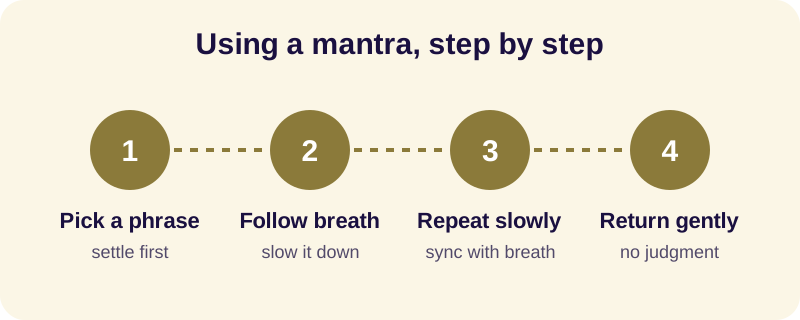
This is close to what happens in meditation more generally: a single object — the breath, a phrase, a sound — becomes the thing the mind holds, and everything else is allowed to pass without being chased down. The phrase itself does not need to be elaborate. Its job is to be short enough to repeat without effort and plain enough that it does not start a new train of thought on its own.
Which mantras are most commonly used in Buddhism?
The best known is Om Mani Padme Hum, used widely in Tibetan Buddhist practice and traditionally linked to Avalokiteshvara, the bodhisattva of compassion. It is often repeated on a string of beads while sitting or walking, one repetition per bead, so the hands keep count and the mind is free to stay with the sound rather than keeping track of numbers.
See also: The Buddhist View on Dreams: What the Teachings Say.
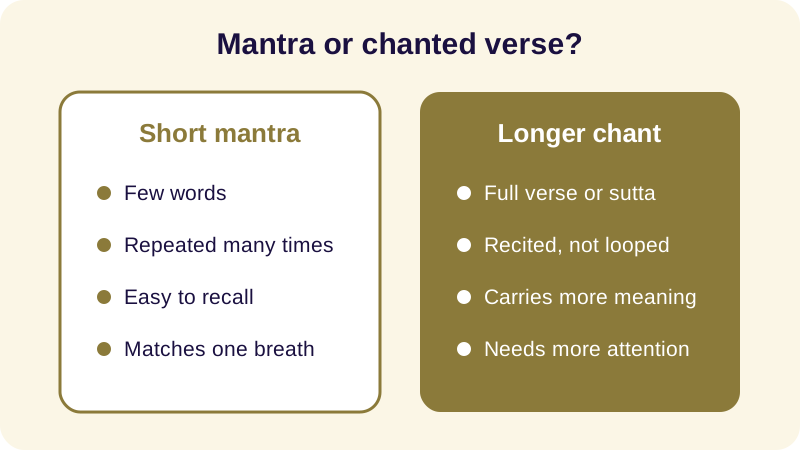
Many other traditions use something similar without calling it a mantra at all. Lines from the Metta Sutta are chanted slowly as a form of loving-kindness practice, and a short phrase drawn from the Dhammapada's 423 verses is sometimes held in mind during sitting practice. The format differs — one is a fixed set of syllables, the other a line of teaching — but the function is the same: a short unit of sound, returned to again and again until it outlasts the noise around it. Because Om Mani Padme Hum is tied to compassion, some people use it much the way others use a loving-kindness phrase from the four brahmaviharas — repeating goodwill toward a specific person until the phrase feels more real than the irritation did. Other traditions lean on a single syllable, or on a teacher's name used as a point of devotion, but the underlying mechanism stays the same across all of them: one small sound, repeated until it becomes the quietest thing in the room.
Do you need the original words for a mantra to work?
No. The original Sanskrit, Tibetan or Pali is not required for the repetition to calm the mind. What matters is that the phrase is short enough to say without thinking about it, and repeated slowly enough to match the breath rather than race ahead of it. Many people use a plain phrase instead of a traditional one — "may I be at ease," or simply "settle" — and find it works through the same mechanism.
It also helps to pick one phrase and stay with it for more than a single night. Switching mantras every evening means the mind has to learn a new sound each time, which works against the very familiarity that makes repetition calming in the first place.
Can repeating a mantra help you fall asleep?
Lying down with a short phrase to return to is one of the more practical uses of a mantra, because the alternative at night is usually unstructured thinking, which tends to escalate rather than settle on its own. A mantra does not force sleep and nobody should expect an instant result from it. What it offers is somewhere steadier than the loop of the day's problems to rest attention on while the body winds down at its own pace. This is close to what a loving-kindness phrase does in metta meditation, and it pairs naturally with slow Buddhist chanting for sleep and relaxation, where a verse is recited gently rather than performed.
Some people find it easier to pair a mantra with a longer narrated teaching rather than using it alone. A few minutes of silent repetition as the body settles, followed by something to listen to once the mind is calmer, tends to work better than asking a single phrase to carry the whole evening by itself.
How can the Buddha Story app help with this practice?
The Buddha Story app narrates the stories and teachings mantras are often drawn from, read slowly for listening in the dark rather than recited quickly for merit.
- Narrated stories and teachings — Jataka tales, episodes from the life of Siddhartha Gautama, and verses from the Dhammapada, read at a pace suited to falling asleep.
- Guided meditation for loving-kindness, body scan and breath awareness, each giving the mind one steady point to hold, the way a mantra does.
- A sleep timer, so a repeated phrase or a narrated story does not play on all night.
- Offline listening and background playback, so a weak signal does not interrupt the routine once it has started.
- A sound mixer for layering rain, ocean waves or singing bowls underneath a story or a phrase.
A mantra, in the end, is a small tool: a few words light enough to carry into sleep, steady enough to hold a drifting mind. Start with one phrase, say it slower than feels necessary, and let the rest of the evening follow on its own.
Frequently Asked Questions
What is a Buddhist mantra, in plain terms?
A mantra is a short phrase or sound repeated aloud or silently during sitting practice. It is not meant to work by magic; it gives a wandering mind one simple thing to return to, the way a breath count does, instead of chasing every passing thought.
What does Om Mani Padme Hum mean?
It is one of the best-known mantras in Tibetan Buddhist practice, traditionally linked to Avalokiteshvara, the bodhisattva of compassion. Practitioners often repeat it on a string of beads, and its syllables are treated as carrying the quality of compassion rather than a literal instruction.
Do mantras have to be chanted aloud?
No. A mantra can be spoken aloud, whispered, or repeated entirely silently in the mind. Many people use it silently while lying down at night, since a whisper or a spoken phrase is not always practical once the lights are off.
Can I use a mantra in English instead of Sanskrit or Pali?
Yes. The original language is not required for the repetition to settle the mind. A short phrase in your own language, repeated slowly and evenly, works through the same mechanism as a traditional mantra: one steady thing to hold instead of many.
Can repeating a mantra replace meditation or treat insomnia?
No. A mantra is a simple calming habit, not a treatment for insomnia or anxiety. It can make an ordinary restless evening easier to settle into, but persistent sleep or mental health problems are worth discussing with a doctor rather than addressing with repetition alone.