Published
Quick answer
What is a mala used for in Buddhism? A mala is a string of beads moved one at a time to count mantras, breaths, or phrases during meditation, so the mind can rest on the practice instead of tracking numbers.
Key takeaways
- A mala is a string of beads used to count mantra or breath repetitions during meditation.
- The guru bead marks the start and end of one full round of counting.
- Moving one bead at a time keeps the mind on the practice, not on numbers.
- A mala is a counting tool, not a charm, and it doesn't treat anxiety or insomnia.
- Any phrase, from a mantra to a loving-kindness wish, can be counted on a mala.
What is a mala used for in Buddhism? A mala — sometimes called mala beads — is a string of beads, moved one at a time through the fingers, used to count repetitions of a mantra, a breath, or a short phrase during meditation.
What is a mala used for in Buddhism?
A mala's single job is to keep count without pulling attention into counting. Each bead marks one repetition, so the mind can rest on the mantra, the breath, or the phrase itself instead of tracking a number in the head.
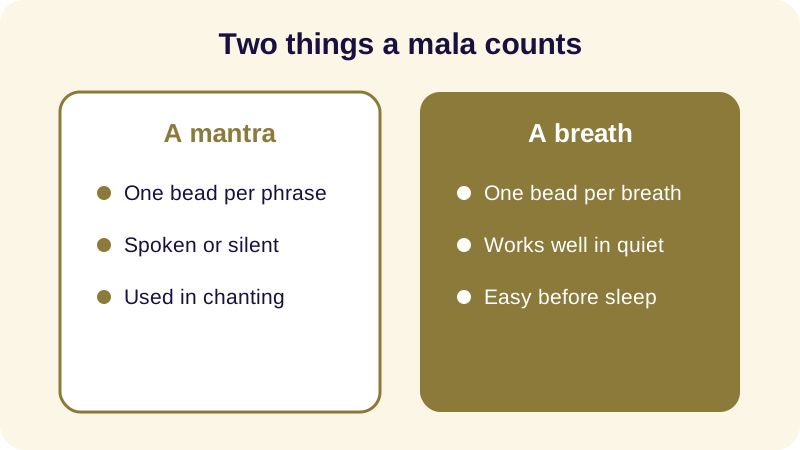
Across Buddhist traditions a mala is used the same basic way, whether someone is chanting the name of a buddha, reciting a phrase of loving-kindness, or simply counting breaths in silence. The beads do not make the practice more powerful on their own — they remove the small mental workload of counting, which is often the first thing to slip when the mind is tired or restless. This is also why the same gesture shows up in very different settings — a long formal chant, or an ordinary person at home counting ten slow breaths before closing their eyes.
See also: The Buddhist View on Dreams: What the Teachings Say.
How many beads does a mala have, and why?
Most malas are strung with a traditional count tied to older Buddhist and Hindu numerology, plus one extra bead, often larger or differently shaped, called the guru bead.
The guru bead marks the start and the end of one full round. When a practitioner's thumb reaches it again, that's a complete cycle of counting — a built-in signal to stop, continue for another round, or simply notice that time has passed. Some malas are shorter, strung for carrying in a pocket or wrapped around a wrist, and used for quicker counts between the same guru bead.
Materials vary by tradition and availability — carved wood, seeds, or polished stone are all common for Buddhist mala beads — but the material doesn't change the function. A mala of plain wood counts exactly as well as an ornate one; what matters is that it's comfortable to hold through many rounds.
How do you use a mala to meditate or chant?
Here is how to use a mala for meditation, and the pattern barely changes between traditions: hold the mala loosely, move one bead with the thumb for each repetition, and start again at the guru bead.
- Hold the mala gently in one hand, resting it over the first two fingers.
- Choose what you're counting: a mantra, a breath, or a short phrase such as a loving-kindness wish.
- Draw one bead toward you with the thumb for each repetition, without reaching over the guru bead.
- When the thumb meets the guru bead again, pause, turn the mala around, and begin the next round the other way.
Any phrase can be counted this way — a formal mantra, a single word like "calm," or the loving-kindness phrases used in metta meditation. If mantras in particular are unfamiliar, our guide to mantras used in Buddhism explains a few common ones and what they mean.
What mistakes should you avoid with a mala?
The most common mistake is treating the mala as decoration rather than a tool, which turns a simple counting habit into one more thing to think about correctly.
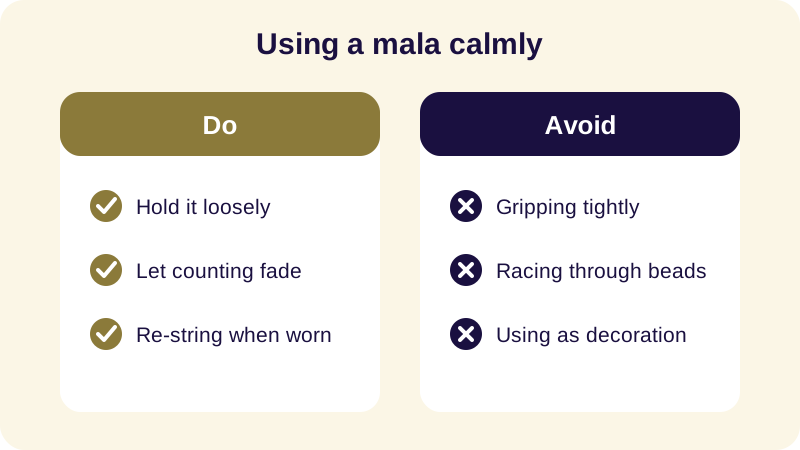
Another frequent mistake is gripping the mala tightly or rushing through beads to finish a round quickly. Both work against the point of the practice, which is to let counting happen in the background while attention settles elsewhere. A worn string or a loose knot is a practical problem, not a spiritual one — most malas are strung to be re-tied, and a broken strand is simply a sign to restring it, not a verdict on the practice.
Can a mala help with a racing mind at night?
A mala gives a busy mind one small, repetitive job instead of several large ones, which is part of why some people keep one on the nightstand rather than only on the cushion.
Counting breaths or a loving-kindness phrase on a mala works on the same principle as other calming practices: it gives attention somewhere steady to land. It sits alongside other approaches described in our guide to Buddhist meditation for insomnia, and pairs naturally with the kind of slow, spoken practice found in Buddhist chants for sleep and relaxation. None of this is a treatment for insomnia or anxiety; if sleep trouble or worry is persistent, it's worth raising with a doctor. For an ordinary restless evening, though, a few quiet rounds on a mala is a small, physical way to tell a busy mind that the day is over.
Is a mala the same as a rosary?
A mala and a rosary serve the same basic function — counting repeated prayers or phrases — but they come from different traditions and carry different sets of words.
A rosary is tied to a specific set of prayers in its own tradition; a mala is used far more flexibly, for anything from a formal mantra to a single breath. Visually they can look similar, strung beads with a marker bead at one point, but a mala carries no requirement to recite any particular words. What matters in Buddhist use — the meaning behind mala beads — is the repetition and the steadiness it brings, not the specific object.
If this is your first time sitting down with any of these practices, our meditation for beginners guide covers posture, breath, and the kind of short daily habit a mala fits into easily. And if beads alone feel too quiet, the four brahmaviharas — loving-kindness, compassion, joy and equanimity — give the counting something warm to count.
Used this way, night after night, a mala becomes less about the object and more about the pause it creates: one bead, one breath, one small return to the present moment before sleep.
Frequently Asked Questions
What is a mala used for in Buddhism?
A mala is a string of beads used to count repetitions during meditation — a mantra, a breath, or a short phrase such as a loving-kindness wish. Moving one bead per repetition keeps count automatically, so attention can stay on the practice instead of tracking numbers.
How many beads does a traditional mala have?
Most malas are strung to a traditional count rooted in older Buddhist and Hindu numerology, plus one extra guru bead marking the start and end of a round. Shorter wrist malas use a fraction of that count for quicker rounds.
Is a mala the same thing as a rosary?
They serve a similar purpose — counting repeated prayers or phrases — but come from different traditions. A rosary is tied to a specific set of prayers; a mala is used more flexibly, for anything from a formal mantra to a single counted breath.
Do you need a mala to meditate in Buddhism?
No. Many forms of Buddhist meditation use no object at all, just the breath or a point of attention. A mala is simply a helpful tool for practices built around repetition, such as chanting or counting breaths, not a requirement.
Can a mala help you fall asleep?
A mala can give a busy mind a small, steady task — counting breaths or a calming phrase — which some people find settling before bed. It is a counting tool, not a sleep treatment; persistent sleep trouble is best discussed with a doctor.