Published
Quick answer
The Buddhist story about the burning house is a parable from the Lotus Sutra: a father lures his absorbed children out of a burning house with promised carts, then gives them something greater outside. It illustrates skillful means.
Key takeaways
- The burning house parable comes from the Lotus Sutra, a genuine Buddhist scripture.
- A father uses promised carts, not warnings, to lead his children to safety.
- The story illustrates skillful means (upaya): meeting people where they are.
- It pairs well with teachings on impermanence and the second arrow.
- The app narrates stories like this one slowly, with a sleep timer and offline listening.
A Buddhist story about the burning house appears in the Lotus Sutra, where a father tricks his children into leaving a burning house by promising them three wonderful carts waiting outside. It is one of the clearest pictures in the tradition of how a teacher meets people exactly where they are, not where it would be convenient for them to be.
The parable is short, almost like a bedtime story in shape, and it rewards a slow read at night as much as a quick summary.
What happens in the Buddhist story about the burning house?
A wealthy man returns home to find his house on fire. His children are inside, absorbed in their games, and they do not notice the smoke or hear his warnings. He could try to carry them out one by one, but the doorway is narrow, the children are many, and the fire is spreading fast, so he tries something else entirely.
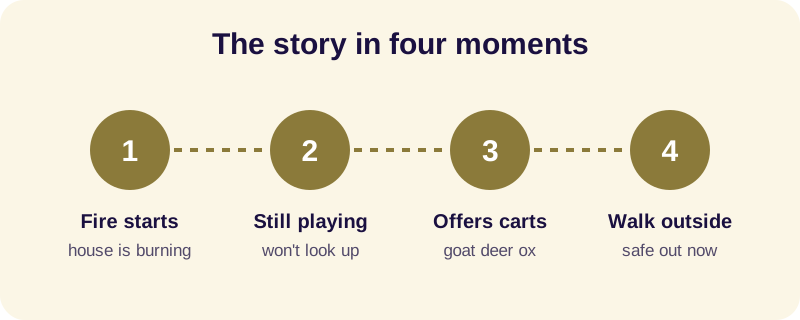
He calls out that he has brought three kinds of carts for them to play with in the yard: a goat cart, a deer cart, and an ox cart. The children, curious about the carts rather than afraid of the fire, run out through the door at once. Once they are safe outside, their father gives each of them something even better than what he promised — a single magnificent cart, far grander than any of the three he described to get them moving.
No one is harmed. No one is scolded for not listening to the first warning. The father simply found a way in that worked, then gave freely once everyone was out of danger.
Where does the burning house parable come from?
This is often called the parable of the burning house, and it comes from the Lotus Sutra, a Mahayana Buddhist scripture. It is not one of the Jataka tales about the Buddha's past lives, and it is not a loose saying taken out of context. It has a genuine sutra source, which is part of why it has been studied and retold across Buddhist traditions for so long, unlike a few popular "Buddhist" sayings that circulate online with no real scripture behind them at all.
The story is usually read as an illustration of skillful means in Buddhism, often called upaya in Sanskrit: the idea that a teaching should fit the listener rather than the other way around. The father does not lecture his children about combustion or escape routes. He speaks in the language they already love — toys — and lets that love carry them safely to the door.
See also: Buddhist Teaching on the Nature of Thoughts Explained.
What does the burning house story mean for a restless mind at night?
Lying awake, most of us are not actually in danger. But the mind often behaves as though it is — turning over an email, a decision, an old conversation, as if the stakes were as high as a fire. The meaning of the burning house parable is useful here precisely because it does not shame the children for failing to notice the smoke. It simply asks: what would help you walk out the door right now?
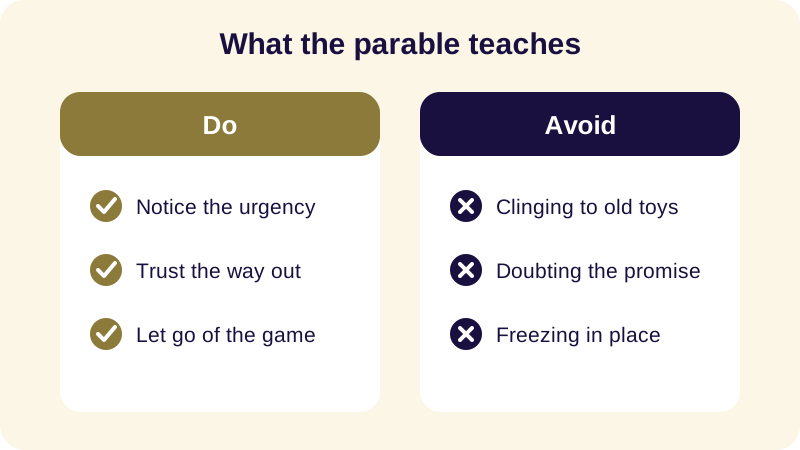
Part of what the story addresses is attachment to the familiar, even when the familiar is actively burning. The children keep playing because the game is what they know. A racing thought at 2am can have the same pull — not pleasant, exactly, but familiar, and familiarity can feel safer than the unknown space of actually letting go and resting. The story suggests you do not need to argue yourself out of that pull. You can simply be offered something better, the way the children were, and let that be reason enough to step outside of it.
This sits close to the Buddhist teaching on impermanence: the house was never going to stand forever, fire or no fire. It also sits close to the second arrow teaching — the first arrow is the fire itself, something that is simply happening; the second arrow is the panic, blame, or self-criticism piled on top, which is optional.
How can you use this story to settle down before sleep?
You do not need to analyze the parable line by line in bed. The simplest use is to let its shape — danger, an easier way out offered gently, safety, then something good waiting on the other side — sit quietly in the background while your body relaxes.
- Picture the house as it is at the start of the story: ordinary, familiar, nothing urgent yet.
- Notice your own version of "still playing" — the thought or worry you keep circling back to.
- Imagine being offered a way out that matches what you actually want, rather than a lecture about why you should leave.
- Picture stepping outside into the yard, where the real gift is waiting, and let the scene rest there.
If you want the same approach applied to other short teachings, Buddhist stories for sleep covers several more, and dharma stories for sleep works through teachings in a similarly unhurried way. The app narrates stories like this one — alongside Jataka tales, episodes from the life of the Buddha, and Dhammapada verses — slowly enough to listen to in the dark. Its sleep timer stops the story and any background sound once the time is up, instead of cutting off mid-sentence, and offline listening means a weak signal at night never interrupts the story partway through.
Frequently Asked Questions
What is the Buddhist story about the burning house?
It is a parable from the Lotus Sutra in which a father's children are absorbed in play inside a burning house and will not leave. He lures them out by promising three kinds of carts, then gives each of them something far grander once they are safely outside.
Where does the burning house parable come from?
It comes from the Lotus Sutra, a Mahayana Buddhist scripture, rather than from the Jataka tales or the Pali suttas. It is one of several extended parables in that text used to illustrate how a teaching can be shaped to fit the listener.
What does the burning house parable mean?
It is usually read as a picture of skillful means (upaya): meeting someone where they actually are, in language they already understand, rather than insisting they first grasp the full danger. It also touches on attachment to the familiar, even when the familiar is not safe.
Is the burning house story considered an authentic Buddhist teaching?
Yes. Unlike some popular sayings that circulate online without a real source, this parable has a genuine sutra behind it, the Lotus Sutra, which is why it has been studied and retold across Buddhist traditions for centuries.
How can this story help with a restless mind at night?
The story does not scold anyone for not noticing danger sooner. It simply offers an easier way out. At night, it can serve as a gentle reminder that you do not need to argue yourself out of a worry — you can be offered something better and let that be reason enough to let go.