Published
Quick answer
What is a mudra in Buddhism? It is a symbolic hand gesture used in Buddhist art and meditation to express a specific quality, such as calm, fearlessness or generosity.
Key takeaways
- A mudra is a hand gesture, not a magic spell or a secret code.
- The dhyana mudra, hands resting in the lap, is easy to use before sleep.
- Common mudras include bhumisparsha, abhaya, varada and dharmachakra.
- A mudra supports calm; it does not treat anxiety or insomnia.
- Hold any mudra loosely — tension in the hands defeats the point.
What is a mudra in Buddhism? A mudra is a symbolic hand gesture used in Buddhist art, ritual and meditation to express a specific quality of mind, such as calm, fearlessness or generosity.
You have almost certainly seen one without knowing its name — the Buddha statue with palms resting one on top of the other, or the raised hand with palm facing outward. Each position has a meaning behind it, and some are still used today by people who meditate, including at the end of a long day when the hands, like the mind, do not quite know where to settle.
What does the word mudra actually mean?
Mudra is a Sanskrit word usually translated as "seal" or "sign." In Buddhist art, it refers to a fixed position of the hands and fingers that carries a specific meaning, the way a seal stamped on a letter confirms who sent it. A mudra is not a secret code or a magic gesture; it is closer to visual shorthand, a way of showing in one still image what a teaching might otherwise take many words to say.
See also: The Buddhist View on Dreams: What the Teachings Say.
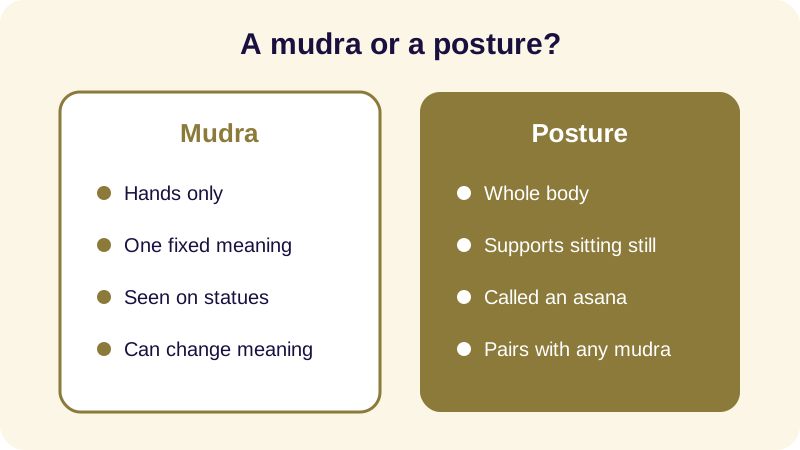
The distinction that trips people up is between a mudra and a posture. A mudra concerns only the hands. The seated position of the whole body is a separate thing, usually called an asana. A statue can combine a seated asana with any number of hand mudras, and changing the hands changes what the same seated figure is understood to be doing.
Older traditions leaned on this visual shorthand because not everyone who visited a temple could read. A gesture carved in stone or painted on a wall communicated instantly, the way a street sign still does today, without requiring a single word of text.
What are the most common Buddhist mudras in statues and paintings?
A handful of mudras appear again and again across Buddhist art, each tied to a moment or quality associated with the Buddha's life and teaching.
| Mudra | Hand position | What it represents |
|---|---|---|
| Bhumisparsha | Right hand reaching down to touch the earth | Calling the earth to witness, the moment of enlightenment under the Bodhi tree |
| Dhyana | Both hands resting in the lap, palms up, one on the other | Meditation and inner stillness |
| Abhaya | Right hand raised, palm facing outward | Fearlessness and reassurance |
| Varada | Hand lowered, palm open and facing forward | Giving, generosity, granting a wish |
| Dharmachakra | Hands held at chest height, fingertips meeting | Turning the wheel of the teaching, the first sermon |
These are the mudras most people encounter at a museum or a temple, but they are also a quiet map of the Buddha's biography: reaching toward the earth, sitting still, reassuring, giving, and teaching. Each one freezes a different scene from a single life into a single gesture. Different Buddhist traditions favor different mudras in their imagery — a standing figure in one region might show the abhaya gesture of reassurance, while a seated figure elsewhere favors the earth-touching bhumisparsha — but the meaning behind each gesture tends to travel well even when the style of the statue changes.
How can you use a mudra in your own meditation practice?
The dhyana, or meditation, mudra is the easiest one to bring into an ordinary sitting practice, and it needs no training or belief.
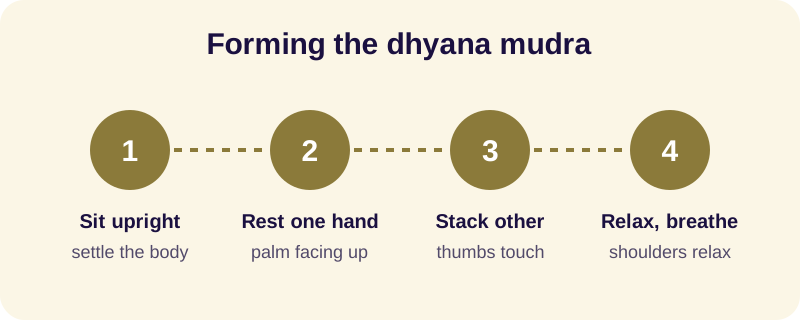
- Sit comfortably, on a chair or cross-legged, with your back reasonably upright.
- Rest one hand, palm up, in your lap.
- Lay the other hand on top of it, also palm up.
- Let the tips of your thumbs touch lightly, forming a soft oval.
- Let your shoulders and fingers relax completely and simply breathe.
Holding the hands this way does nothing mystical. What it does is give restless hands somewhere settled to be, which can make it easier to notice when the shoulders have crept up or the jaw has tightened. It pairs naturally with simple breath awareness, the kind used in mindfulness for sleep practice, or with a short loving-kindness practice like metta meditation before bed.
Is there a wrong way to hold a mudra?
No. There is no strict rulebook for a lay person using a mudra at home, and no gesture is required for meditation to be worthwhile.
The gestures matter because of what they point to, not because of any power in the fingers themselves. A loose, approximate dhyana mudra done with a relaxed mind does more for an evening wind-down than a precise one held with gritted effort. If sleeplessness, anxiety or racing thoughts are a regular, persistent problem rather than an occasional restless night, that is worth raising with a doctor — a hand position is not a substitute for that conversation.
Why bother with a hand gesture at bedtime?
Because the body and the mind tend to calm down together, not one after the other. A fidgeting hand usually goes with a fidgeting mind; a still hand gives the mind one less thing to manage. This is close to the principle behind many buddhist meditation for insomnia practices — body scans, breath counting, loving-kindness phrases — that settle attention in the body before asking anything of the thinking mind. It is also close to the spirit of the four brahmaviharas — loving-kindness, compassion, joy and equanimity — qualities the mind can hold gently, without strain, the same way the hand holds a gesture.
You do not need to study Buddhist art to borrow this one small habit. Resting your hands in the dhyana mudra for a few minutes before sleep, alongside slow breathing, is a modest, physical cue that the day's doing is finished and it is time to rest.
How does the Buddha Story app fit in?
If a few minutes of stillness with your hands in your lap is still not enough to switch your mind off, a short guided practice or a slow story can help carry you the rest of the way. The app offers guided meditation for beginners, including loving-kindness, body scan and breath awareness sessions, alongside narrated Jataka tales, episodes from the life of Siddhartha Gautama, Dhammapada verses and Zen parables for listening in the dark. A sleep timer that pauses the story when it ends, relaxing sounds like rain and singing bowls, and offline listening mean you can settle in without reaching for your phone again once you've found your position. The app is available for Android on Google Play, with a 3-day free trial before any subscription starts.
A mudra is a small, physical way of saying: this is the shape of calm. Whether or not you ever learn another one, the dhyana position in your lap is a quiet, free way to meet your pillow with your hands already at rest.
Frequently Asked Questions
What is a mudra in Buddhism?
A mudra is a fixed position of the hands and fingers used in Buddhist art, ritual and meditation to express a specific idea or quality of mind, such as calm, fearlessness or generosity. It works like a visual shorthand, showing in one still gesture what a teaching might otherwise take many words to explain.
What does the dhyana mudra mean?
The dhyana mudra is the meditation gesture: one hand rests palm-up in the lap, the other hand rests on top of it, also palm-up, with the thumb tips lightly touching. It represents stillness and inward focus, and it is the mudra most people use for their own sitting practice.
Do I need to use a mudra to meditate?
No. A mudra is optional. Meditation, breath awareness and simple stillness all work without any particular hand position. A mudra can give restless hands somewhere settled to rest, which some people find helpful, but it is not a requirement for a meditation practice to be worthwhile.
What is the difference between a mudra and a posture?
A mudra concerns only the hands; a posture, or asana, concerns the whole body's position while sitting. A statue or a meditator can combine any seated posture with any hand mudra, and changing the hands changes the meaning of the gesture without changing the body's position at all.
Can a mudra help with sleep?
Resting the hands in a simple mudra like dhyana can support an ordinary wind-down by giving the body one less thing to fidget with. It is not a treatment for insomnia or anxiety; persistent sleep problems are worth discussing with a doctor rather than addressing with a hand position alone.
