Published · Updated
Quick answer
What is samsara in Buddhism? It's the cycle of birth, death and rebirth kept turning by craving, karma and ignorance, pictured as a wheel with six realms, until the path toward nirvana winds it down.
Key takeaways
- Samsara means the cycle of rebirth driven by craving, karma and ignorance.
- The wheel of samsara pictures six realms, from gods to hell beings.
- Samsara keeps turning through conditions, not a fixed fate handed down.
- Nirvana is release from samsara's wheel, not another realm to be reborn into.
- The teaching reframes a restless night as one more turn, not a verdict.
What is samsara in Buddhism? It is the term for the beginningless cycle of birth, death and rebirth that a mind driven by craving and ignorance keeps moving through, life after life.
What does samsara mean in Buddhism?
Samsara literally means "wandering on" or "continuous flow." It names the condition of being caught in repeated existence, pushed from one life to the next by unresolved craving, aversion and confusion about how things actually work. Nothing permanent travels from one life to another in this picture — there is no fixed soul riding along — but a stream of cause and effect continues, shaped by intention and action, which Buddhism calls karma.
The word shows up constantly in the earliest texts, usually paired with its opposite: samsara and nirvana, the wandering and the point at which the wandering stops. Siddhartha Gautama's awakening under the Bodhi tree is described as precisely this — seeing the whole mechanism of samsara clearly enough that its hold loosened. The teaching has been retold for roughly 2,500 years since, in the Dhammapada, in the Jataka tales of the Buddha's past lives, and in countless discourses aimed at ordinary people trying to work out why life keeps feeling the same shape over and over.
What keeps samsara turning?
Traditional teaching describes samsara as a wheel, and a wheel needs something to keep it moving. The classic answer is a chain of conditions: not seeing clearly leads to craving, craving leads to action, and action leaves a residue that ripens into another round of experience, which starts the whole sequence again.
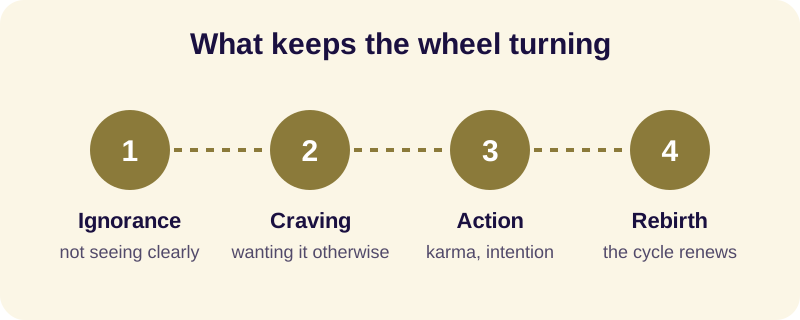
This sequence is laid out in detail in the teaching on dependent origination, which traces twelve linked conditions rather than four, but the core logic is the same at any scale: nothing in the cycle stands alone, and nothing keeps itself going except by feeding the next link. Karma is the part most people have heard of, and it is worth being precise about what it means — not fate or punishment, but the simple fact that intentional action has consequences, explained more fully in our piece on karma in Buddhism.
See also: Buddhist Story About the Burning House Explained.
What are the six realms of samsara?
Traditional Buddhist cosmology pictures samsara as a wheel divided into six realms, each a different quality of existence a being might be reborn into: gods, demigods, humans, animals, hungry ghosts and hell beings. The god realm is pleasant, even blissful, but not final — pleasure there eventually runs out, and the craving for more of it starts the cycle again. The human realm is considered unusually workable precisely because it mixes enough comfort with enough discomfort to prompt real reflection, which is part of why the Jataka tales so often cast the Buddha-to-be as a human or an animal learning a hard lesson rather than as a god enjoying an easy one.
None of the six realms is described as an exit. Even the most fortunate rebirth is still inside samsara, still conditioned, still temporary. That is part of the point: the realms are not a ladder to climb toward comfort but a map of how varied and how impermanent conditioned existence is, in any direction.
How is samsara different from nirvana?
Nirvana is usually translated as "extinguishing" — not the end of a person, but the end of the craving, aversion and confusion that keep the wheel of samsara turning. Where samsara is characterized by repetition, nirvana is described as what is left when the repetition stops: not another realm to be born into, but the release from needing to be born into any realm at all.
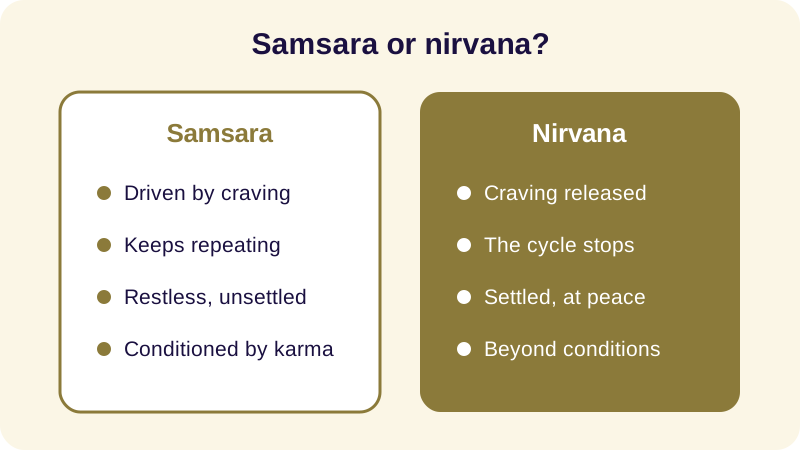
The route between the two is laid out in the Four Noble Truths: there is dissatisfaction, it has a cause, the cause can end, and there is a path that ends it — the Noble Eightfold Path. That path is not an extreme renunciation on one side or indulgence on the other but the Middle Way, a steady middle course of ethics, attention and understanding practiced over time rather than achieved in a single effort.
What does samsara have to do with a restless night?
A racing mind at bedtime is a small, fast version of the same pattern samsara describes at a larger scale: something arises, the mind grasps at it or pushes it away, that reaction sets up the next thought, and the cycle repeats without resolving anything. Recognizing the shape of the loop does not stop it instantly, but it does something useful — it turns "why can't I stop thinking about this" into "this is what craving and aversion do, and it is not a personal failing."
The teaching on impermanence fits naturally alongside this: every state in samsara, pleasant or unpleasant, is temporary, including the restless mood keeping you awake right now. That is not a promise about how quickly it will pass, only a reminder that it is not a fixed condition. A simple wind-down that touches the breath, the body and a few minutes of quiet reflection — along the lines described in our evening routine — gives the mind somewhere to rest besides the loop it has been running.
None of this is a cure for ongoing sleep trouble or anxiety, and persistent difficulty with either belongs with a doctor rather than with a teaching about rebirth. What the idea of samsara offers an ordinary restless night is perspective: the loop you are in has a shape, that shape has been described and worked with for a very long time, and it is not the same thing as a fact about tomorrow.
Frequently Asked Questions
What is samsara in Buddhism, in simple terms?
Samsara is the endless cycle of birth, death and rebirth that beings move through, driven by craving, aversion and not seeing clearly. It has no known beginning and does not end on its own. Buddhist practice aims at understanding what keeps it turning, so the turning can eventually stop.
Is samsara the same as reincarnation?
They overlap but are not identical. Reincarnation often implies a fixed soul moving from body to body. Samsara in Buddhism describes a stream of conditions continuing without a fixed, unchanging self being reborn, shaped by karma rather than by a soul.
What are the six realms of samsara?
Traditional teaching pictures six realms within samsara: gods, demigods, humans, animals, hungry ghosts and hell beings. None is permanent or final. A being moves between them according to karma, and even a pleasant realm eventually ends, which is part of why none is described as an escape.
How does someone get out of samsara?
The traditional answer is the Noble Eightfold Path, built on understanding the Four Noble Truths: seeing craving as the engine of the cycle and training the mind to loosen its grip. Nirvana is the name for what remains when that grip is fully released.
Does believing in samsara matter for an ordinary person trying to sleep better?
No belief is required. The teaching is useful even read as a description of the mind: thoughts and moods arising, driven by craving and aversion, cycling again. Seeing that pattern at night can take some of the urgency out of it without requiring any particular view on rebirth.