Published
Quick answer
The Buddhist story about the lotus flower describes the Buddha, soon after his awakening, picturing the world as a pond of lotuses at every stage of growth, from mud to open bloom. It is a canonical image of patience with wherever a mind currently stands.
Key takeaways
- The lotus pond scene comes from the Buddha's own account of deciding to teach after his awakening.
- Lotuses at different depths stand for people at different stages of readiness to understand.
- A lotus rises through mud and water yet opens clean above the surface, untouched by either.
- The image doesn't ask for mud to disappear first, only for patience with where things stand.
- At night it offers a reason to stop demanding instant calm from a busy mind.
The Buddhist story about the lotus flower tells how, soon after his awakening under the Bodhi tree, the Buddha surveyed the world and saw it as a great pond of lotuses in every stage of growth.
Some flowers were still under the mud, some were rising through the water, and some stood clear above the surface, entirely untouched by it. The scene sits in the oldest layer of Buddhist scripture, in the passage describing what the Buddha weighed up right after his enlightenment, before he had taught a single word. It is one of the most quoted images in the tradition, and one of the gentlest to sit with at the end of a long day.
What happens in the story of the lotus pond?
After his awakening, the Buddha is said to have hesitated. What he had seen went against the grain of ordinary craving and self-concern, and he doubted whether anyone caught up in those currents could follow him there. Looking out over the world with his awakened sight, he pictured it as a pond of lotuses rather than a crowd of people.
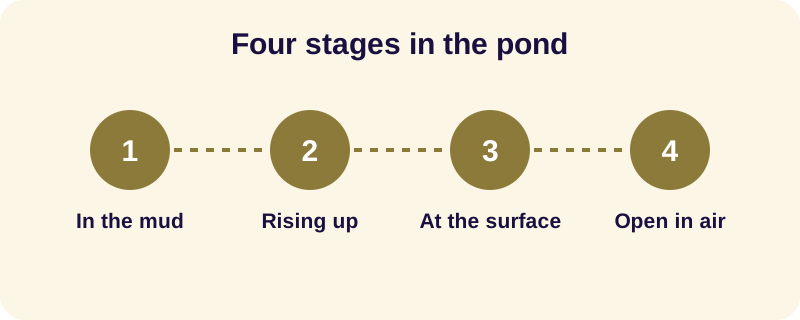
Some lotuses, he saw, were still deep in the mud and would stay there a long while. Some were lower in the water but climbing. Some had just about reached the surface. And some had already risen clear of the water and stood in open air, dry and unstained, even though the same water had raised them that far. Seeing beings arranged the same way, at every degree of readiness, he decided there would be some who could understand if he taught, and so he chose to speak. That choice led, soon after, to the first teaching he gave to his five former companions, and from there to everything that followed, including the Four Noble Truths and the Noble Eightfold Path that grew out of it.
See also: Buddhist Teaching on Compassion for Enemies.
Why does the lotus grow through mud instead of around it?
The detail that gives the story its staying power is not the bloom but the mud. A lotus does not grow in clean water set apart from the murk; its roots are in the thick, dark silt at the bottom of the pond, and the stem has to pass through all of that water on its way up. What opens at the top is unmarked by any of it. The flower is not proof that the mud was avoided. It is proof that something clean can rise directly out of what looks unpromising, without needing the conditions underneath to be tidy first.
This is also why the lotus sits so naturally beside other core teachings instead of standing apart from them. The Middle Way points to the same patience with conditions as they actually are, rather than as we wish they were, and the Five Precepts describe a gradual training rather than a finished state. None of these ask for a clear pond before the work begins.
How can this story help a restless mind at night?
Most nights that the mind won't settle, it isn't because something has gone wrong. It is because the day's leftover thoughts are still moving through, the way water keeps moving through a pond. Lying there waiting for that movement to stop before you can rest is a little like asking a lotus to wait until the pond is still and clear before it starts to grow. The story suggests a different order: the growing can happen while the water is still moving.
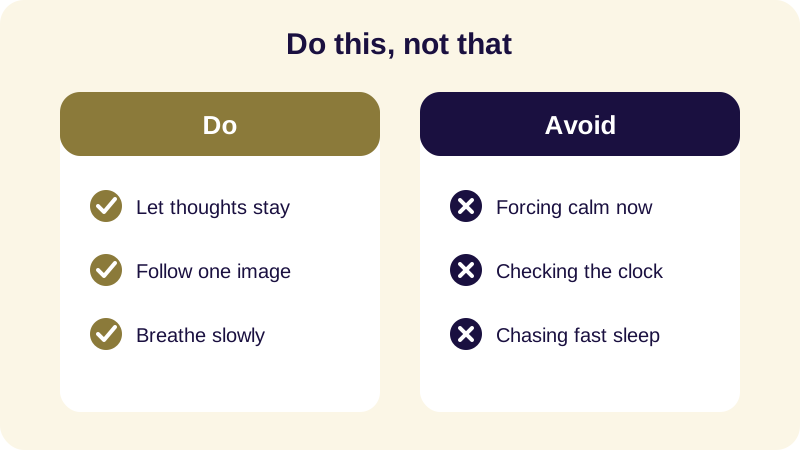
If you want to try this directly rather than only read about it, a short sitting practice works well alongside the story. Settle into a comfortable position, let the breath be as it is without adjusting it, and notice thoughts arriving the way water moves through a pond — present, but not something you have to chase or shut out. This pairs naturally with the longer list of Buddhist stories for sleep, which gathers other narratives built the same way: a single slow scene to follow instead of the day's unfinished business.
What does the lotus mean elsewhere in Buddhism?
The lotus shows up well beyond this one scene. Images of the Buddha are often shown seated on a lotus, and the flower appears across Buddhist art and teaching as a recurring sign of something clean emerging from difficult ground, without denying that the ground was difficult. That broader symbolism, along with other common Buddhist images and what each one points to, is covered in our guide to Buddhist symbols and their meanings. The episode under the Bodhi tree that leads into the lotus pond scene is told in full in our account of the Buddha's enlightenment story.
How does the Buddha Story app use stories like this?
The app narrates episodes from the Buddha's life, including the period around his awakening that this story belongs to, alongside Jataka tales, Dhammapada verses and Zen parables, all read slowly for listening at night rather than in passing. A sleep timer stops the story and sounds for you instead of letting them run on, and the stories can be layered with rain, ocean waves or singing bowls, or played alongside guided meditation for loving-kindness, body scan or breath awareness. Everything downloads for offline listening and keeps playing in the background once the screen is locked, so nothing depends on staying awake enough to keep tapping a phone.
None of this promises a fast or guaranteed sleep, and a mind that stays restless night after night is worth discussing with a doctor rather than left to a story alone. What the lotus pond offers is smaller and more ordinary than a cure: a reason to stop treating a busy mind as a problem to fix before rest can begin, and to let it rise through the evening's noise at its own pace, the way every lotus in that pond eventually did.
Frequently Asked Questions
Is the lotus flower story actually Buddhist, unlike the two wolves tale?
Yes. Unlike the Two Wolves story, the lotus pond image comes from the Buddha's own account of the time after his awakening, when he weighed whether to teach. It is a genuine early teaching, not a later folk tale attached to his name.
What do the different lotus stages in the story represent?
Each stage stands for a different degree of readiness to understand. Some lotuses are still deep in the mud, some are rising through the water, some are near the surface, and some have opened clear above it, representing people at every point along the path.
Why did seeing the lotus pond change the Buddha's mind about teaching?
He had doubted whether what he had realised could be understood by minds caught up in craving and distraction. Seeing beings at every stage of readiness, the way lotuses stand at every stage of growth, showed him that some would understand if given the chance, so he decided to teach.
Does the lotus pond story appear in the Jataka tales?
No. The lotus pond scene belongs to the account of the time just after the Buddha's enlightenment, not to the Jataka tales of his earlier lives. It sits alongside other episodes from his life story rather than among the 547 Jataka tales.