Published
Quick answer
The story of the Buddha enlightenment tells how Siddhartha Gautama sat beneath the Bodhi tree, faced Mara's temptations through the night, and awakened at dawn to the Four Noble Truths.
Key takeaways
- Siddhartha Gautama awakened after a night of meditation under the Bodhi tree.
- The night unfolded in three watches, each revealing a deeper insight.
- Mara's temptations stand for the mind's own fear, desire and doubt.
- The Buddha met every test by staying seated and touching the earth.
- The story models staying still through a restless night rather than fighting it.
The story of the Buddha enlightenment is the account of one night under the Bodhi tree when Siddhartha Gautama moved from a searching ascetic to an awakened teacher. It describes what he faced in the dark, what he saw at dawn, and why the scene still matters to a restless mind today.
By the time he sat down that evening, he had already tried the opposite extremes of luxury and self-denial and found neither one gave him an answer. He chose a spot beneath a large tree beside a river, arranged grass into a seat, and made one quiet resolve: he would not rise until he understood the cause of suffering and the way out of it.
What happened the night the Buddha became enlightened?
He sat facing the rising sun, legs crossed, back straight, and let his attention settle. The traditional accounts divide the night into three watches, each one going deeper than the last, as his mind grew steady enough to look clearly at what it usually looks away from.
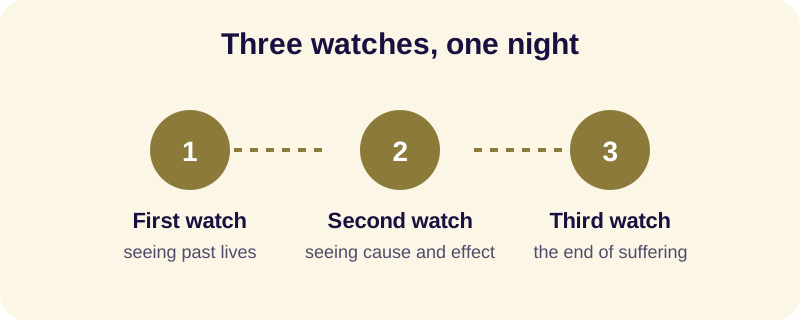
In the first watch, he is said to have recalled countless earlier lives, seeing how one existence had followed another without a fixed, separate self running through them. In the second, he saw how beings rise and pass according to their actions, the pattern later unfolded as karma and as dependent origination — nothing arising on its own, everything conditioned by what came before it. In the third watch, as the sky began to lighten, he saw the nature of suffering itself clearly enough that it stopped gripping him, an insight later taught as the Four Noble Truths.
Who was Mara and what did he try to do?
Before the stillness of the third watch, the story places a struggle. Mara, a tempter figure who appears throughout Buddhist mythology, arrives to stop Siddhartha from finishing what he started. Mara is usually read less as an external demon and more as everything in a mind that resists sitting still: fear, craving, doubt, pride, the pull of easier things to do instead.
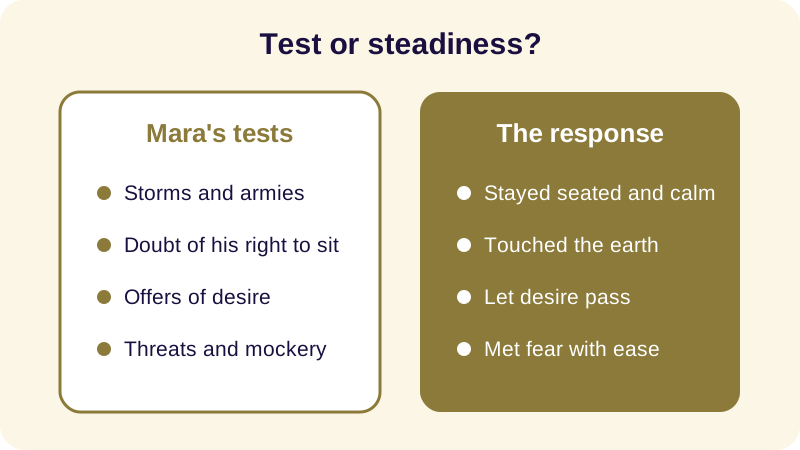
Mara sends storms and armies to frighten Siddhartha away, then questions his right to sit in that seat at all. Siddhartha responds not with an argument but with a gesture: he touches the ground with one hand, calling the earth itself to witness his years of effort. The earth is said to tremble in confirmation, and the armies disperse. When force fails, Mara tries desire instead, sending his daughters to distract him — again Siddhartha simply continues to sit, unmoved by either threat or temptation.
What did the Buddha actually realize under the Bodhi tree?
What arrives in the third watch is not a vision or a voice but a clear seeing of how experience is put together. Suffering has a cause, that cause can be traced, and because it can be traced it can also be undone — this becomes the Four Noble Truths, and the path out of suffering becomes the Noble Eightfold Path. None of it depends on belief; it is described as something seen directly, the way you see that a fire needs fuel once you have watched a few fires burn out.
This is also where the Middle Way becomes visible as more than an idea. Neither indulgence nor harsh denial had given Siddhartha what steady, balanced effort gave him in one night of sitting. The Middle Way he had wrestled with for years as a principle turns out, in the story, to be the exact condition his mind needed to see clearly at all.
What can this story offer a restless mind at night?
Most nights do not bring storms or armies, but they do bring something that rhymes with Mara: a worry that will not settle, a temptation to get up and do one more thing, a flicker of doubt about whether rest is even possible tonight. The story does not promise those won't arrive. It offers a different relationship to them — stay seated, let the wave move through, and notice it passes whether or not you fight it.
That is a gentler instruction than most advice about a racing mind, which often pushes you to solve or silence the thought. Here the suggestion is closer to what is described in guidance on a racing mind at night: let the thought be a visitor rather than an opponent, and it tends to lose its grip on its own.
How does Buddha Story bring this night to life for sleep?
The app narrates this story slowly, alongside the wider collection it is drawn from — the Jataka tales of the Buddha's earlier lives, Dhammapada verses, and other Buddhist stories for sleep — so the three watches of the night can unfold at the pace a tired mind actually needs, rather than the pace of a lesson.
- Narrated slowly, built for listening in the dark rather than for study.
- Sleep timer that stops the story for you, so you never reach for the phone.
- Sound mixer to layer quiet rain or singing bowls underneath the voice.
- Offline mode and background playback so the story keeps going once the screen is dark.
You do not need to believe anything in particular to let this story do its work. It asks only one thing of the listener, the same thing it asked of Siddhartha under the tree: stay, and let the night pass through you rather than around you.
Frequently Asked Questions
What is the story of the Buddha's enlightenment?
It is the account of the night Siddhartha Gautama sat beneath the Bodhi tree, resolved not to move until he understood suffering and its end. Through the night he faced inner resistance, often pictured as Mara, and at dawn arrived at the insight that became the Four Noble Truths.
Who was Mara in the Buddha's enlightenment story?
Mara is the figure who tries to stop the Buddha from awakening, embodying fear, desire, doubt and attachment. In the story he sends storms, armies and temptations; the Buddha meets each one by staying seated and touching the earth as witness, rather than by fighting back.
What did the Buddha realize under the Bodhi tree?
Traditional accounts describe him seeing the chain of cause and effect behind suffering, known as dependent origination, and arriving at the Four Noble Truths: that suffering exists, has a cause, can end, and that a path leads to its end.
Is the Buddha's enlightenment story only for Buddhists?
No. It is told here as a plain narrative about facing fear and restlessness with steadiness rather than resistance. Anyone drawn to a calmer night, Buddhist or not, can find the same image useful: sitting through discomfort instead of fleeing it.