Published · Updated
Quick answer
The buddhist story about the poisoned arrow tells of a man refusing treatment until he knows who shot him, naming the arrow, the bow and more. The Buddha used it to show that practice matters more than answering every speculative question.
Key takeaways
- The parable: a wounded man delays treatment by demanding to know every detail about the arrow and the archer first.
- The Buddha told it to a monk who refused to keep practicing until unanswerable questions were settled.
- The lesson: some questions can wait; easing suffering now matters more than resolving every debate.
- At night, it supports setting aside unsolvable worries instead of turning them over again and again.
The buddhist story about the poisoned arrow is the Buddha's answer to a monk who refused to keep practicing until his hardest metaphysical questions were settled. It is one of the clearest teachings in the Pali Canon on why some questions are better set aside than solved.
What is the buddhist story about the poisoned arrow?
A monk comes to the Buddha and says he will stop following the practice unless the Buddha first answers a list of hard questions: whether the world is eternal or not, whether it is finite or infinite, whether the self and the body are the same thing, and what happens to a person after death. The Buddha does not answer any of them directly.
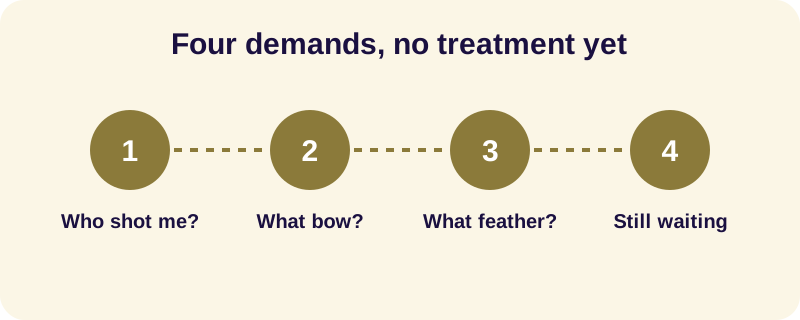
Instead the Buddha tells a story. A man is struck by an arrow coated in poison. His family rushes a surgeon to him, but the man refuses to let the arrow be pulled out. First, he says, he must know who shot him — the archer's name, clan and caste. Then he must know what kind of bow was used, what the bowstring was made of, what wood the shaft was cut from, and what kind of feather was bound to it. He insists on an answer to every detail before he will allow any treatment at all.
The Buddha's point is blunt: the man would die of the poison long before any of that was settled. Chasing those details might satisfy him about the shooting, but it does nothing for the wound. In the same way, the Buddha said, a life spent demanding answers to questions like whether the world is eternal will end before those questions are resolved — and none of them, resolved or not, touches the actual task at hand, which is removing the arrow of suffering already lodged in a person.
What does the parable of the poisoned arrow actually teach?
The parable of the poisoned arrow is not an argument against curiosity. It is a statement about priority: some questions can be studied for a lifetime without changing how much a person suffers, and others — what is causing this pain, and what actually eases it — can be worked with directly, starting now.
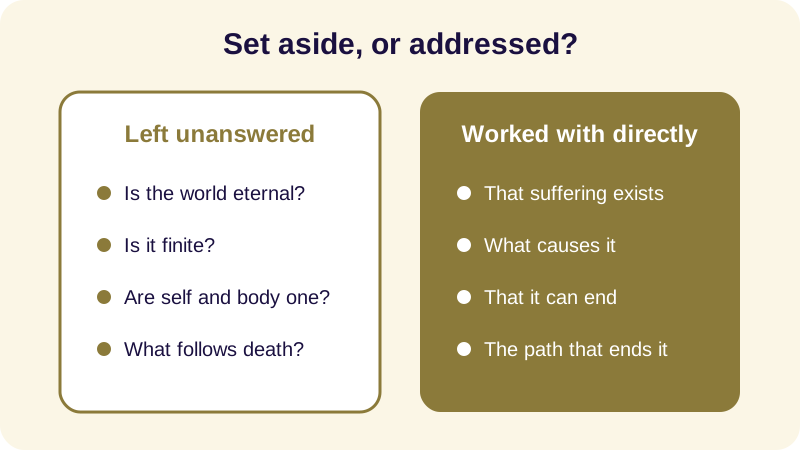
This is why the Buddha tied the parable to the Four Noble Truths and the Noble Eightfold Path. He described his teaching as addressing only a handful of things: that there is suffering, that it has a cause, that it can end, and that there is a path to end it. Everything else, in his own comparison, was like a forest of leaves he could have picked up and discussed but chose to leave on the ground, because a handful was already enough to point the way out of the forest.
That practical focus is also at the heart of the Middle Way — not an answer to every extreme question about existence, but a path that works whether or not those questions are ever settled. The same spirit shows up in the Five Precepts: simple, workable commitments rather than a philosophy to argue about first.
Is this the same as the second arrow teaching?
No, though the two are often confused because they share the same image. The poisoned arrow parable is about speculative questions getting in the way of practice. A separate teaching, usually called the second arrow, is about how reacting to pain with resistance and story adds an extra layer of suffering on top of the first one. They point at different problems, and the second teaching has more to say about a racing, worried mind that keeps adding commentary to an ordinary bad moment.
See also: The Buddhist Story About the Lotus Flower Explained.
Put together, the two teachings cover a lot of what keeps a mind busy at night: unanswerable questions pulled from the past or the far future, and the running commentary added to whatever is happening right now. Neither teaching asks you to stop thinking altogether. Both simply point out which thoughts are carrying weight and which ones are just more arrows.
How can this story help a racing mind at night?
Lying awake, the mind often behaves like the man with the arrow. It refuses to rest until every open question is settled — tomorrow's conversation, an old regret, a worry with no new information attached to it. The parable is a quiet permission slip to let some of those questions wait until morning, because turning them over again right now will not supply the missing facts.
Practically, this can look like naming the question once — "I'm worried about tomorrow's conversation" — and then deliberately setting it down, the way the Buddha set aside questions about the eternity of the world. Simple anchors give the attention somewhere else to go instead of straight back into the question: a loving-kindness phrase repeated slowly, a few rounds of counted breath, or a short routine for a racing mind built for exactly this moment.
Where can I hear more stories like this one?
The parable above is a short example of a method the tradition uses constantly: teaching through story rather than lecture. The Jataka tales work the same way, folding a lesson about patience or generosity into a short narrative instead of a list of instructions, and they sit well alongside this one for an evening of quiet listening.
The app narrates stories like this — Jataka tales, episodes from the life of the Buddha, Dhammapada verses and Zen parables — slowly, for listening in the dark rather than reading in daylight. A sleep timer stops the narration for you once you have drifted off, and offline listening with background playback mean the story keeps going even if the phone is locked or the signal drops for the night.
None of this is a cure for a sleepless night that keeps happening, week after week — that is a question worth bringing to a doctor, not a parable. But for the ordinary restless evening, the man and his arrow offer a simple, almost physical image: put the question down, and let whatever is actually in front of you — the breath, the body, the next few minutes — get the attention instead.
Frequently Asked Questions
What is the buddhist story about the poisoned arrow?
It is a parable the Buddha told a monk who refused to practice until his hardest questions were answered. A man struck by a poisoned arrow insists on knowing who shot him and what the bow was made of before letting a surgeon treat him, and dies before getting his answers.
What is the meaning of the poisoned arrow parable?
It means some questions, however interesting, do not change how much a person suffers or help remove the cause of that suffering. The Buddha used it to redirect attention from speculation toward the practical task of understanding and easing present suffering.
Is the poisoned arrow the same as the second arrow teaching?
No. The poisoned arrow is about speculative questions delaying practice. The second arrow is a separate teaching about how reacting to pain with resistance adds extra suffering on top of the original pain. They share an image but make different points.
Why is this story useful at bedtime?
A racing mind at night often behaves like the man with the arrow, refusing to settle until every open question is answered. The story offers a gentle reminder that some questions can be set down for the night without being solved first.