Published
Quick answer
This buddhist story about simplicity and contentment retells how Siddhartha Gautama gave up palace luxury and harsh fasting for a simple bowl and robe, finding peace in having enough rather than more.
Key takeaways
- The Buddha rejected both palace luxury and harsh deprivation before settling on simple enough
- Contentment grows from needing less, not from acquiring more
- The Middle Way sits between excess and self-denial, favouring sufficiency
- A short evening pause can borrow the same simple-enough mindset before sleep
- Simplicity is not about owning nothing, but about not being ruled by wanting
This buddhist story about simplicity and contentment comes straight from the life of the Buddha: the night he traded a palace of comforts for a single bowl and robe, and found that peace, not more things, was what he had been missing.
The story matters at night because so much bedtime restlessness is really a quiet case of wanting more — one more scroll, one more thing fixed, one more hour squeezed out of the day. A prince who already had everything he could want, and still found no peace in it, has something useful to say to an ordinary evening mind that keeps reaching for just one more thing before it can rest.
What is the Buddhist story about simplicity and contentment?
Before he became known as the Buddha, Siddhartha Gautama was raised inside a palace built specifically to give him every comfort and to keep every hardship out. Music, food, beautiful surroundings — nothing was withheld. By most measures, he had enough and more. Yet the stories agree that none of it settled him, and that some restlessness in him kept asking whether comfort itself was the answer.
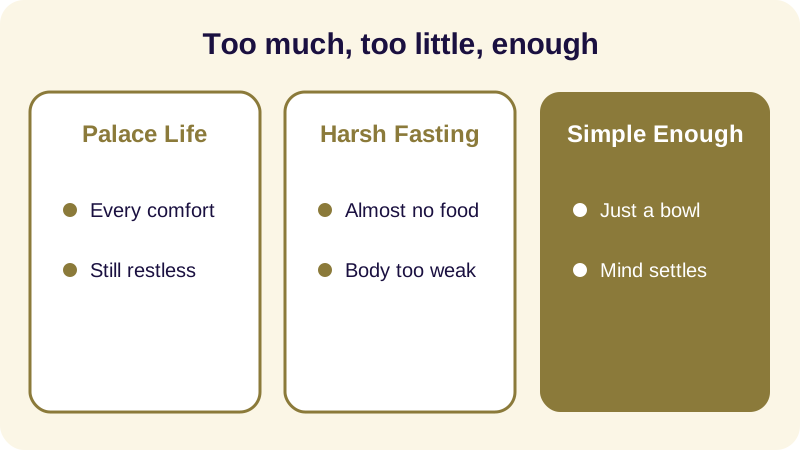
So he left the palace and went to the other extreme. For years he practised severe fasting alongside other ascetics, eating almost nothing, believing that denying the body enough would free the mind. It made him weak, not clear. The story says he accepted a simple bowl of food from a passing stranger, and in doing so quietly admitted that starving himself had been its own kind of excess — just pointed in the opposite direction from the palace he had left behind.
What he sat down with that evening, under the Bodhi tree, was almost nothing: a borrowed seat of grass, a bowl, a robe, and his own attention. No palace, no self-punishment. Just enough to stay alive and alert. The tradition remembers this rejection of both extremes as the Middle Way — not a compromise, but a recognition that neither more nor less was ever really the point. Contentment, in this story, is not about the amount owned. It is about no longer needing the amount to change before the mind can rest, and that shift is really the whole turn of the story.
Why does owning less bring contentment?
It is worth asking why a story about giving things up counts as good news rather than loss. The ordinary assumption is that contentment follows once enough has been acquired — the right house, the finished project, the cleared inbox. The Buddha's story runs the other way: he had already acquired everything available to a prince, and contentment still did not arrive. It arrived only once the wanting itself slowed down, which is a harder thing to arrange than simply getting more.
See also: Buddhist Story About a King and a Beggar.
A mind that is always reaching for one more thing is a mind that treats the present moment as unfinished. That habit does not stop at the bedroom door. Lying down at night, the same reaching shows up as replaying the day, rehearsing tomorrow, or scrolling for something slightly better than silence. The Dhammapada, a collection of 423 verses attached to stories much like this one, returns again and again to the idea that an unsettled mind is rarely short of possessions — it is short of a reason to stop reaching, and that reason has to come from inside rather than from acquiring anything further.
This is also where the story connects to practice rather than biography alone. Learning to name what is already sufficient — this bed, this breath, this quiet room — is close to what meditation trains directly: attention resting on what is present instead of running ahead to what is missing. The same noticing that settled a prince under a tree can, on a much smaller scale, settle an ordinary evening.
How can I bring this simplicity into my evening?
You do not need a Bodhi tree or a change of robes to borrow the shape of this story. A small, deliberate pause before bed can do something similar on an ordinary night — naming what is enough, instead of reviewing what still isn't, and letting that be the last thought of the day rather than a fresh list of wants.
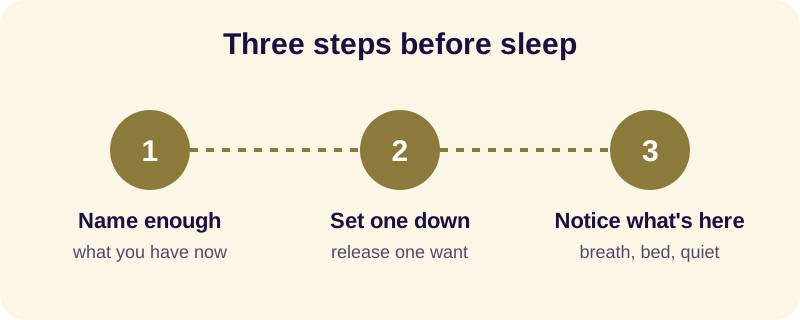
- Name what's already enough. Before turning off the light, say plainly, even silently, what today already provided — not what's missing from it.
- Set one want down. Pick the single thing your mind keeps circling back to fix or finish, and put it down for the night. It will still be there tomorrow.
- Notice what's already present. The breath, the weight of the blanket, the quiet of the room — simple, available, and requiring nothing further from you.
This is close in spirit to a Buddhist evening routine built around winding down rather than winning the day. None of it promises instant sleep, and it is not a substitute for addressing ongoing sleep or anxiety difficulties with a doctor — it is simply a small, repeatable way of practising the same "enough" the Buddha found under the Bodhi tree. Practised over many nights rather than once, it becomes less of an idea you remember and more of a habit the mind falls into on its own.
If you would rather have the story narrated to you than reread it, the app brings together the life of the Buddha alongside Jataka tales — the 547 traditional birth stories — and verses from the Dhammapada, with a sleep timer that pauses the story and sounds for you rather than fading them out, so you are not left reaching for your phone at the end of the night to turn anything off yourself.
Frequently Asked Questions
What is the Buddhist story about simplicity and contentment?
It is the account of Siddhartha Gautama leaving a palace of comforts, then trying years of harsh fasting, and finding that neither extreme settled his mind. Sitting under the Bodhi tree with only a bowl and robe, he found that having enough, held lightly, was itself a kind of peace.
Is this story actually from Buddhist tradition?
Yes. It comes from the traditional life of the Buddha, the same narrative that gives rise to the Middle Way and the Dhammapada's verses on contentment. This separates it from popular tales like the Two Wolves or Sai Weng's horse, which circulate widely but are not Buddhist in origin.
Does Buddhist simplicity mean giving away everything I own?
No. The story is not an argument for owning nothing, but for noticing how much restlessness comes from always wanting one thing more. Most people can practise the same idea by choosing, on any given evening, what is already enough rather than adding to it.
How can this story actually help me sleep?
Night-time restlessness is often a quiet form of wanting — one more task, one more fix, one more thing checked. Recalling that the Buddha found peace in having less, rather than more, gives the mind a gentler story to settle into than its usual list of unfinished wants.
What should I do if restlessness at night is a persistent problem?
A single calming story is not a treatment for ongoing sleep or mental health difficulties. If worry or sleeplessness is frequent and affecting your days, it is worth speaking with a doctor; a story like this is meant for an ordinary restless evening, not a lasting condition.