Published
Quick answer
This Buddhist story about anger management tells of the Buddha declining an angry man's insults, as if refusing an unwanted gift, so the anger stays with the man who offered it. The point for a restless night is the same: you don't have to accept every angry thought that shows up.
Key takeaways
- The Buddha's reply to insult: refuse it, and it stays with whoever offered it.
- A classic image compares holding anger to picking up a burning coal — it burns you first.
- Noticing anger without acting on it is a practice, not suppression.
- A short pause before reacting can keep anger from following you into sleep.
- Loving-kindness practice is the traditional antidote offered alongside these stories.
A Buddhist story about anger management tells of the Buddha facing a furious, insulting stranger and simply declining to accept the insults, as if they were a gift he chose not to open. The man walked away still holding his own anger, because the Buddha never picked it up.
What is the story, exactly?
A man came to where the Buddha was teaching and began shouting abuse at him — insults, accusations, curses, the kind of tirade meant to provoke a reaction. The Buddha listened without answering. When the man finally ran out of breath, the Buddha asked him a quiet question: if you offer someone a gift and they do not accept it, who does the gift belong to? The man said it would still belong to him. The Buddha said that was exactly what had happened with the insults. He had not accepted them, so they remained the man's own.
See also: Buddhist Teaching on Compassion for Enemies.
That is the whole story. There is no dramatic confrontation, no clever comeback, no victory lap. The Buddha's only action is to not take something that was being handed to him. The man leaves carrying the same anger he arrived with, because nobody took it off his hands.
Why did the Buddha refuse the insult?
The refusal is not coldness or avoidance. It is a recognition that reacting to anger with anger just keeps the anger moving between two people, growing as it goes. If the Buddha had argued back, defended himself, or returned an insult of his own, the exchange would have continued — and both of them would have gone home more agitated than before. By declining to pick it up, he ended it on the spot.
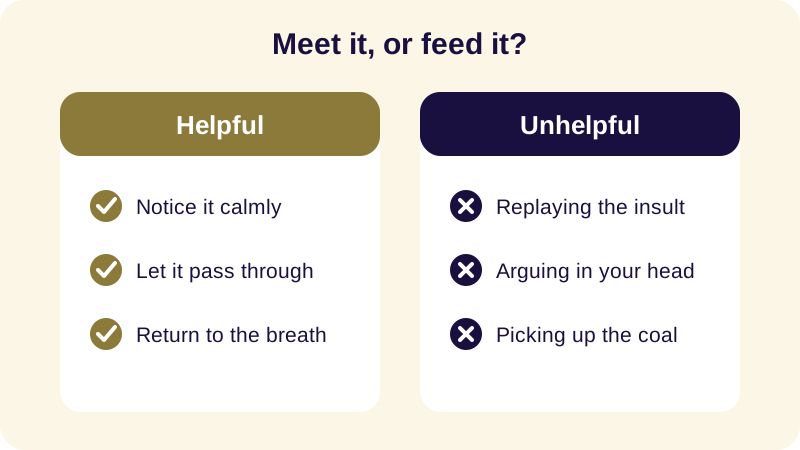
This is the same logic behind the well-known line from the Dhammapada: hatred is never settled by more hatred, only by its absence. You can read that verse and the short story behind it in our piece on the Dhammapada twin verses. The idea in both places is the same — adding anger to anger only increases the total amount of anger in the room.
What does the burning coal story teach about anger?
A second image, often paired with the first, makes the same point in physical terms. Holding on to anger in order to throw it at someone has been compared to picking up a burning coal with your bare hand — you are the one who gets burned, well before the coal ever reaches the other person. The damage happens in your own hand first.
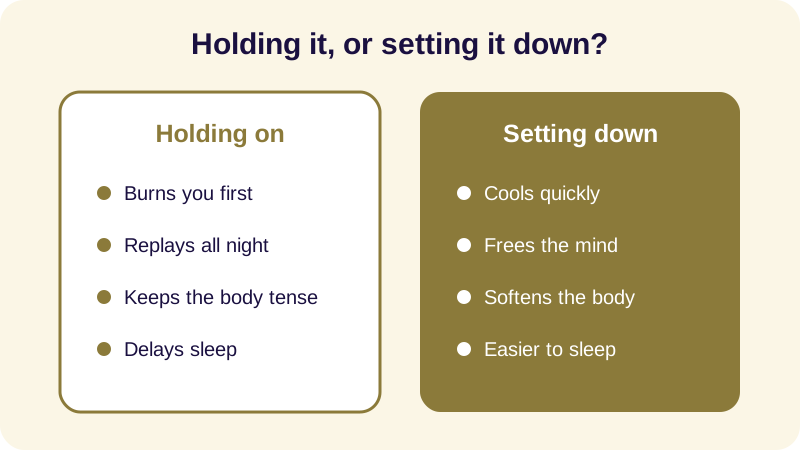
Both stories point at the same mechanism. Anger is not dangerous because someone else is angry at you — it is dangerous because of what you then do with it inside your own head. Carrying an insult into bed, rehearsing a better comeback, drafting the argument you wish you'd won: all of that is picking the coal back up, hours after the person who threw it has gone home and gone to sleep.
How can I use this story when anger keeps me awake?
The story gives you a simple question to ask a racing mind at night: is this mine to carry, or can I decline it? That question does not erase the anger, but it interrupts the automatic habit of picking it up again and again.
- Name what's happening. Notice that the mind is replaying an argument or an insult, without judging yourself for it.
- Ask the Buddha's question. If this were a gift, would you accept it right now, in bed, at this hour? Often the honest answer is no.
- Feel where it sits in the body. Anger usually has a physical home — jaw, chest, stomach. Notice it rather than only thinking about the story behind it.
- Soften on the exhale. A few slow breaths, letting the body loosen slightly with each one out, gives the coal somewhere to cool.
- Offer a quiet goodwill phrase. Even a plain "may this settle" or "may we both be at ease" shifts the mind away from rehearsal and toward rest.
That last step draws on a practice much older than this story. Metta, or loving-kindness, is the traditional counterweight to anger in Buddhist teaching — not because it denies the anger, but because it gives the mind something warmer to do instead of replaying the grievance. You can find a full version of this practice in our guide to metta meditation for sleep.
What else does Buddhism say about anger?
Anger sits at the center of several core teachings, not as something to be ashamed of but as something to understand. It is addressed directly in the four brahmaviharas, the four qualities of loving-kindness, compassion, shared joy and equanimity, each of which is described as a direct response to a particular kind of difficult state — anger's traditional opposite being loving-kindness. It is also touched by the five precepts, the everyday ethical guidelines that ask practitioners to pause before acting on harmful impulses, anger included.
Jataka tales — stories of the Buddha's earlier lives — often dramatize this same choice between retaliation and restraint, usually with an animal standing in for the hot-headed character who has to decide whether to strike back. A few of those are retold in our Jataka tales retold collection, if you want more stories built around the same question.
Anger that flares up with a worried or anxious edge — the kind that keeps circling the same unresolved scene — often responds to the same approach used for anxious thoughts at night. Our guide to Buddhism and anxiety covers that overlap in more detail, including the idea of not adding a "second arrow" of self-criticism on top of the first feeling.
None of this asks you to pretend the anger wasn't justified, or that the other person was right. The Buddha in the story does not say the man's words were fair. He simply does not accept them as something to carry forward. That is the small, repeatable act this story offers a restless mind at night: noticing the gift being offered, and quietly, without drama, declining to take it home.
Frequently Asked Questions
What is the Buddhist story about anger management called?
It has no single official title, but it is often told as 'the Buddha and the angry man' or 'the gift not accepted.' A stranger hurls insults at the Buddha, who calmly declines them, comparing an unaccepted insult to a gift the giver must keep for himself.
What is the moral of the Buddhist anger story?
You choose whether to accept an insult or an angry thought. If you don't pick it up, it has nowhere to land and stays with whoever offered it. The moral applies as much to a racing mind at night as to a real argument.
Does Buddhism say anger is wrong to feel?
No. The teaching is not about denying anger but about not feeding it with replayed arguments or imagined retaliation. Noticing the feeling, naming it, and letting it move through without acting on it is the practice, not pretending it isn't there.
What if my anger feels too strong to manage this way?
These stories are a calming frame for an ordinary restless evening, not a treatment. If anger feels constant, overwhelming, or is harming your relationships or sleep over time, it's worth talking to a doctor or counselor rather than relying on a story alone.
