Published
Quick answer
The Buddhist teaching on compassion for enemies asks you to keep loving-kindness alive toward someone who wronged you, without excusing harm or returning to unsafe contact.
Key takeaways
- Compassion for an enemy means guarding your own mind, not approving what they did.
- The four brahmaviharas and parable of the saw both point toward loving-kindness without limits.
- You can keep firm boundaries and end contact while still practicing goodwill in a general sense.
- Metta meditation widens step by step, placing a difficult person before the widest circle.
- Some nights only naming the anger is possible, and that still counts as practice.
The Buddhist teaching on compassion for enemies is simple to state and hard to live: keep loving-kindness (metta) turned on, even toward the person who wronged you, without pretending the wrong did not happen. It does not ask you to trust them again or to stay in harm's way; it asks only that your own mind not harden into hatred.
This teaching shows up again and again in the Pali Canon under different names — the four brahmaviharas, the parable of the saw, verses in the Dhammapada — because the problem it addresses is ordinary and recurring. Minds replay a wrong at odd hours, rehearsing arguments nobody is having anymore, and the teaching is less a moral demand than a practical way to stop that loop.
Why does Buddhism ask for compassion toward someone who hurt you?
The four brahmaviharas — loving-kindness, compassion, sympathetic joy and equanimity — are traditionally described as having no edges. They are not meant to run out when they reach an inconvenient person. Metta meditation is usually taught as a sequence that widens on purpose, starting with yourself and moving outward until it includes people you find difficult, precisely because the easy part is loving people you already love.
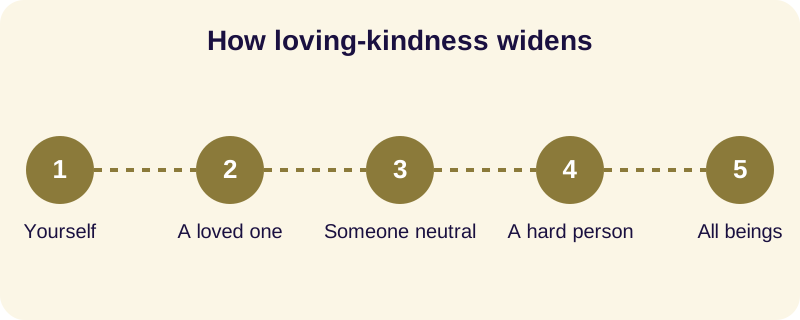
Placed this way, the sequence does something practical: it builds the capacity on easy ground first. By the time the practice reaches a person who has actually harmed you, there is already some steadiness to draw on, instead of starting cold with the hardest case.
What is the parable of the saw?
One of the sharpest versions of this teaching describes bandits seizing a traveler and sawing off their limbs with a two-handled saw, and the Buddha saying that even there, a disciple should not let the mind turn to ill will. It is a deliberately extreme image. The point is not that this is an expected daily standard; it is that it marks the direction of training so clearly that smaller provocations look manageable by comparison.
Read this way, the parable is not instruction about what to tolerate from other people. It is a description of what you train your own mind to do regardless of what others do. That distinction matters, because it separates the pain someone causes from the extra suffering added by a mind that keeps swinging between replaying the injury and plotting a response — the same distinction explored in the story of the second arrow.
See also: Buddhist Story About the Burning House Explained.
Does compassion for an enemy mean I have to forgive or stay close to them?
No, and this is where the teaching is most often misread. Compassion here is a description of your own mind, not a verdict on someone else's behavior, and not a requirement to trust them again. You can hold a clear, even public judgment that what someone did was wrong, keep firm boundaries, end contact permanently, and still practice wishing them freedom from suffering in the general sense the brahmaviharas intend. These are not contradictions; they sit side by side.
This is closer to the Middle Way than it looks at first: neither suppressing anger and performing forgiveness you do not feel, nor feeding the anger and letting it run your decisions. The practice sits between those two extremes, and it is worth comparing with the related teaching on forgiveness of others, which covers the same ground from a different angle.
How can I actually practice this before bed?
The practice itself is plain and short enough to do lying down. It is a version of ordinary metta meditation, aimed at one particular person instead of people in general.
- Name the anger honestly for a moment, instead of skipping past it — pretending calm you do not feel tends to backfire later.
- Begin the phrases with yourself: may I be free from suffering, may I be at ease.
- Move to someone you love easily, repeating the same phrases for them.
- Bring to mind someone neutral — a cashier, a neighbor you barely know — and offer the same wish.
- Only then approach the difficult person, keeping the phrases general: may you be free from suffering, not a review of what happened.
- Stop there. You do not need to reach warmth in one sitting, or ever.
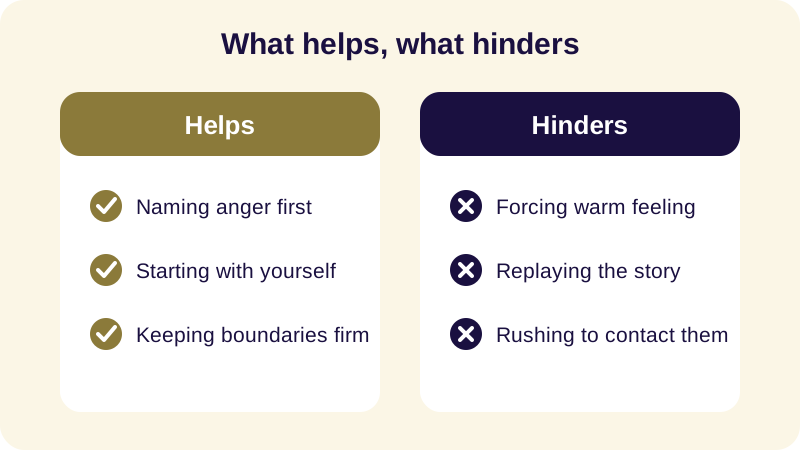
Some nights the mind will not move past step one, and naming the anger is as far as it gets. That is not a failed attempt at the practice; it is the practice. Verses on anger and letting go in the Dhammapada return to this same point often: the work is on your own mind, and it can be picked up again tomorrow night exactly where it left off.
Where this fits into an evening practice
Compassion for someone who has wronged you is rarely the first practice anyone tries, and it does not need to be. It tends to make more sense after some ordinary familiarity with metta aimed at easier people, and with stories that model the same movement — a Buddhist story about anger can show the shape of the practice before you attempt it yourself, which is often easier than starting from an instruction alone.
The Buddha Story app narrates teachings and stories in this vein — Jataka tales, episodes from the Buddha's life, Dhammapada verses — alongside guided meditation for loving-kindness, body scan and breath awareness, and a sleep timer that stops the story for you rather than fading it out. None of it is a substitute for working through a specific grievance with a person qualified to help; it is simply somewhere to let the mind rest once the harder thinking is done for the night.
Frequently Asked Questions
What does Buddhism teach about compassion for enemies?
It teaches that loving-kindness (metta) should not stop at people you like. The four brahmaviharas and the parable of the saw both point the same way: keep your own mind free of hatred, even toward someone who has wronged you, without pretending the wrong did not happen.
Does compassion for an enemy mean forgiving or excusing what they did?
No. Compassion is about your own mind, not a verdict on their behavior. You can wish someone well in a general sense while still naming what they did as wrong, keeping firm boundaries, and never returning to contact that is unsafe.
What is the parable of the saw?
It is a teaching in which the Buddha describes bandits sawing off a person's limbs, and says that even then, the mind should not turn to ill will. It is an extreme image meant to show the direction of training, not a literal standard to meet immediately.
How do I practice loving-kindness for someone who hurt me?
Start with yourself, then a person you love easily, then someone neutral, before approaching the difficult person. Use short phrases like 'may you be free from suffering' at a pace that feels tolerable, and stop if the practice starts to feel forced.