Published
Quick answer
An app for zen parables narrated aloud plays short Zen koans and stories read slowly aloud, so you can listen instead of read before sleep. Buddha Story includes Zen parables alongside Jataka tales and Dhammapada verses, with offline listening and a sleep timer.
Key takeaways
- A narrated zen parable needs only your ears, not a lit screen, before sleep.
- Short parables like the empty cup or broken bowl work better at night than long tales.
- A sleep timer keeps narration from playing on after you doze off.
- Offline listening and background playback matter more at night than a huge catalogue.
- Zen koans are meant to interrupt thinking, not to be solved before bed.
An app for zen parables narrated aloud lets you listen to short Zen stories read slowly in the dark, instead of squinting at a lit screen trying to make sense of them yourself. Buddha Story narrates Zen parables alongside Jataka tales, the life of the Buddha and Dhammapada verses, with a sleep timer that stops the story for you once you drift off.
Zen parables are built to be short, and that is deliberate. A monk is asked a plain question and gives an answer that seems to miss the point entirely; a teacup overflows while a guest keeps talking; two monks argue over whether a flag or the wind is moving. These are small, odd stories, meant to interrupt ordinary thinking rather than explain anything, and that is part of why they sit so well in the ear at the end of a long day, when explanations are the last thing a tired mind wants.
What makes narrated Zen parables different from reading them?
Reading a koan on a phone keeps the analytical mind switched on: you parse the sentence, wonder what it is really asking, maybe look for a commentary. A narrated zen parables app removes that loop. A voice sets the pace for you, so the listening mind has far less work to do than the reading mind, which is exactly what a restless evening needs.
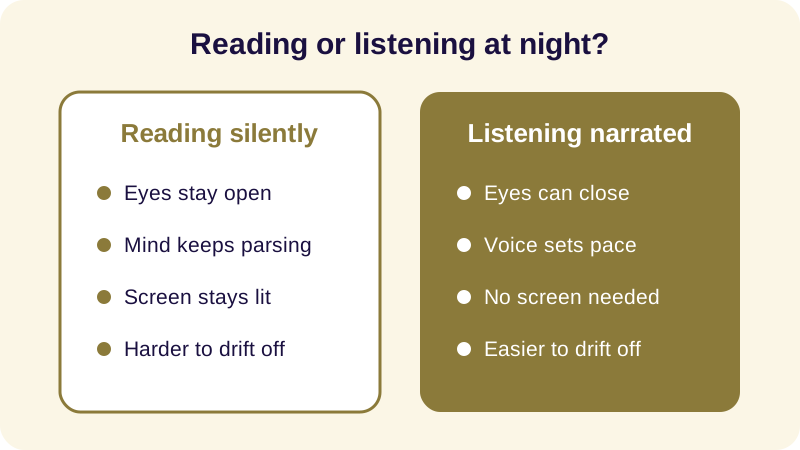
This matters most right before sleep, when the mind is already tired of deciding things. Hearing the parable read aloud, slowly, with no requirement to respond or interpret, lets you treat it the way you would treat a quiet voice in the next room: present, but not something you have to work at. There is also a simple practical reason a narrated zen parables app suits bedtime: you can close your eyes from the first sentence, which reading, even by a dim light, never quite allows.
Which zen parables work best at night?
Short, image-based parables work better than long, plot-heavy ones when you want to listen to zen parables at night. The story needs to land in one or two pictures, not a chain of events you have to track to the end, and a line that takes only a moment to describe can still fill several unhurried minutes once it is narrated slowly, which is usually the right length for settling in.
- The story of the empty cup, about a scholar who arrives already full of his own opinions, lands its point in a single image.
- The story of the broken bowl is just as short, and useful for a mind still turning over some small loss from the day.
- A wider set of nine short koans, each with its meaning explained plainly afterward, is collected in Zen stories, so you can move between parables without switching source.
How do you build a bedtime routine around narrated zen parables?
A zen parable audio app works best as the last ten or fifteen minutes of an otherwise ordinary wind-down, not as a replacement for one. The parable gives the mind something to follow; the rest of the routine tells the body it is time to stop.
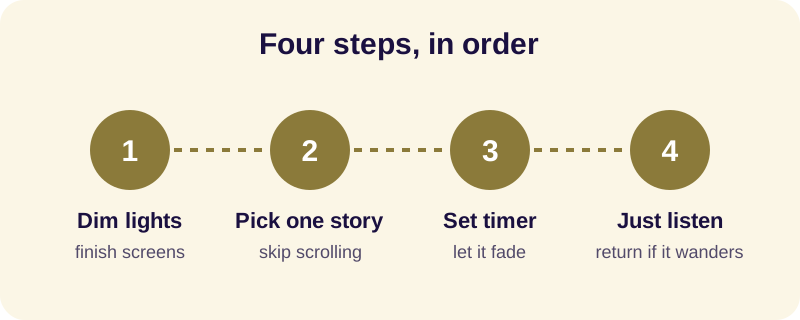
- Finish any screen work you need to do well before bed, then dim the lights.
- Settle into bed and choose one short Zen parable rather than scrolling through several.
- Set a sleep timer so the narration stops on its own instead of playing all night.
- Let your attention follow the voice; if it wanders to tomorrow's list, just return to listening.
None of this requires getting the koan "right." If you are asleep before the parable ends, it has done what it was there to do.
What should you look for in a zen parable narration app?
A handful of practical features matter more at night than a large catalogue of content.
| Feature | Why it matters at night |
|---|---|
| Sleep timer | Stops the narration after the time you choose instead of playing until morning |
| Offline listening | Keeps the story playing even if the connection drops once the phone is face-down |
| Background playback | Lets the screen go dark while the voice keeps going |
| No ads | Nothing bright or loud interrupts a parable partway through |
| Relaxing sounds | Rain, waves or a bell can sit quietly under the narration if silence feels too empty |
None of this means a long catalogue is wasted — more parables simply mean more nights covered once the basics above are in place. For a broader comparison of apps built around this kind of listening, see our comparison of Buddhist sleep apps, and for downloading stories ahead of a weak-signal night, see how to listen to sleep stories offline.
How does Buddha Story narrate zen parables for sleep?
Buddha Story is a narrated zen parables app built specifically for listening at night rather than for study during the day. Its library runs across more than 90 stories in 28 collections, narrated in English, and includes Zen parables alongside Jataka tales, Dhammapada verses, the Four Noble Truths and the Noble Eightfold Path, and episodes from the life of Siddhartha Gautama, including the night under the Bodhi tree.
- Sleep Timer — narration stops on its own after the time you choose.
- Offline Mode — download a parable so a dropped connection never interrupts it.
- A sound mixer for layering rain, waves or singing bowls under the voice.
- Background playback, so the story continues with the screen off.
- Guided Meditation, for nights when a story isn't what you need.
- No ads, a 3-day free trial, and Monthly or Yearly plans, on Android via Google Play.
If you also want to listen without a connection at all, our guide on how to listen to sleep stories offline covers the setup in a few steps. Readers curious how Zen parables sit alongside other strands of the tradition can compare approaches in our piece on the difference between Zen and Theravada Buddhism, or start with the basics in what Zen Buddhism means in simple terms.
A narrated zen parables app will not solve a koan for you, and it is not meant to. What it does is give a tired mind a short, strange, gentle story to follow instead of the day it is still rehearsing — which, most nights, is enough.
Frequently Asked Questions
What is an app for zen parables narrated aloud?
It's an app that reads Zen koans and short parables out loud instead of leaving you to read them on a screen. Buddha Story narrates Zen parables along with Jataka tales, the life of the Buddha and Dhammapada verses, paired with a sleep timer and offline listening.
Am I supposed to understand a Zen koan right away?
No. Zen koans are often built to resist a quick, logical answer; that is part of the point. At night the goal is not to solve the riddle but to let an odd, short story occupy the mind gently enough that the day's rehearsing quiets down.
How long should a narrated zen parable be for sleep?
Shorter is usually better at bedtime. A parable that takes a few minutes to narrate, like the empty cup or the broken bowl, gives the mind a clear shape to follow without demanding the sustained attention a longer story needs.
Do I need to know anything about Buddhism to listen to zen parables?
No prior knowledge is needed. Zen parables are told as plain stories about a monk, a cup, a bowl or a question, and the calming effect of hearing them narrated slowly works whether or not you follow the tradition behind them.
Does listening to narrated zen parables replace meditation?
No, and it isn't meant to. Listening to a parable is a passive, restful activity for winding down, while meditation is an active practice. Many people use both: a sitting practice during the day and narrated parables at night.