Published · Updated
Quick answer
An app for Dhammapada verses narration reads short teachings aloud slowly, pausing between lines instead of rushing through chapters. Buddha Story includes several Dhammapada episodes alongside Jataka tales and other narrated teachings, with offline playback and a sleep timer that stops the story for you.
Key takeaways
- Each Dhammapada verse is short, so narration can pause after every line instead of carrying a long argument.
- Buddha Story includes several Dhammapada episodes alongside Jataka tales and the life of the Buddha.
- A sleep timer with set lengths stops the story and sounds for you so you never reach for the phone.
- Offline listening means a weak signal at bedtime won't cut a verse off halfway through.
- Picking a theme — anger, a restless mind, impermanence — works better at night than starting at verse one.
An app for Dhammapada verses narration reads short teachings aloud, slowly and without drama, so you can take in a line about anger, patience or the mind before sleep instead of scrolling a page in the dark.
The Dhammapada is a short collection of sayings attributed to the Buddha, arranged loosely by theme rather than by story. Each verse is only a line or two, which makes the whole collection unusually well suited to listening: a narrator can read one stanza, pause, and let it sit, rather than carrying a plot across many pages the way a longer teaching does. That shortness is part of why people reach for it specifically at night, when a long chapter is the last thing a tired mind wants to follow.
What does narration actually add to the Dhammapada?
Reading the Dhammapada silently works fine in daylight, with good light and a clear head. At night, with the lamp off and your eyes already closed, reading isn't really an option.
Narration turns the text back into something closer to how it was first passed down: spoken, heard, carried by a voice rather than decoded letter by letter on a lit screen. A line like "hatred is never appeased by hatred" lands differently read aloud slowly than skimmed in a list of quotes on a page. The pace is set for you, not chosen by how fast your eyes happen to move. There is no chapter to check visually for length — only the next line, arriving when it arrives.
For many people this is the real appeal of listening to Dhammapada verses rather than reading them end to end: nothing to manage, nothing to finish, just a voice to follow until the mind loosens its grip on the day.
What should a good Dhammapada verses narration app actually do?
Not every recording of the Dhammapada is built with sleep in mind. Some are brisk, chapter-by-chapter readings meant for study, moving at a pace better suited to a commute than a dark bedroom. Others are structured around one long continuous sitting, which is awkward if you only wanted ten quiet minutes before your eyes closed on their own.
See also: App for Adults Who Cant Sleep: What Actually Helps.
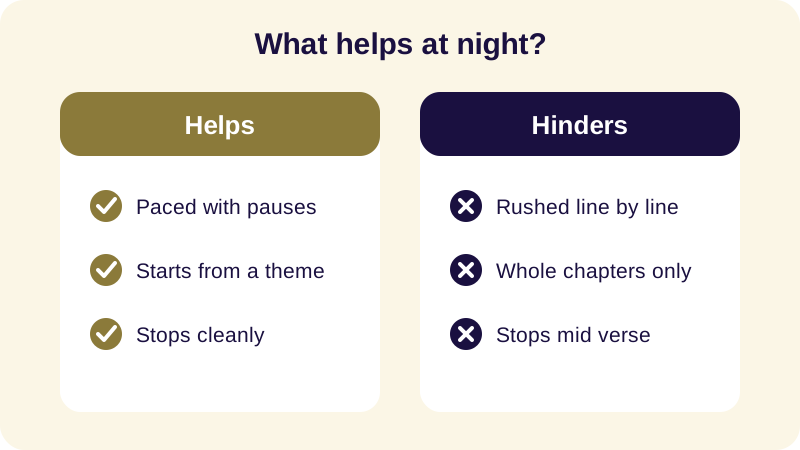
A few things matter more than the rest for nighttime listening:
- Pace. A voice that treats each verse as worth a pause, not a line to get through quickly on the way to the next one.
- Short entry points. The option to start from a theme — anger, a restless mind, impermanence — rather than always beginning at verse one each night.
- A clean way to stop. A sleep timer that stops the story and any sounds once the chosen length is up, rather than cutting off mid-verse or running on for hours after you've fallen asleep.
- Offline playback. A weak signal, or a phone left in airplane mode overnight, shouldn't interrupt a verse halfway through.
How do I build a nightly habit around narrated verses?
Most people who listen to narrated Dhammapada verses at night don't try to get through the collection in order, the way you might read a book from cover to cover. They come back to a handful of verses that match whatever kept them awake that particular evening — a line about anger after a hard conversation, one about a restless mind after a day of too much noise and too many open tabs.
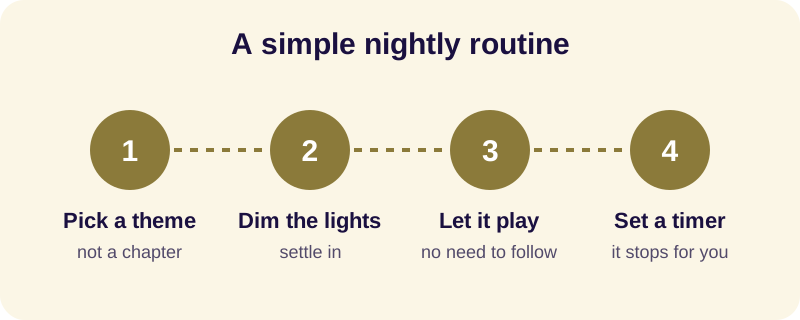
None of this needs to be precise. The point isn't to finish a chapter or to remember a verse the next morning. It's to give the mind one slow, plain thing to attend to instead of the day's unfinished business.
If you're not sure where to start on a given night, the roundup of Dhammapada verses for a restless mind groups a few verses by the kind of night you're having, so you can go straight to one instead of searching for it yourself.
Does narrated listening replace reading the Dhammapada?
Not entirely, and it doesn't need to. Reading lets you go back over a line, compare how a verse is worded, sit with a single troublesome word for as long as you like.
Listening does something reading can't: it removes the small physical effort of focusing your eyes on text, which is exactly the effort worth dropping right before sleep. Many people end up doing both — reading a verse or two in daylight with real attention, then letting the same verses return later as narration at night, when attention is the one thing in short supply. Neither approach replaces the other; they simply do different jobs at different hours of the day.
For the fuller background on the text itself — its structure, its recurring themes, where it sits among the Buddha's other teachings — the guide to the Dhammapada covers that in plain, unhurried terms.
How does Buddha Story narrate the Dhammapada verses?
The app includes several Dhammapada episodes, narrated slowly from a public-domain translation, alongside Jataka tales, episodes from the life of Siddhartha Gautama under the Bodhi tree, and Zen parables — so listening to narrated Dhammapada verses is one part of a wider library rather than an isolated file you have to hunt down separately.
Offline Mode keeps a verse playing even without a signal, so a weak connection at bedtime doesn't cut it off. The Sleep Timer offers 10, 20, 30 or 60 minutes, and once that time is up it stops the story and sounds for you, so you don't have to reach for the phone yourself to switch anything off. A sound mixer lets you layer the narration with rain or other ambient sound, and background playback keeps the voice going once the screen goes dark. There are no ads interrupting a verse partway through.
Beyond the Dhammapada, the library runs to more than 90 stories, including Jataka tales, the Metta Sutta, the Satipatthana Sutta, and teachings like the Four Noble Truths, the Noble Eightfold Path, the Five Precepts, and the four brahmaviharas, all narrated in English. There is also Guided Meditation for anyone who wants a practice alongside the stories. A three-day free trial is available, followed by a monthly or yearly subscription, on Android through Google Play.
If you want to see how different Buddhist sleep apps compare before settling on one, the overview of best Buddhist sleep apps lays out the options side by side.
Frequently Asked Questions
What does an app for Dhammapada verses narration do?
It reads short Dhammapada teachings aloud in a slow, steady voice, so you can take in a line about anger or the mind before sleep without needing to focus your eyes on a page. The verses are brief, which suits listening rather than following a long argument.
Does the narration include every verse of the Dhammapada?
Not as a line-by-line reading of the whole text. Buddha Story includes several Dhammapada episodes narrated from a public-domain translation, alongside Jataka tales and other teachings, rather than working through all 423 verses in sequence.
How does the sleep timer work on a narration app?
A sleep timer lets you choose a length. On Buddha Story that is 10, 20, 30 or 60 minutes, and once that time is up, the story and any background sounds stop for you, so you never need to reach for the phone yourself.
Can I listen to narrated verses without an internet connection?
Yes, if the app offers offline playback. Buddha Story's Offline Mode lets you download episodes in advance, so a weak signal or a phone left in airplane mode overnight will not interrupt a verse halfway through.
Should narrated verses replace reading the Dhammapada?
Not necessarily. Reading lets you linger on a single line or compare wording, while listening removes the effort of focusing your eyes, which suits bedtime. Many people do both: reading in daylight, then letting narration carry the same verses back at night.