Published
Quick answer
An app for short guided meditations at night works best with five-to-fifteen-minute sessions—breath awareness, body scan or loving-kindness—plus a sleep timer that stops on its own. Short, familiar practices are easier for a tired mind to follow through than long ones.
Key takeaways
- Five to fifteen minutes suits a tired mind better than a long session.
- Breath awareness, body scan and loving-kindness are the three core short practices.
- A sleep timer that stops cleanly matters more than extra app features.
- Repeating the same practice nightly works better than switching every night.
- Persistent insomnia or anxiety belongs with a doctor, not just a bedtime app.
A good app for short guided meditations at night offers five- to fifteen-minute practices—breath awareness, body scan, loving-kindness—paired with a sleep timer that stops on its own instead of playing until morning. The best of these sessions come from an actual tradition rather than a vague voice telling you to "relax," because a real technique gives the mind something specific to do.
This matters more for guided meditation at night than for any other time of day. A tired mind does not need a long lecture or a complicated practice; it needs one short, clear thing to follow until attention loosens and sleep can take over on its own.
What Counts as a Short Guided Meditation at Night?
In practice, "short" means something you can start lying down, in the dark, without needing to remember instructions. Three practices cover most of what a brief meditation before bed needs: breath awareness, a body scan, and loving-kindness.
See also: How to Meditate Offline Without Internet.
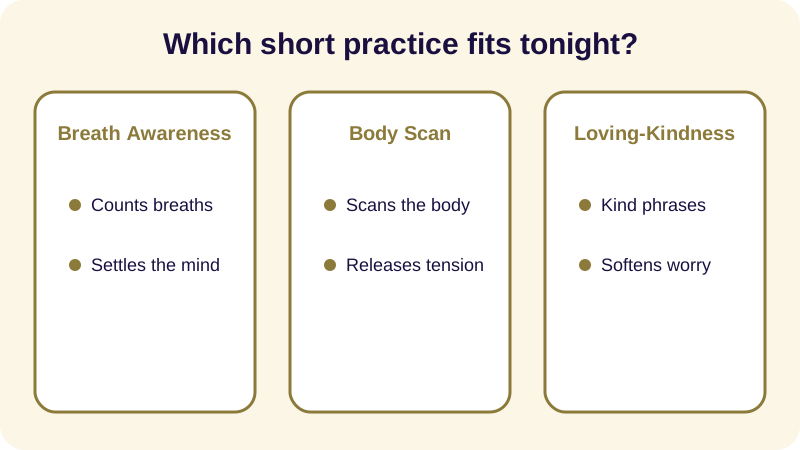
Breath awareness, or anapanasati (mindfulness of breathing), asks you to notice the breath exactly as it is, without changing it. A body scan moves attention slowly through the body, part by part, which gives a racing mind a long, low-stakes task instead of a worry to chew on. Loving-kindness meditation, or metta, has you silently repeat a few phrases of goodwill—for yourself, then for others—until the repetition itself becomes restful. None of these need twenty minutes to work; five is often enough to notice the shift, and the breath awareness guide walks through the first one in more detail.
Why Do Shorter Sessions Work Better Before Sleep?
A fifteen-minute body scan is not a smaller version of a one-hour sit; it is a different tool, built for a mind that is already tired and does not want to be taught anything new.
Long guided sessions are designed to build concentration over time, which takes sustained attention—exactly what a tired evening mind struggles to give. A short session asks less, which paradoxically makes it easier to follow all the way through instead of drifting into unrelated thought halfway in, then giving up. There is also a simple mechanical reason: most people are asleep well before the fifteen-minute mark, so a session built to run twenty or more minutes partly wastes its own length. If you are weighing how much time to set aside before bed, the guide to meditation length before sleep covers this in more depth; if the problem is a mind that will not stop replaying the day, quieting a racing mind at night is the more direct starting point.
What Should a Meditation App Actually Do at Bedtime?
Beyond offering the right length of session, a short guided meditation app needs to get a few practical things right, or the technology itself becomes the thing keeping you awake.
A sleep timer should stop the session rather than let it run on; Buddha Story's timer pauses the story and sounds outright when the time (10, 20, 30 or 60 minutes) is up, rather than fading them out, so you are not left guessing whether it is still playing. Offline listening matters for the same reason screens do: a buffering icon in the dark is its own small jolt of alertness. Background playback means you can lock the phone and let the practice continue without touching it again. None of this replaces the practice itself—it just gets out of its way.
How Do You Build a Short Nightly Meditation Routine?
A routine does more work than any single session, because the mind learns to associate the pattern itself with winding down.
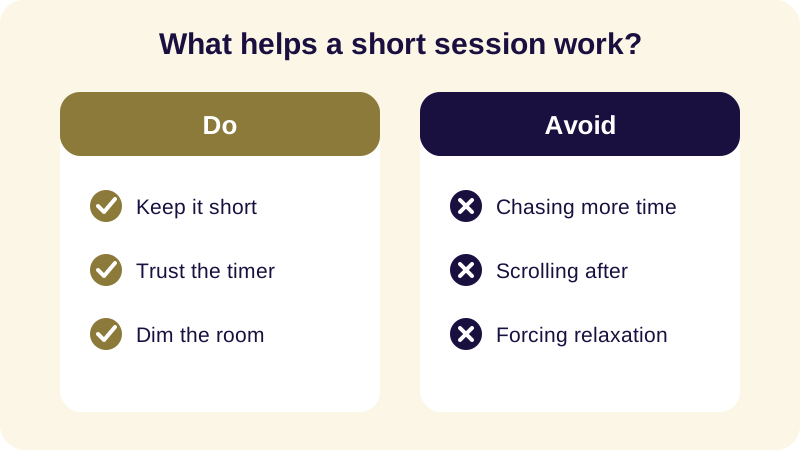
- Pick one practice—breath awareness, body scan or loving-kindness—and use the same one for a week rather than switching nightly.
- Start it before you are already wide awake with worry, ideally as part of lying down rather than after an hour of scrolling.
- Set the sleep timer to a length you actually tend to need, and let it close the session rather than listening until it ends.
- Keep the room dark and the phone face down or across the room once the session starts.
- If you are still awake when it ends, stay still and let the quiet continue rather than reaching for the phone again.
Are Short Meditations Enough, or Do You Need the Full Teaching?
Short guided meditations borrow their structure from much older practices, and knowing a little of where they come from can make them easier to trust rather than treat as a gimmick.
Breath awareness and the body scan both trace back to the Satipatthana Sutta, a foundational discourse on mindfulness; loving-kindness has its own early text, the Metta Sutta. Buddhist teaching places these alongside the Noble Eightfold Path and the Four Noble Truths as part of a larger whole, but you do not need any of that background to use a five-minute practice at bedtime. The beginner's guide to meditation is a good next step if the short sessions leave you curious, and the loving-kindness meditation guide covers the phrases in full if that is the practice that suits you best.
What Else Is on an App Like This?
Guided meditation is only one part of what a bedtime app can offer; most nights, the practice and the narration work together rather than competing.
Buddha Story pairs its guided meditation for loving-kindness, body scan and breath awareness with narrated Buddhist stories—Jataka tales, the life of the Buddha, Dhammapada verses and Zen parables—plus relaxing sounds like rain, ocean waves and singing bowls that can run underneath either. Some nights a five-minute breath practice is enough on its own; other nights it works better as the quiet opening to a longer, slower story. Either way, the room stays dark, the phone stays face down, and nothing needs to be figured out at eleven at night beyond pressing play. For anyone comparing how different apps in this space actually handle stories and sessions, the comparison of Buddhist sleep apps lays out the differences plainly, and building a daily meditation habit is the place to go once a single bedtime session starts to feel too small for what you actually want from the practice.
Frequently Asked Questions
How short should a guided meditation be at night?
Most bedtime sessions work well at five to fifteen minutes—long enough to settle attention, short enough to finish before you are already asleep. Breath awareness, a body scan and loving-kindness are the three practices that fit this length most naturally, and any of them can be repeated nightly without losing effect.
What is the difference between a guided meditation and a sleep story?
A guided meditation gives you something active to do—following the breath, scanning the body, repeating kind phrases—while a narrated story asks you only to listen. Both can calm a restless evening; which one works better often depends on whether your mind needs a task or a gentle distraction.
Can a short meditation really help you fall asleep?
It can make an ordinary restless evening easier to settle by giving the mind one simple thing to follow instead of the day's unfinished business. It is not a cure for insomnia or anxiety; if sleeplessness persists night after night, that belongs with a doctor rather than a meditation app.
Should the sleep timer stop the audio or fade it out?
Either can work, but a timer that stops cleanly tells you clearly that the session has ended, rather than leaving you half-listening to fading sound. Buddha Story's sleep timer pauses the story and sounds outright at the chosen length—10, 20, 30 or 60 minutes—rather than fading them.