Published
Quick answer
The Buddhist story about the broken bowl tells of a monk whose bowl shatters and shows how grief shrinks once he remembers it was fragile all along. It's a short, practical lesson in impermanence, useful for settling a mind caught up in a small evening loss.
Key takeaways
- The broken bowl story shows grief growing when we forget a thing was always fragile.
- Remembering impermanence can shrink a small loss instead of feeding rumination.
- The teaching is about the size of the reaction, not about not caring.
- It works well for replaying a small mistake or loss right before sleep.
The Buddhist story about the broken bowl is a short teaching about a monk whose only bowl shatters, and about how quickly his grief eases once he remembers the bowl was fragile from the start. It is told in different forms across Buddhist communities to make one point: the things we love were always breakable.
If you are lying awake tonight replaying something that cracked, spilled, slipped, or went wrong earlier in the day, this old parable was built for exactly that kind of mind.
What happens in the story of the broken bowl?
A monk owns one bowl, given to him on the day he was ordained — plain fired clay, already chipped along one edge from years of daily use at the alms round. One evening, carrying it back from the river, he catches his sandal on a root. The bowl leaves his hands and breaks on the stone path into more pieces than he can easily count.
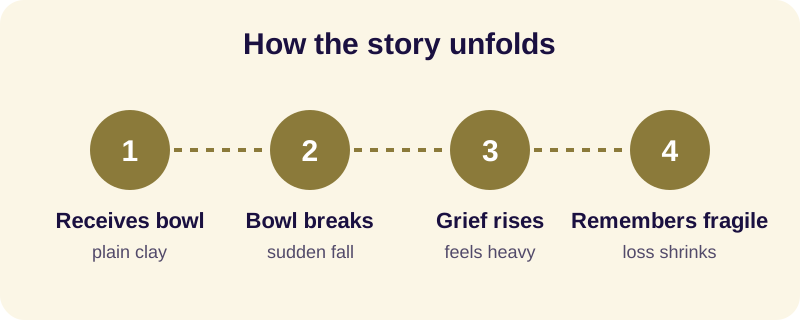
His first feeling is not philosophical. It is a drop in the stomach, as if something in him had cracked along with the clay. He kneels and gathers the pieces anyway, half expecting them to fit back together if he is careful enough. They do not. Sitting with the shards in his lap, he notices how large his sorrow feels for only a bowl — and that noticing is where the story turns.
He remembers a plain fact he had always known and rarely felt: the bowl was never whole in the way he had been treating it. Clay fired in a kiln is already on its way to breaking; every bowl like his cracks eventually, in someone's hands, on some ordinary evening. Tonight's stumble did not cause the ending. It only supplied the date. He sets the pieces down, decides he will ask for another bowl in the morning, and walks the rest of the way home without turning the moment over and over.
What does the broken bowl teach about impermanence?
The story is usually told to illustrate impermanence — the idea that everything made of parts is also, slowly, unmaking itself the whole time we own it. A monk's bowl is one example; a favourite cup, a plan for tomorrow, a friendship, are others. None of this is meant to make care foolish or attachment wrong. It is a description of how things actually behave, offered so that when the ordinary happens, it does not arrive with the added injury of feeling betrayed.
That second injury is usually the larger one. The bowl breaking is a small, finished event. The mind insisting it should not have broken — replaying the stumble, assigning blame, imagining the evening where it did not happen — is what stretches one dropped bowl into an hour of lost sleep. This is the same pattern explored in the broader teaching on impermanence: the first loss is usually brief; the second one, the argument with reality, is the part we choose to keep running.
How does this connect to letting go without indifference?
A fair worry about this story is that it sounds like permission not to care. It is not. The monk is not told to stop valuing his bowl or pretend the loss means nothing — he simply asks for a replacement the next morning, an ordinary act of practical care. The teaching concerns the size of the reaction, not the presence of one. This is also the territory of the broader teaching on non-attachment: holding things with open hands rather than a locked grip, so losing one does not also cost you the whole night.
The raft parable makes a related point from a different angle — a tool is useful while it serves its purpose, and clinging to it past that point becomes its own burden. The broken bowl story is the quieter, more domestic cousin of that teaching: most nights do not hand us a dramatic lesson in letting go, only a cracked mug or a missed train, and the practice is learning to meet those small losses the same way.
How can the broken bowl story help a restless mind at night?
Most people do not lie awake over the bowl itself. They lie awake over the loop — the replay of the stumble, the if only, the quiet argument with an evening that has already finished happening. The story gives that loop somewhere to land.
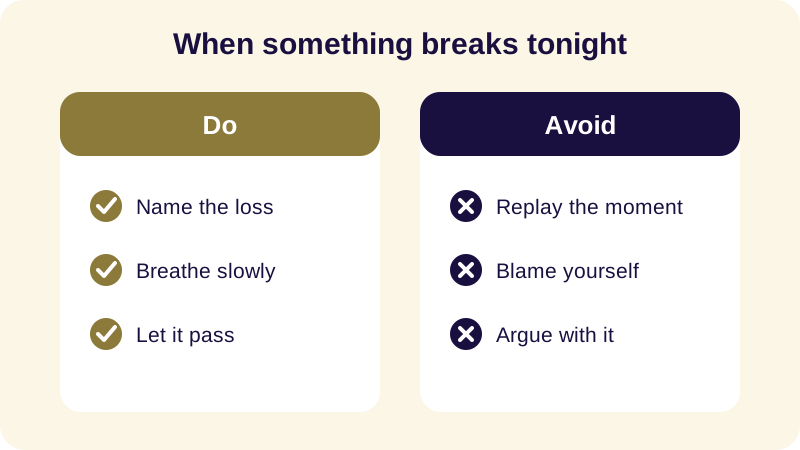
Try it the next time something small goes wrong close to bedtime — a dropped glass, a sharp word, a mistake you cannot undo tonight. Say to yourself, plainly, that the thing was already breakable, already capable of going this way, long before tonight gave it the occasion. That is not resignation; it is accuracy. Most restless replaying is the mind trying to rewrite a version of events that was never actually available to it.
Pairing the thought with a few slow breaths, or with a short mindfulness for sleep practice, gives the body time to catch up with what the mind has just agreed to. If the restlessness is about something heavier than a dropped bowl — ongoing worry or grief — that belongs with a doctor rather than a parable.
Where can I hear more stories like this one?
The broken bowl belongs to a wide family of short teaching stories — Jataka tales, Zen anecdotes, episodes from the Buddha's life — that all use one small, concrete image to make a point the mind can hold onto in the dark. If this kind of story settles you, a short set of verses for a restless mind works the same way, one short teaching at a time instead of one long argument with yourself.
The Buddha Story app narrates stories like this one slowly, for listening with the lights off rather than reading with the lights on. It includes 90+ narrated stories, among them Jataka tales, episodes from the life of Siddhartha Gautama, and readings from the Dhammapada, alongside a sound mixer for rain or singing bowls, a Sleep Timer that stops the story for you, Offline Mode for a weak connection, and background playback so the story keeps going after the screen locks, without ads interrupting it.
Whatever broke today — a bowl, a plan, a conversation — the story asks the same small question: was it ever really whole, or only on its way to this, all along?
Frequently Asked Questions
What is the Buddhist story about the broken bowl?
A monk's only bowl shatters, and his grief fades once he remembers it was fragile from the start. The story is a short teaching on impermanence: things we love were always breakable, and most of the pain comes from forgetting that plain fact.
Is the broken bowl story from a specific sutta?
No single canonical source is usually cited for it. It circulates as a teaching story across Buddhist communities, often used alongside formal teachings on impermanence, to make an abstract idea concrete rather than leaving it as theory.
What does the story say about attachment?
It does not say that caring is wrong. The monk still asks for a new bowl the next morning. The point is that holding something as if it could never break adds a second, larger loss on top of the first when it inevitably does.
Do I need to be Buddhist for this story to help?
No. The story is told as a plain observation about fragile things and restless minds, not as a religious instruction. Anyone replaying a small loss before bed can use the same idea: name what broke, and let the argument about it go.
What if the thing keeping me awake is more than a broken bowl?
Ongoing worry, grief or anxiety that does not ease with a story or a few slow breaths is worth taking to a doctor. This parable is for the ordinary restless evening, not a substitute for care when a problem is persistent or serious.