Published
Quick answer
The Buddhist teaching on impermanence, or anicca, holds that every thought, feeling and physical thing arises and passes away, so clinging to any of them as fixed causes suffering.
Key takeaways
- Anicca, or impermanence, is one of the Buddha's three marks of existence, alongside dukkha and anatta.
- A worry at 2am feels permanent but is itself a passing mental state, like the mood before it.
- The mustard seed story of Kisa Gotami shows that no household is untouched by loss or change.
- Naming a sensation as changing, rather than fighting it, is a simple nightly way to use this teaching.
- Impermanence is not a cure for insomnia or anxiety; lasting problems deserve a doctor's attention.
The Buddhist teaching on impermanence, known in Pali as anicca, says that everything which arises also passes away — a thought, a mood, a body, even a mountain, just on different timescales. Nothing you are holding onto tonight, including the worry itself, was built to last forever.
What is the Buddhist teaching on impermanence?
Impermanence is one of the three marks of existence the Buddha pointed to again and again: nothing made of parts and held together by conditions stays the same from one moment to the next. The other two marks are dukkha (suffering or unsatisfactoriness) and anatta (not-self), and the three are linked. Because things change, clinging to them as if they were fixed brings a kind of suffering, and that very flux is why no unchanging "self" can be found sitting still inside the experience.
The Buddha built this observation into the Four Noble Truths, where craving for things to stay put — a feeling, a relationship, a version of yourself — is named as the root of unnecessary suffering. Impermanence in Buddhism is taught as something to observe directly, not a doctrine to accept on faith, which is part of why it shows up so often in stories rather than only in argument.
Why does everything we think is solid keep changing?
A body replaces its cells on its own schedule. A mood that feels like it will never lift usually shifts within minutes if you stop feeding it with the same thought. A relationship, a career, a street you grew up on — all of it is mid-change, just slower than a single breath. This is the Buddhist view of change: not a doctrine to memorize, but a pattern available to notice directly, at whatever speed it happens to be moving.
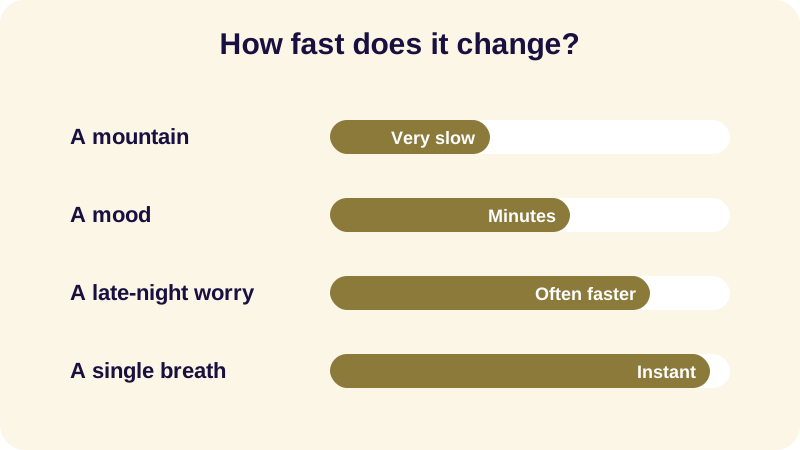
None of this is abstract. The teaching on dependent origination describes exactly how a changing thing arises because certain conditions are present, and passes away once those conditions shift — which is also why the same worry rarely keeps the same grip twice in a row, even if it returns.
What story makes impermanence easier to feel than to think about?
The clearest illustration is the story of a mother named Kisa Gotami, who carried her dead child from house to house asking for medicine to revive him. She was told to bring back a mustard seed — ordinary, kept in almost every kitchen — but only from a household that had never lost anyone to death. She visited every house in the village. Every one had a story of loss. None had the seed she needed.
She did not find the seed, but she found what she actually needed: evidence, gathered door by door, that loss touches every household without exception. It is one of the oldest stories about letting go in the tradition, and it works less as an argument than as proof — the kind a tired mind at night can actually use, because it does not ask you to believe anything, only to notice what is already true of every house on the street.
Stories of the Buddha's own earlier lives, the Jataka tales, return to the same theme in dozens of forms — a kingdom lost, a friendship ended, a season turning into the next one without asking permission.
How does remembering impermanence help with a racing mind at night?
At 2am a worry can feel like a fixed fact about your life rather than a passing mental event. The teaching on impermanence offers a quieter way to hold it: this thought, like every thought before it tonight, arose because certain conditions were present, and it will pass when those conditions change, usually faster than it feels like it will. You do not have to solve it to be done with it for the night — you only have to notice that it is already moving.
This is also why Buddhist teachings pair well with simple attention practices. A racing mind at night is rarely solved by more thinking; it settles when attention has somewhere steadier to rest than the loop itself.
How can I practice this before sleep tonight?
You do not need a cushion or a formal sitting practice to use this teaching at bedtime. A short, deliberate pass through what is changing right now — in the body, in the room, in the mind — is usually enough to loosen the grip of a single insistent thought.
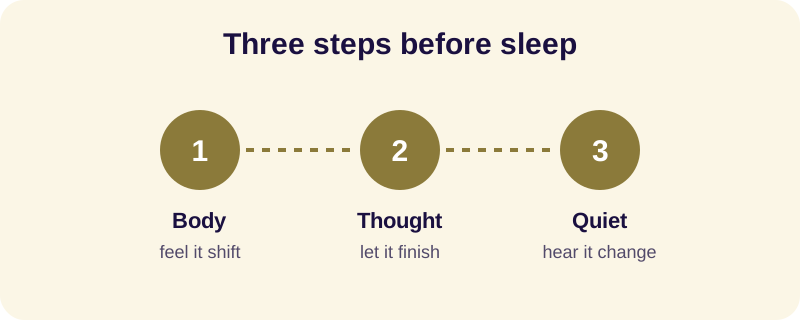
- Notice one physical sensation and watch it shift or fade within a few breaths.
- Notice one thought arise, and let it finish on its own instead of following it.
- Notice the quiet itself change, as sounds come and go around you.
None of this is a technique for forcing sleep to arrive faster, and it is not a treatment for ongoing insomnia or anxiety — those belong with a doctor. It is simply a way of meeting an ordinary restless evening with something closer to how things actually are.
Some people find it easier to let a voice carry the reflection rather than holding it alone. Short Dhammapada verses return to impermanence often, and hearing them slowly, in the dark, can do what reading them in daylight cannot.
How does the Buddha Story app support this practice?
The app narrates exactly the material this teaching draws on: the Dhammapada, the Jataka tales, and episodes from the life of Siddhartha Gautama, read slowly for listening in the dark rather than skimming on a screen.
- Guided meditation for breath awareness and body scan, so the sensations mentioned above have a structure to follow.
- A sleep timer that stops the story for you, so the phone can stay face down.
- Offline listening and background playback, so the screen can stay dark.
- A sound mixer with rain, ocean waves and singing bowls alongside the narration.
The teaching on impermanence does not ask for belief. It asks for attention — to a breath, a thought, a sound that is already changing as you listen. That is usually enough for one ordinary, restless night.
Frequently Asked Questions
What does impermanence mean in Buddhism?
Impermanence, or anicca, is the teaching that everything conditioned — bodies, moods, thoughts, relationships — arises and passes away. It is one of the three marks of existence alongside dukkha (suffering) and anatta (not-self), describing a pattern you can observe directly rather than a belief to adopt.
Is impermanence the same as saying nothing matters?
No. The teaching says the opposite: because a moment will not come again, it is worth meeting fully instead of resisting. Impermanence points to a lighter way of holding experience, not indifference, and it sits alongside ethical teachings like the Five Precepts rather than replacing them.
What is the mustard seed story about impermanence?
It tells of Kisa Gotami, who sought a mustard seed from a house untouched by death to revive her child. She found none, because every household had known loss, and the search itself became her teaching about impermanence.
Can thinking about impermanence help me sleep?
It can help an ordinary restless mind by showing that a worry at 2am is itself a passing state, not a fixed fact. It is not a treatment for insomnia or anxiety; persistent sleep or mood problems are best discussed with a doctor.
What are the three marks of existence?
The three marks are anicca (impermanence), dukkha (suffering or unsatisfactoriness), and anatta (not-self). Together they describe conditioned existence: things change, clinging to change causes suffering, and no fixed, unchanging self can be found within the constant flux.
