Published
Quick answer
What is karma in Buddhism, simply? It means intentional actions by body, speech or mind leave a trace that shapes future experience — not fate, not punishment, just cause and effect in character and circumstance over time.
Key takeaways
- Karma means intentional action, not everything that happens to you.
- Kind or harmful intentions tend to repeat and strengthen into habits.
- Karma is not fate, and it should never judge others' suffering.
- Karma works alongside rebirth and dependent origination in the wider teaching.
- A short, honest review of the day's intentions can ease bedtime rumination.
What is karma in Buddhism, simply? Karma simply means that intentional actions shape what comes next, in the mind and in life, not a ledger of cosmic reward and punishment.
This article lays out what that means in plain terms: how karma works, what it is not, and how understanding it can ease a mind that keeps replaying the day at bedtime.
What does karma actually mean in Buddhism?
Karma, from the Pali word kamma, means "action" — but only the kind of action that comes from intention. Thoughts, words and deeds that are chosen, not reflexes or accidents, are what count. The law of karma, as it is sometimes called, is really just this: intention leaves a trace, and the trace shapes what comes next.
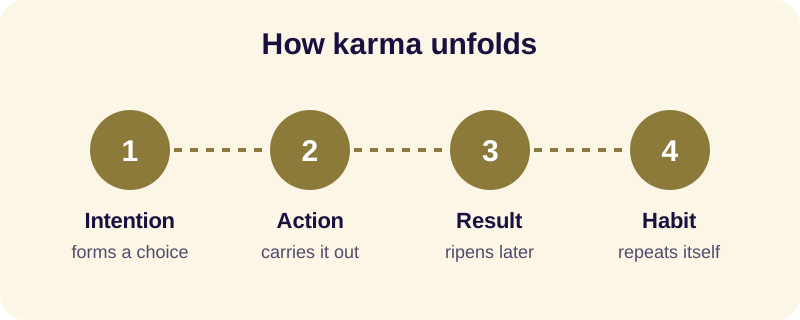
An act rooted in greed, ill will or confusion tends to leave a residue — guilt, tension, a habit that is easier to repeat next time. An act rooted in generosity, patience or honesty tends to leave the opposite residue — ease, trust, a habit that is also easier to repeat. Over days and years, this is how a character forms. The Five Precepts are really a description of which actions tend to go which way, offered as training rules rather than commandments.
This is also why karma is sometimes translated loosely as the law of karma, though "law" can make it sound more mechanical than it is. The Buddhist concept of karma is closer to a tendency than a formula: a strong intention leaves a strong trace, a casual one leaves a faint one, and context always matters.
Is karma the same as fate or punishment?
No. Fate implies a script already written; karma describes a pattern still being written by what you do now. The two get confused constantly, especially the idea that someone's illness, poverty or grief must be "their karma" catching up with them — a reading the early teachings do not support and one that causes real harm when used to excuse cruelty or indifference toward people who are suffering.
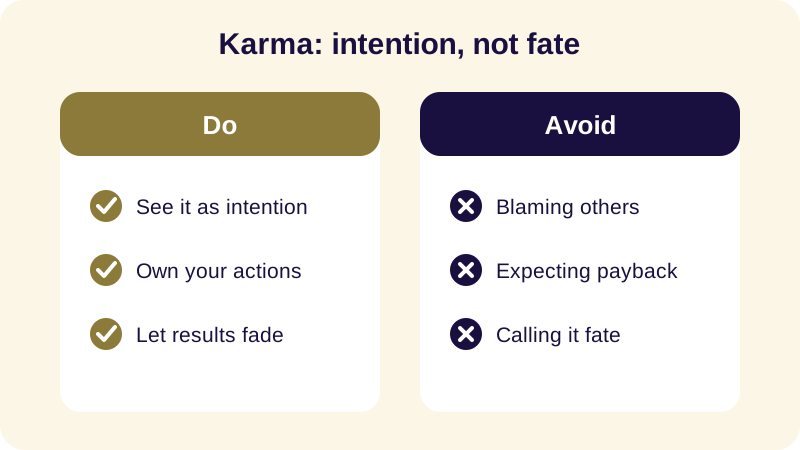
Karma also is not punishment handed down by an outside judge. There is no record-keeper tallying your actions; the tendency is built into the actions themselves, the way a habit builds itself through repetition rather than through someone grading it. The Middle Way is relevant here too — the Buddha's teaching steers between two extremes, strict determinism on one side and the idea that actions have no consequence at all on the other.
Does karma mean everything happens for a reason?
Not in the sense of a hidden meaning behind every event. A storm, an illness, an accident — much of what happens to a person comes from ordinary physical causes, not from anything they did. Karma in Buddhism only explains the ethical weight carried by intentional actions, not every weather pattern or chance event in a life. Reading every misfortune as deserved is a mistake the tradition itself warns against.
How does karma connect to rebirth and dependent origination?
In the traditional cosmology, karma and rebirth are taught together: karma is one of the threads that carries a life's momentum from one existence into the next, shaping the conditions a new life begins in. But karma does not need the full cosmology to be useful on an ordinary Tuesday. The same logic — intentional action leaves a trace, the trace shapes the next moment — is visible within a single day, even within a single conversation.
This is part of a wider teaching called dependent origination: nothing arises on its own, everything is conditioned by what came before it. Karma is the ethical slice of that larger pattern — specifically how intentional action conditions what follows. It sits alongside the Four Noble Truths, which name suffering and its cause, and the path that is largely a description of which intentional actions ease that cause.
A short example
Say a sharp word to someone out of irritation. In the next minute you may feel a small, specific tightness — not punishment from outside, just the direct aftertaste of the intention you acted on. Say a kind word instead, even a small one, and the aftertaste is different: looser, easier to carry into sleep. Multiplied over years, this is the whole of karma in miniature.
What does this mean for a mind that won't settle at night?
Lying awake replaying the day is, in a sense, karma being felt directly — the mind turning over this morning's sharp word or yesterday's kindness, still warm. Understanding karma as intention rather than fate can soften this. You cannot rewrite what you did, but you also are not stuck with a verdict; the next intention is still yours to choose, starting with the next breath.
A simple bedtime version of this: before sleep, review the day briefly and honestly, without turning it into self-attack. Notice one thing you did from kindness and one thing you would do differently. Let both go and move toward rest. This pairs naturally with the kind of attention taught in loving-kindness meditation or the four brahmaviharas — ways of aiming intention somewhere warm right before the mind lets go for the night.
If replaying the day keeps you up more nights than not, that is worth mentioning to a doctor rather than solving alone; an ordinary restless mind at night and a diagnosable sleep or mood problem are not the same thing, and the second deserves proper care.
Buddhist stories carry this same teaching without stating it as a rule. Many of the Jataka tales are built around exactly this: a character's generosity, patience or honesty quietly shaping what happens to them many lifetimes later. Hearing a story like that at night is a gentler way to sit with the idea of karma than analysing it, and it gives a racing mind somewhere slower to go. The guide to Buddhist stories for sleep has more on how that works.
The Buddha Story app narrates stories built on exactly this teaching — Jataka tales, episodes from the life of Siddhartha Gautama, and Dhammapada verses — alongside guided meditation for loving-kindness and a sleep timer that stops the story for you, so the story can carry you toward sleep rather than keep you listening.
Frequently Asked Questions
What is karma in Buddhism, simply?
Karma means intentional action — thoughts, words or deeds you choose, not accidents or reflexes. The teaching is that actions rooted in greed, hatred or confusion tend to bring more suffering, while actions rooted in kindness, patience or honesty tend to ease it, both for you and for others around you.
Is karma the same thing as fate?
No. Fate suggests a script already written; karma describes a pattern still being shaped by what you choose now. The Buddhist concept of karma leaves room for change at every moment, since a new intention always has the power to start a different pattern from here.
Does bad karma mean I am being punished?
No outside judge keeps score in this teaching. The weight of an action is built into the action itself, the way a habit strengthens through repetition. Reading someone's illness or hardship as deserved punishment misunderstands karma and is a use of the idea the tradition itself warns against.
How is karma connected to rebirth?
In traditional Buddhist cosmology, karma and rebirth are taught together: the momentum of intentional action is said to carry from one life into the next, shaping the conditions a new life begins in. The same cause-and-effect pattern is also visible within a single day, without needing the wider cosmology to be useful.
Can karma change over time?
Yes. Karma describes a tendency, not a fixed verdict. A strong intention leaves a strong trace and a casual one leaves a faint one, but the next intention is always yours to choose, which is why the teaching points toward practice rather than resignation.