Published
Quick answer
The Buddhist story about a stubborn donkey is the Jataka tale of a donkey dressed in a lion's skin, who gives itself away by braying at another donkey. It shows how old habits surface no matter the disguise, worth remembering on a restless night.
Key takeaways
- The stubborn donkey is the Jataka tale of a donkey in a lion's skin, not an Aesop fable.
- Disguised as a lion, the donkey still brays at another donkey's call and gives itself away.
- The story points to how habitual patterns resurface, however well we dress them up.
- The salt-carrying donkey who rolls in a river is Aesop's fable, not a Buddhist one.
- The Pali Jataka collection holds 547 tales, each pairing a creature with a moral lesson.
The Buddhist story about a stubborn donkey most often told is the Jataka tale of a donkey dressed in a lion's skin. It still has a tail, a bray, and a nature it cannot leave behind, even wrapped in disguise.
What is the Buddhist story about a stubborn donkey?
A cloth trader owned a donkey that carried his goods by day. At night, to let the animal graze freely without being chased off other people's land, the trader covered it in the skin of a dead lion. Draped in the skin, the donkey wandered into barley fields in the dark, and the farmers who saw its shape fled, certain a lion had come to feed. Night after night the trick worked. The donkey ate its fill, the trader lost nothing, and nobody came near enough to look closely.
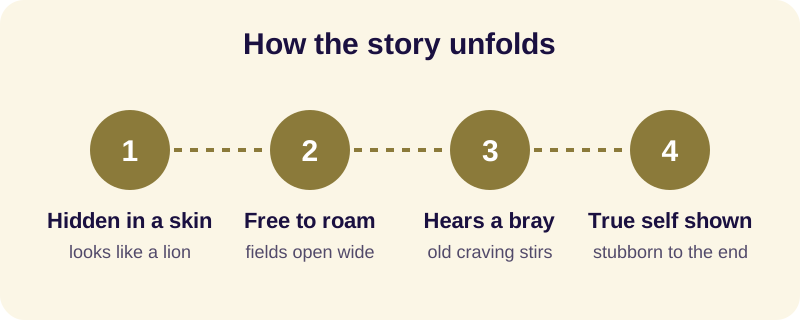
Then, one night, the donkey heard another donkey braying somewhere beyond the field. The lion's skin did nothing to change what was underneath it. Overcome by the old, familiar urge, the disguised donkey threw back its head and brayed in answer. The villagers, who had been afraid of a lion, heard the unmistakable sound of a donkey and understood at once what had been happening. They came out with sticks, and the donkey — still dressed as something fierce, still acting exactly like itself — was beaten and driven off. The disguise had never changed its nature. It only delayed the moment the nature showed itself.
Why does the donkey's stubbornness matter for a mind at night?
The donkey's stubbornness is not really about willfulness. It is about a pattern so deeply worn that no outer covering can quiet it. That is a useful thing to sit with at bedtime, when the mind often does something similar: it puts on a calm face, lies still, closes its eyes, and then the same old worry brays back the moment something familiar triggers it — a half-remembered email, an unresolved conversation, a fear that has visited many nights before.
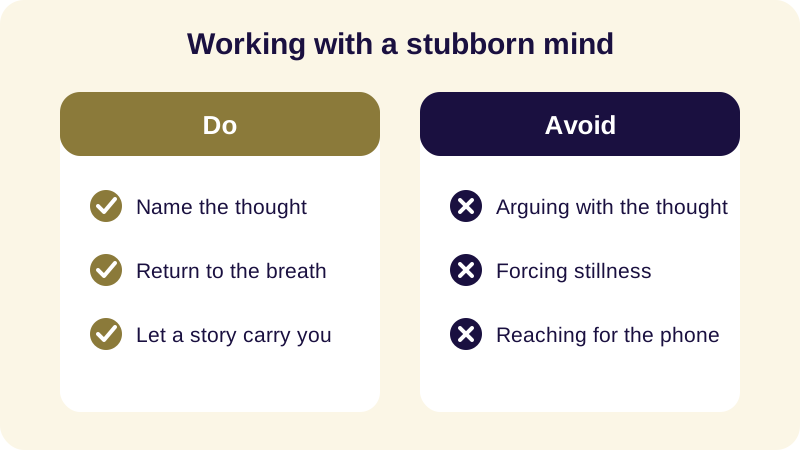
The donkey's mistake wasn't wearing the skin. It was believing the skin alone would be enough, that nothing underneath needed tending. A mind that tries to force sleep the same way — gritting through it, telling itself firmly to stop thinking — often meets the same result: the old pattern answers back anyway, louder for having been resisted. Working gently with the actual thought, the way you might with the second arrow of added worry on top of a plain one, tends to go further than any amount of trying to appear calm.
Is this donkey story really from the Jataka tales?
Yes. The donkey in the lion's skin belongs to the Jataka tales, the collection of 547 stories traditionally told as the Buddha's past lives or as illustrations of how actions shape character. Many versions exist across the wider body of Indian fable literature too, which is partly why the story sometimes circulates without its source attached. The core shape, however — a borrowed appearance that cannot override an inner nature — is consistent with the kind of moral the Jataka collection returns to again and again: that what we are shows up in our actions, not in what we are dressed as.
See also: The Buddhist Story About the Lotus Flower Explained.
It is worth being careful here, because not every animal story shared under a "Buddhist" heading actually has a Buddhist source. Two Wolves and the story of Sai Weng's horse are both widely circulated with Buddhist framing but are not Buddhist in origin either. The donkey in the lion's skin, by contrast, sits inside the genuine Jataka tradition, which makes it a fair one to reach for if you want a story that is actually part of this lineage rather than borrowed and relabeled.
How can this story help you unwind at night?
Part of what makes the donkey tale useful before sleep is its shape rather than its moral. Nothing frightening happens until the very end, and even then the stakes are small — a startled village, a donkey chased off. The bulk of the story is simply description: a quiet field, a grazing animal, fields under moonlight. That slow, undramatic pacing is closer to what a tired mind needs than a story built on suspense, which is part of why Jataka tales in general work well as bedtime stories rather than page-turners.
There's also something quietly reassuring in a story where the disguise fails. It takes the pressure off appearing composed. You do not have to perform calm to deserve rest; you can simply let the evening's noise be what it is and still drift off, the way the donkey's pretense falls away and the night continues regardless.
Buddha Story narrates stories like this one slowly, in English, alongside the Jataka tales, episodes from the life of the Buddha, Dhammapada verses and Zen parables, with relaxing sounds such as rain, ocean waves and singing bowls layered underneath. The app includes guided meditation for loving-kindness, body scan and breath awareness, offline listening, background playback, and a sleep timer with no ads interrupting the night.
If tonight's mind feels as stubborn as the donkey in the story, that is not a failure of willpower. It is simply an old pattern asking to be met gently rather than argued with — and a slow story, followed rather than fought, is often enough to let it settle on its own. For a wider set of stories built around exactly this kind of nightly unwinding, the guide to Buddhist stories for sleep is a good place to keep exploring.
Frequently Asked Questions
What is the Buddhist story about a stubborn donkey?
It is the Jataka tale of a donkey covered in a dead lion's skin by a trader, so it could graze freely in other people's fields at night while farmers fled thinking a lion had come. The donkey's stubborn nature undoes the trick when it hears another donkey braying and cannot resist answering.
Is the donkey in the lion's skin a real Jataka tale?
Yes. It belongs to the Jataka tales, the collection of 547 Buddhist birth stories. Unlike some donkey or animal fables that circulate online under a Buddhist label, this one has a genuine source in the tradition, retold across generations as a story about habit and pretense.
Is the donkey carrying salt who rolls in a river a Buddhist story?
No. That tale, where a donkey learns to lighten its load by rolling in water, is an Aesop fable, not a Buddhist one. It is often shared alongside genuine Buddhist tales online, but it has no source in the Jataka or the wider Buddhist canon.
What does the stubborn donkey teach about a restless mind at night?
The donkey's disguise works until an old urge rises, and then its real nature shows through anyway. A racing mind at night often works the same way: trying to force calm from the outside rarely holds if the underlying habit of worrying hasn't been met with some gentleness first.
How can I listen to this story before bed?
Buddha Story narrates Jataka tales, including stories like this one, slowly and in English, alongside relaxing sounds and a sleep timer that stops the story for you rather than fading it out, so you can simply listen and let the mind settle.