Published
Quick answer
The jataka tale about the monkey and the crocodile tells of a monkey who outwits a crocodile sent to drown him, by calmly claiming he left his heart in a tree. It is a short bedtime story about presence of mind rather than panic.
Key takeaways
- A crocodile plots to kill a trusting monkey friend for his heart.
- The monkey stays calm and claims his heart hangs safely in a tree.
- Quick, clear thinking, not panic, is what saves him on the river.
- The tale points to steadiness of mind, useful to recall before sleep.
The jataka tale about the monkey and the crocodile tells of a clever monkey who talks his way out of a crocodile's trap by claiming he left his heart behind in a tree. It is a short, old story about keeping a clear head when someone you trusted turns on you.
What happens in the jataka tale about the monkey and the crocodile?
A monkey lives alone in a rose-apple tree on the bank of a river, eating its sweet fruit every day. Across the water a crocodile lies in the shallows and watches him. In time the two strike up an easy friendship: the monkey tosses fruit across to the crocodile each morning, and the crocodile comes to visit and talk.
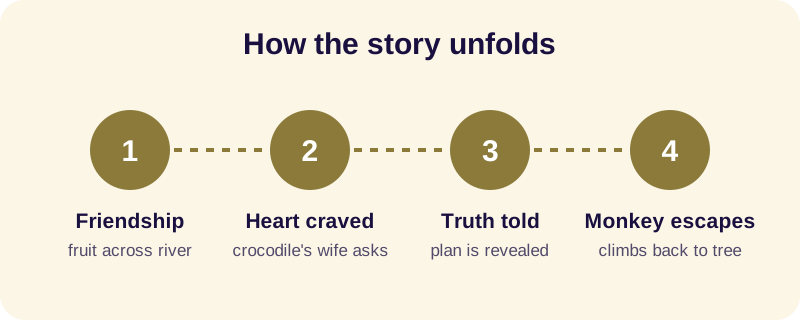
The crocodile takes some fruit home to his wife, who finds it so delicious that she wants more than fruit — she tells her husband she craves the monkey's heart and will not be satisfied without it. Reluctant but talked into it, the crocodile returns to the tree and offers the monkey a ride across the river, to a part of the forest with even better fruit. The monkey, trusting his friend, climbs onto the crocodile's back.
Halfway across, the crocodile begins to sink lower in the water and admits the truth: he has been sent to drown the monkey and bring his heart home. The monkey does not panic or struggle. Instead he says, quite calmly, that of course he would gladly have given his heart — but like all monkeys, he does not carry it around inside him. He leaves it hanging safely in the rose-apple tree, and if the crocodile turns back, he will happily fetch it for him.
The crocodile, believing him, swims back to the riverbank. The moment they reach the tree, the monkey leaps up into the branches and tells the crocodile plainly that he now knows the truth, and that a friend who plots against you is no friend at all. The story ends there, with the crocodile swimming home empty-handed and the friendship broken.
What is the moral of the monkey and crocodile story?
The tale is usually read as a story about presence of mind. The monkey does not win because he is stronger than the crocodile — he is not — he wins because he stays steady long enough to think of a way out instead of freezing or thrashing in fear. Panic narrows thinking down to nothing; staying level kept his options open.
See also: A Buddhist Story About a Lost Traveler and What It Teaches.
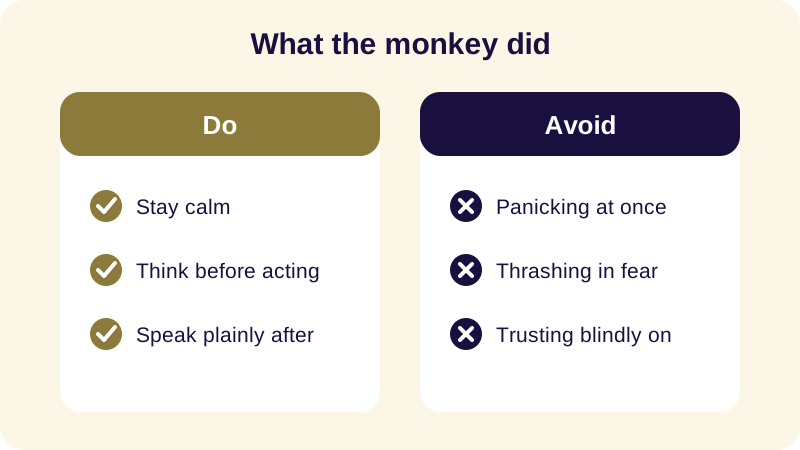
There is a second thread too, about trust and its limits. The monkey has been a generous, easy friend, throwing fruit across the water without a second thought, and that openness is not treated as foolish — the crocodile's trouble was his own hunger for a reward beyond friendship, not the monkey's warmth. But once betrayal is named, the monkey draws a clear line and does not pretend the friendship continues as before. Kindness and clear boundaries are not opposites in this story; it holds both at once.
This tale sits among the wider collection of Jataka tales, stories of the Buddha's past lives that number 547 in the traditional count. Many of them use an animal fable in exactly this way, to make a single point about character stand out clearly against a simple plot.
Why does this story settle a restless mind at night?
A mind that is replaying an argument or bracing for tomorrow is doing something close to what the crocodile's panic might have produced if the monkey had let it spread: reacting as though the danger is still live and close, instead of noticing there is room to think. Hearing the monkey stay level, slowly and without hurry, gives a listening mind a model to lean on rather than a lesson to memorize.
The story also has a shape that suits falling asleep: a quiet opening on the riverbank, a slow build of tension, and an unhurried resolution once the monkey is safely back in his tree. There is no twist left waiting. Once the monkey is up the tree, the story is simply finished, and the mind can let it be finished too.
How can I listen to this story before sleep?
The monkey and crocodile tale works well read slowly, in a low, unhurried voice, with the lights already off. Because it is short, it suits a night when you want one complete story rather than something long that outlasts your attention before the ending arrives.
If racing thoughts keep returning once the story ends, pairing it with a few slow breaths or a short loving-kindness meditation can help settle the mind further. If sleeplessness is a frequent, ongoing problem rather than an occasional restless night, it is worth raising with a doctor — a bedtime story is a small comfort, not a treatment.
For more short tales built the same way, Jataka tales retold collects similar animal stories, each turning on one clear event and short enough for a single sitting before sleep. The Buddha Story app narrates stories like this one slowly, with a sleep timer that stops the story for you and the option to layer in gentle background sound while you drift off.
Frequently Asked Questions
What is the jataka tale about the monkey and the crocodile?
It is a short Jataka tale in which a monkey living in a riverside tree befriends a crocodile. The crocodile's wife craves the monkey's heart, so the crocodile offers him a ride across the river to kill him, but the monkey talks his way free by claiming he left his heart behind in the tree.
Is the monkey and crocodile story part of the Jataka tales?
Yes. It belongs to the wider body of Jataka tales, stories of the Buddha's past lives, which number 547 in the traditional collection. Like many of them, it uses an animal fable to make a point about character under pressure.
What is the moral of the story?
The usual reading is that presence of mind matters more than strength. The monkey survives not by fighting the crocodile but by staying calm enough to think of a plausible excuse. It also shows that warmth and clear boundaries can coexist: the monkey is generous, but ends the friendship once betrayal is plain.
Can listening to this story actually help me fall asleep?
It can help settle a racing mind the way any slow, complete story can: by giving attention somewhere calm to land instead of the day's worries. It is not a treatment for insomnia, and ongoing sleep problems are worth discussing with a doctor rather than solving with a story alone.
