Published
Quick answer
A good Buddhist story for kids about honesty is the Buddha's water-pot lesson to his young son: pouring out almost all the water shows how a lie empties out trust. Retold slowly at bedtime, it ends with a simple question instead of a scolding.
Key takeaways
- The Buddha taught his young son about honesty using a nearly empty water pot as a visible image.
- A short, single-image story works better at bedtime than a long list of rules.
- The fourth precept and several Jataka tales also speak to truthful speech.
- Ending with a gentle question invites a child to reflect instead of feeling lectured.
A good Buddhist story for kids about honesty is one that shows rather than lectures: the Buddha once used an almost-empty water pot to teach his young son why telling the truth matters. It is short, visual, and ends with a question a child can actually answer.
What makes a good Buddhist story for kids about honesty?
The best honesty stories for children are not long and they do not rely on fear. A single clear picture — a jar, a pot, a seed, a path — carries the point better than a stacked list of dos and don'ts. The story should also leave room for the child to notice something themselves, rather than being told exactly what to think at the end.
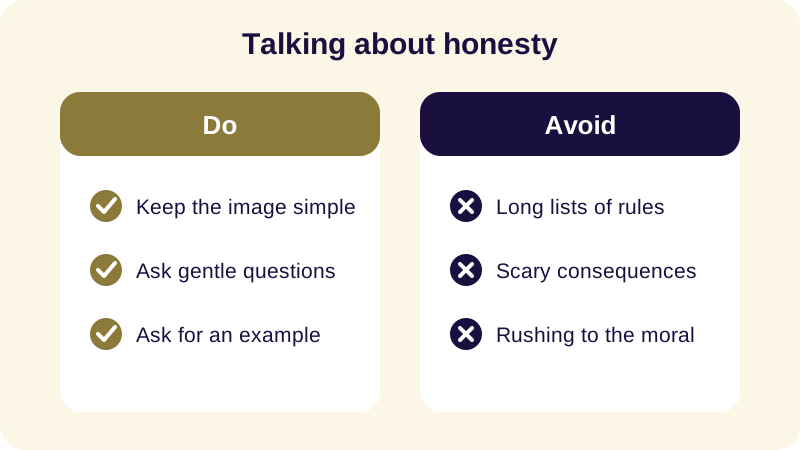
This is also why so many teaching stories in the Buddhist tradition use ordinary objects — a bowl, a pot, a jar of water — instead of abstract ideas. Children remember what they can picture, and a picture that stays with them does more work than a rule they are told to memorize.
How does the Buddha's water pot story teach honesty?
In this well-known scene, the Buddha is washing his feet with water from a pot while his young son sits nearby. When he finishes, there is only a small amount of water left in the bottom. He holds the pot up and asks his son a simple question: is this a little water, or a lot? His son answers that it is very little.
The Buddha tells him that a person who lies without any shame about it is left with about that much — a small, almost nothing amount of honesty left in them. Then he tips the pot over and pours out even that last bit, so the pot is completely empty, and says that someone who has given up truthfulness altogether is like this: nothing left inside at all.
See also: A Buddhist Story About Adapting to Change.
He does not stop there with a warning. He goes on to describe a simple habit: before saying something, while saying it, and after saying it, pause and ask whether it is true and whether it might cause harm. That three-part pause — before, during, after — is really the whole teaching, and it travels well into a child's world, whether the words in question are about a broken toy or a missing cookie.
How can you tell this story to a child at bedtime?
The story works best told slowly, in a quiet voice, without turning it into a test. A few simple beats are enough to carry it from start to finish.
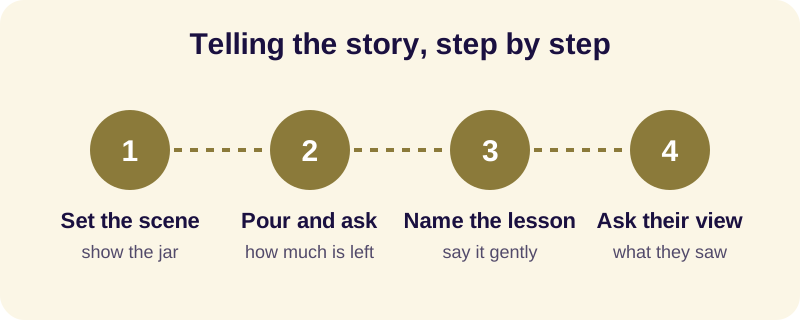
Resist the urge to add a moral at the end in your own words once the story is done. The pause and the question do the work on their own, and a child who is asked "what did you notice?" usually finds something closer to the point than anything an adult could add.
What other Buddhist stories and teachings touch on honesty?
Honesty is not a one-story topic in this tradition. The fourth of the Five Precepts is a commitment to truthful speech, stated plainly and without exceptions carved in for convenience. It sits alongside precepts about not harming others and not taking what isn't given, and children can usually grasp the idea of "a true thing, a kind thing, a timely thing" long before they could follow the Pali term for it.
The Jataka tales — stories of the Buddha's earlier lives, told as animal fables — also return to honesty again and again, usually through a character who could get away with a lie and chooses not to. These make good follow-up listening once the water-pot story has settled in, since the format of "a character faces a small test" repeats itself and becomes familiar and easy to predict, which is part of what makes it calming at night.
How does the Buddha Story app help with honesty stories for kids?
The app narrates stories like these slowly and plainly, without the added commentary that can turn a simple tale into a lecture. A sleep timer stops the story on its own, so nobody has to get up when a child is already drifting off by the final lines.
Background playback and offline listening mean a bedtime routine does not depend on a strong signal or a phone staying unlocked and awake on the nightstand. For parents building a small rotation of calm, honest, unhurried stories, this removes one more thing to manage at the end of a long day. If you want more options for the nights in between, a wider set of Buddhist bedtime stories covers kindness, patience, and letting go as well as honesty, so the rotation does not wear thin.
None of this is a substitute for an actual conversation when something bigger than a bedtime story is going on — if a child is dealing with ongoing anxiety or real trouble telling the truth, that is worth talking through with someone who knows them, not something a story alone is meant to fix. What the water-pot story offers is smaller and more modest: one clear picture, one gentle question, and a few quiet minutes before sleep.
Frequently Asked Questions
What is a good Buddhist story for kids about honesty?
One of the simplest is the water-pot story: the Buddha pours out nearly all the water from a jar and asks his young son what is left. The small amount becomes a picture of what lying does to trust, which is easy for a child to see and remember.
Is the water-pot story suitable for young children?
Yes. It has no scary consequences and no long list of rules — just a jar, some water, and a gentle question. It works well read slowly at bedtime and can be shortened further for very young listeners without losing the point.
How long should an honesty story be for bedtime?
A few minutes is enough. Children settle better with one clear image and a short, calm ending than with a long tale full of twists. The water-pot story can be told in under five minutes and still leave something to think about.
What other Buddhist teachings relate to honesty?
The fourth of the Five Precepts is a commitment to truthful speech, and several Jataka tales show characters choosing honesty over an easy lie. Both can be introduced to children gradually, one short story or idea at a time.