Published
Quick answer
A Buddhist story about compassion for animals often cited is the Banyan Deer Jataka, where a deer king offers his life for a pregnant doe and moves a hunting king to protect every animal in the forest. It works well as a quiet bedtime story about mercy, not guilt.
Key takeaways
- The Banyan Deer Jataka: a deer king offers his life for a pregnant doe, moving a king to spare all animals.
- A separate story has young Siddhartha save a wounded swan instead of letting it be claimed as a trophy.
- The first of the Five Precepts is to refrain from harming any living being, animals included.
- Compassion, one of the four brahmaviharas, extends naturally to animals, not only to people.
- Reading these stories slowly at night gives a busy mind something gentle to settle on instead of worry.
A Buddhist story about compassion for animals that many people return to is the Jataka tale of the Banyan Deer, in which a deer king offers his own life to save a pregnant doe and moves a hunting king to protect every animal in the forest. It comes from the Jataka tales, stories of the Buddha's past lives, and it still works as a quiet bedtime story about mercy.
What is the Buddhist story about compassion for animals called?
The story is the Banyan Deer Jataka, one of the Jataka tales — the collection of 547 stories the tradition tells about lifetimes before the Buddha's final one, in which he appears as a deer, a monkey, a merchant or a king, learning the same lessons of patience and kindness in different bodies.
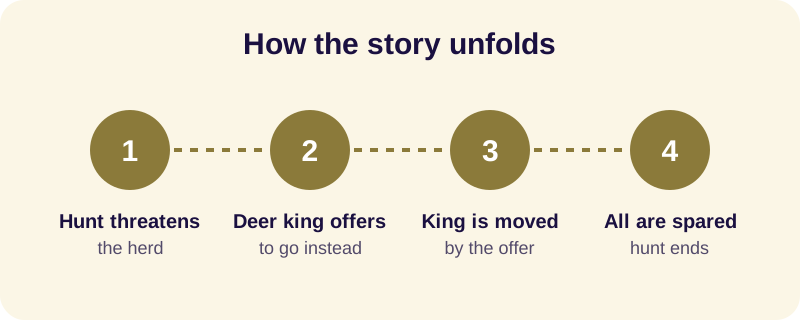
In the tale, two herds of deer share a forest where a king hunts daily, chasing the animals into exhaustion and panic. The two deer kings strike a bargain with him: each day, one deer will walk to the king's table on its own, in rotation, so the rest of the herd can graze in peace instead of living in constant fear. It is a hard arrangement, but it ends the terror of the chase.
One day the turn falls to a doe who is carrying young. She goes to her own herd's leader and asks to be spared until her fawn is born, promising that another will take her place after. He cannot help her — the choice has already been made. So she goes instead to the other deer king, the Banyan deer, and asks him. He has no obligation to her at all; she is not even from his herd. But rather than send her away, he walks to the king's table himself, in her place.
The human king is startled. No animal has ever offered its own life for another's before. When he asks why, the deer king says simply that he could not let her suffer what was not hers to bear alone. The king, moved by what he has seen, spares them both — and then goes further, declaring the hunt over and granting safety to every animal in the forest, not only the deer.
Why does a story about a wounded swan belong here too?
A second story, often told alongside the first, comes from the Buddha's own boyhood as Siddhartha Gautama, long before his awakening under the Bodhi tree. A swan is struck by an arrow and falls, wounded, into a garden. The boy who finds it first pulls out the arrow and tends the wound. Another boy, his cousin, arrives claiming the bird as his by right — he is the one who shot it, after all. The dispute is brought before a council of elders, who decide that life belongs to the one who preserves it, not to the one who tries to end it. The swan is healed and released.
Both stories share the same quiet logic. Compassion for animals here is not sentimentality; it is the plain recognition that another creature's wish to live and to avoid suffering is as real and as urgent as one's own.
How can this story shape how you treat animals day to day?
These tales sit close to the first of the Five Precepts, the training rule to refrain from harming living beings, and to the four brahmaviharas, the four qualities of heart that include compassion toward whatever is suffering, wherever it is found. Neither asks for grand gestures. They point mostly to small, ordinary choices: whether you startle a spider out the window or crush it without a thought, whether you speak roughly or gently to an animal that cannot answer back.
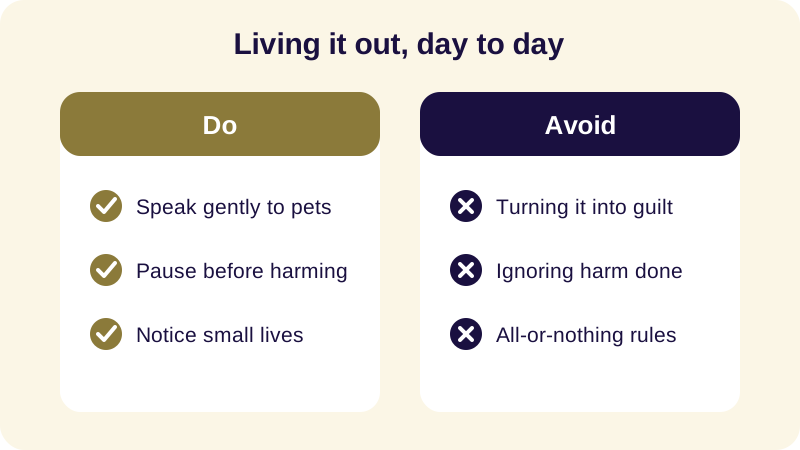
Practice varies widely across Buddhist traditions and individual practitioners; some keep strict diets because of this teaching, many do not. What the stories agree on is the underlying attitude: that a creature's fear or pain is real, and worth noticing rather than stepping around.
How does a story like this help a racing mind at night?
A story about mercy gives a busy mind somewhere gentle to rest its attention. Instead of circling the day's unfinished arguments, you are following a deer walking calmly toward a king's table, or a boy pulling an arrow from a wing. There is no suspense built to keep you alert — the stories move slowly toward resolution, which is exactly what a mind trying to wind down needs.
This is not a treatment for insomnia or anxiety, and a story alone will not resolve a persistent sleep problem — that is worth raising with a doctor. But for an ordinary restless evening, a slow tale about kindness toward a creature that cannot ask for it in words is a reasonable thing to fall asleep to. You can find more of this kind in Buddhist bedtime stories, and the same approach to settling the mind generally is covered in mindfulness for sleep.
Where can you find more stories like this one?
The Jataka tales hold hundreds of variations on this same theme — animals showing patience, generosity or courage toward each other and toward people. The story of the hare who offers himself to a hungry traveller is a close cousin to the Banyan Deer tale, and the full count of Jataka tales gives a sense of how much of this material exists beyond the handful retold most often.
The app narrates stories like these slowly, for listening in the dark rather than reading by lamp light, alongside Dhammapada verses, episodes from the life of the Buddha, and simple guided practices such as loving-kindness and breath awareness. A sleep timer stops the narration on its own, and stories can be downloaded for listening without a connection, so nothing interrupts the quiet once it has settled in.
Frequently Asked Questions
What is the main Buddhist story about compassion for animals?
It is usually the Banyan Deer Jataka, in which two herds agree to send one deer at a time to a hunting king so the rest can live without terror. When the lot falls on a pregnant doe, the deer king offers to go in her place, and the king, moved by this, ends the hunt and protects every animal in the forest.
Is the wounded swan story also a Buddhist teaching?
Yes. It comes from accounts of Siddhartha Gautama's boyhood, before his awakening, when he tended an injured swan his cousin had shot and refused to hand it over as a trophy. A council ruled that life belongs to whoever preserves it, not whoever ends it.
Do these stories mean Buddhists must be vegetarian?
Not necessarily. The first of the Five Precepts asks practitioners to refrain from harming living beings, but how that is lived out varies across traditions and individuals. The stories point to an attitude of care rather than one fixed rule about food.
How can a story like this help at bedtime?
A slow story about mercy gives a busy mind something calm to follow instead of its usual loop of worry. It is not a treatment for insomnia or anxiety; if sleep problems are persistent, that is worth raising with a doctor rather than relying on a story alone.
Where can I hear more stories like this one?
The Jataka tales include hundreds of similar episodes about kindness toward animals, and the app narrates many of them slowly for listening at night alongside other calming material from the Buddhist tradition.