Published
Quick answer
The buddhist story about the wise old turtle is the Jataka tale of a turtle carried through the air by two geese, who falls only when he opens his mouth to answer an insult. It is a teaching about silence, patience and letting unkind words pass.
Key takeaways
- The wise turtle falls only after he breaks his own silence to answer mockery.
- This Jataka tale is one of 547 traditional stories of the Buddha's past lives.
- The fall is a lesson in restraint, not a judgment on cleverness or folly.
- At night, replaying an insult is the mind opening its mouth mid-air.
- The story pairs well with practices for calming a racing mind before sleep.
A Buddhist story about the wise old turtle tells of a turtle so set on answering an insult that it cost him his hold on life itself, even while two geese were carrying him gently through the sky. It belongs to the Jataka tales, the collection of 547 stories about the Buddha's past lives, and underneath the animal plot it is really a teaching about silence.
What is the Buddhist story about the wise old turtle?
The turtle lives in a pond with two geese for friends. One year the pond begins to dry, and the geese, worried for him, offer a way out: they will each take one end of a stick in their beaks, and the turtle will grip the middle with his mouth, and together they will fly him to a lake that never runs dry. There is one condition. He must not speak, not for any reason, until they land.
The turtle agrees, and the three set off. For a while it works exactly as planned. Below them, people look up at the strange shape crossing the sky and point and call out. The turtle hears all of it and says nothing, and the flight goes on.
Why did the wise turtle fall from the sky?
It is a single remark that undoes him. Someone below shouts something mocking about the odd sight of a turtle dangling from a stick, and the words land harder than all the rest. The turtle, stung, opens his mouth to answer back, and loses his grip on the stick the instant he does. He falls, and the story ends there, plainly, without softening it.
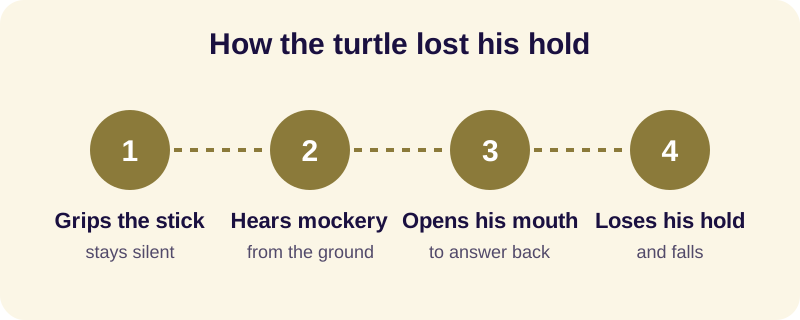
What makes this turtle and geese jataka worth retelling is that the turtle is not foolish for most of the story. He accepts good advice, trusts his friends, and holds his silence through plenty of provocation before the one remark that gets through. The lesson is not "turtles are silly" but something closer to: a long stretch of steadiness can be undone by a single moment you did not guard.
What does the wise old turtle teach about a restless mind at night?
At night the mind often does something close to what the turtle did. It is holding steady, carried along on the breath, and then one thought arrives with a sting in it — an email left unanswered, a comment from earlier, a decision you are still defending — and the mind opens its mouth to reply. The reply is never spoken aloud. It happens entirely inside, as a rehearsed comeback, a better version of what you should have said, a case built and rebuilt. Each round is the mind letting go of the one thing that was keeping it steady to grab at something that was never worth the fall.
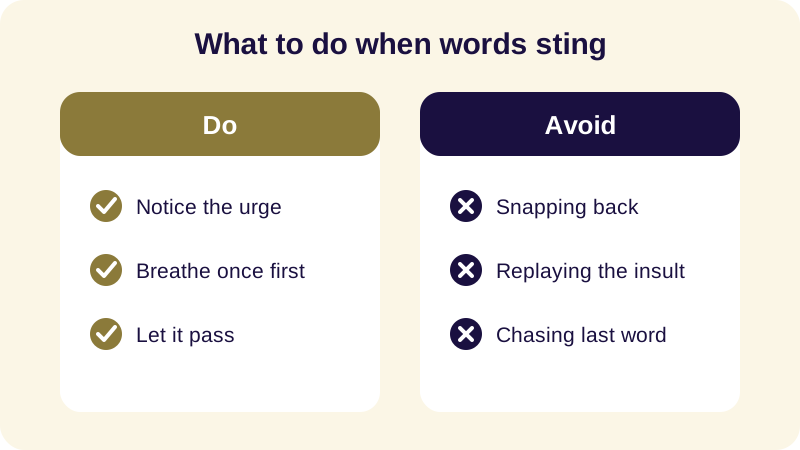
This is close to the territory covered in how to quiet a racing mind at night: the goal is not to silence every thought before it arrives, which is not realistic, but to notice the turtle's mouth starting to open and choose not to follow it. A slower breath, a simple return to the body, or a single line held in mind can take the place of the reply you were about to give. If the pattern is anger specifically — a remark you cannot put down — the story about anger management covers that ground directly.
Are there other wise turtle stories in Buddhist teaching?
Yes. Buddhist literature also uses the image of a turtle surfacing for air through a wooden yoke adrift on a wide ocean, to describe how rare and unlikely it is for any being to meet the conditions for a human life and a chance to hear the teaching at all. It is a different turtle making a different point — not about speech, but about not wasting a rare opportunity once it has come. Between the two turtles, the tradition manages to say something about restraint and something about gratitude using the same quiet, slow-moving animal.
See also: A Buddhist Story About a Lost Traveler and What It Teaches.
Both turtle stories sit comfortably alongside the other animal fables in the Jataka tales, where a monkey, a hare, a deer or a crocodile each carries a single lesson in a short, memorable shape. If this kind of tale suits your evenings, the Jataka tales retold collects more of them, and the monkey and crocodile Jataka tale makes a good next listen, since it shares the same gentle animal cast and the same plain moral delivery.
How can the wise old turtle story become a bedtime practice?
The simplest way to use this turtle jataka tale at night is to retell it slowly to yourself, the way it would have been told aloud centuries ago: the drying pond, the offer from the geese, the quiet flight, the one remark, the fall. You do not need to draw the moral out loud each time. Just noticing where the turtle's mouth opens, and noticing where your own mind tends to do the same thing, is enough.
If you are new to using stories this way, the broader guide to Buddhist stories for sleep covers how a slow narrative occupies a restless mind without demanding anything of it, and the Dhammapada verses for a restless mind pair well with it on nights when a short verse feels more useful than a full tale. None of this is a treatment for insomnia or anxiety; if sleeplessness or worry is a nightly, ongoing problem, that belongs with a doctor rather than a story.
Buddha Story narrates Jataka tales like this one, along with the life of the Buddha, Zen parables and Dhammapada verses, read slowly for listening in the dark. A sleep timer stops the story for you, and offline listening means a weak signal never interrupts the turtle mid-flight.
Frequently Asked Questions
What is the Buddhist story about the wise old turtle?
It is a Jataka tale about a turtle who lives in a drying pond with two geese for friends. When the water fails, the geese offer to carry him through the air gripping a stick in his beak, on one condition: he must stay silent. He agrees, and all goes well until villagers below mock the strange sight, and the turtle opens his mouth to answer back.
Why does the turtle fall in the story?
The turtle falls because he cannot bear to let the mockery pass unanswered. The moment he opens his mouth to reply, he loses his grip on the stick and drops to the ground. The story is careful to show that his undoing is not a lack of intelligence but a lapse in restraint under provocation.
Is this part of the Jataka tales collection?
Yes. It belongs to the Jataka tales, a collection of 547 stories describing the Buddha's past lives in animal and human form, each ending with a plain moral about conduct. The turtle and geese story is one of several animal fables in the set that use a simple plot to carry an ethical point.
What does the wise old turtle teach about anger or insult?
It teaches that wisdom and restraint are not the same as never being provoked. The turtle was wise enough to accept the geese's one condition, and wise enough to keep silent through most of the flight. His fall came from the single moment he let an insult pull a reply out of him.
How can this story help with a racing mind at night?
At night the mind often does what the turtle did: it reopens an old argument to answer it one more time. Treating each replay as the turtle's open mouth, something to notice and not act on, makes it easier to stay with the breath instead of the reply, and let the mind settle.