Published
Quick answer
What is reincarnation in Buddhism? It is usually described as rebirth, not the migration of a fixed soul: a stream of karma and craving that conditions a new life, like one flame lighting another.
Key takeaways
- Buddhism speaks of rebirth, not reincarnation of an unchanging soul.
- Anatta, no fixed self, means nothing permanent travels between lives.
- Karma carries conditioning forward, like one flame lighting another.
- The path aims to end the cycle of rebirth, not just improve it.
- Sitting with this teaching calmly can loosen fear of death rather than feed it.
What is reincarnation in Buddhism? It is usually a loose word for what the tradition itself calls rebirth: a continuity of karma and craving that conditions a new life, without any fixed soul traveling unchanged from one body to the next.
That short answer settles the main confusion people bring to the question, but the longer version is more useful if you actually want to sit with it at night. Buddhism does not deny that something continues after death. It denies that the something is a changeless self.
Is reincarnation the same thing as rebirth in Buddhism?
Not quite, and the difference matters. Reincarnation vs rebirth in Buddhism is really a question about whether a fixed self migrates. The popular idea of reincarnation, borrowed loosely across many traditions, pictures an unchanging soul that steps out of one body and into the next, keeping its identity intact the way a traveler keeps a passport. Buddhism teaches rebirth instead — a process without a traveler.
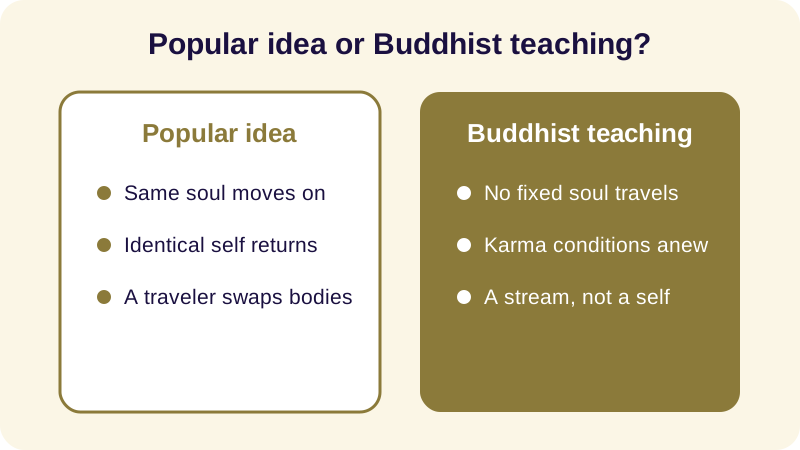
This is where the teaching of anatta — no fixed self — does its work. The five aggregates that make up a person (body, feeling, perception, mental formations and consciousness) are already changing moment to moment while you are alive. Death is simply the most dramatic of those changes, not the one moment a stable soul finally has to move house. For more on how this fits the bigger picture, see what samsara means and the Buddhist teaching on impermanence.
What actually continues from one life to the next?
If there is no fixed self, what travels? The traditional image is a flame lighting another flame: the new flame is not the same flame, and it is not a wholly different one either — it is continuous with it, conditioned by it, but not identical to it. That is closer to how karma in Buddhism is said to work across lives than a soul changing address.
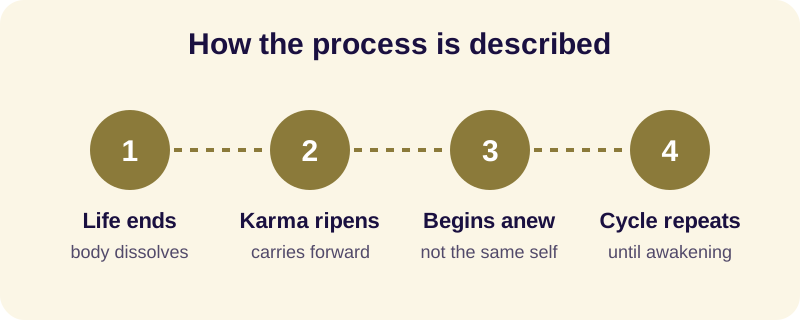
The process is mapped in more detail in the teaching of dependent origination, which traces how craving, clinging and becoming link one moment — or one life — to another. None of the links require a passenger riding along unchanged.
Why doesn't Buddhism teach a soul that reincarnates?
Do Buddhists believe in reincarnation the way it is often pictured in films and folk tales — someone remembering a past life as the same "them"? Mostly, no. The Buddha's teaching of anatta, no fixed self, was a direct response to the idea of an eternal soul passing unchanged from life to life. He taught that clinging to the idea of a permanent self is itself a source of suffering, and that a careful look at experience never turns up anything solid enough to call an unchanging soul.
This is also why the goal of the path, laid out in the Four Noble Truths and the Noble Eightfold Path, is not simply a better rebirth for "you." It is the end of the whole cycle — what the tradition calls liberation from samsara, not an upgrade within it.
What happens after death, then?
The short version: what continues is a pattern of conditions, not a person. For a fuller walk through what the early texts actually say, and what they pointedly decline to say, what happens after death in Buddhism covers the question directly and at more length than fits here.
Does thinking about rebirth actually help at bedtime?
Oddly, yes, for a lot of people — not because it resolves the mystery, but because it reframes it. A mind lying awake at night is often circling a fear of ending, of loss, of not mattering. The rebirth teaching does not promise that you, personally, continue. It suggests that nothing ever stood still in the first place, which is a strange kind of relief: there was never a fixed self to lose.
The Buddha taught this slowly, in stories and discourses meant to be heard more than argued with. The app narrates many of them — Jataka tales, episodes from the life of Siddhartha Gautama, verses from the Dhammapada — read gently enough for a dark room, with a sleep timer that stops the story for you and sounds like rain or singing bowls layered underneath if you want them.
You do not need to settle every question about rebirth to use the teaching well. Sit with the flame image, or the five aggregates, and notice that the mind doing the worrying tonight is itself already in motion, already changing, already not quite the one that woke up this morning. That is the same observation the teaching makes about lives — just at a scale small enough to feel tonight.
Frequently Asked Questions
Is reincarnation the right word for what Buddhism teaches?
Not exactly. Buddhism usually speaks of rebirth rather than reincarnation, because reincarnation suggests a fixed soul moving unchanged into a new body. The teaching of anatta, no fixed self, describes a conditioned stream of karma continuing instead, closer to one flame lighting another than a traveler changing vehicles.
Do Buddhists believe in reincarnation the way popular culture describes it?
Mostly no. Popular depictions often picture the same personality or memories carrying over intact. Buddhism teaches that what continues is a pattern of karma and craving, not a recognizable, unchanged self, so the new life is conditioned by the old one without being the same person reborn.
What is anatta and why does it matter here?
Anatta means no fixed self. The Buddha taught that nothing in experience — body, feeling, perception, mental activity or consciousness — stays the same long enough to count as an unchanging soul, which is why rebirth is described as a continuity of conditions rather than a soul's journey.
Is the goal of Buddhist practice a better rebirth?
Not ultimately. A better rebirth is sometimes described as a result of ethical living, but the deeper aim, set out in the Four Noble Truths and the Noble Eightfold Path, is the end of the whole cycle of rebirth, not simply a more comfortable turn within it.
Can thinking about rebirth help me sleep?
For some people, yes, as a way of sitting with impermanence rather than fighting it. It won't resolve every question about death, but it can loosen the grip of a fear that something fixed in you must be protected or lost. Persistent distress is better discussed with a doctor.