Published
Quick answer
What is right effort in Buddhism? It is the sixth factor of the Noble Eightfold Path: balanced energy that neither strains nor slackens, worked out through the four right efforts to prevent, release, cultivate and sustain states of mind.
Key takeaways
- Right Effort is the sixth path factor, grouped with right mindfulness and right concentration.
- It has four parts: prevent, release, cultivate and sustain mental states.
- Balanced effort feels like steady attention, not forcing or straining.
- At night, it means noticing a racing mind gently rather than fighting it.
- It is a skill built over time, not a single act of willpower.
What is right effort in Buddhism? It is the sixth factor of the Noble Eightfold Path, the steady, balanced energy that keeps the mind from straining or slumping.
In Pali this is called samma vayama, or right effort. It does not mean trying harder at everything. It means putting just enough energy, in the right direction, so the mind can settle instead of fighting itself.
What does right effort mean in Buddhism?
The Buddha is said to have compared the mind to the string of a lute: pulled too tight, it snaps; left too loose, it makes no sound. Right effort is that middle tension, enough energy to stay present, not so much that the mind grips and tires itself out. It belongs to the concentration group of the path, alongside right mindfulness and right concentration, because effort is what keeps attention from collapsing into dullness or spinning off into agitation.
See also: What Is Reincarnation in Buddhism? A Clear Guide.
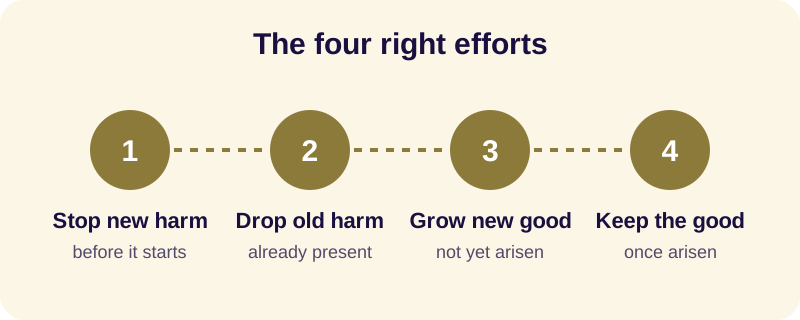
Traditionally this energy is broken into four tasks, the four right efforts. The first is preventing unwholesome states that have not yet arisen: noticing the first pull of a worry before it becomes a spiral. The second is letting go of an unwholesome state already present, the way you might loosen a clenched hand rather than pry it open. The third is encouraging a wholesome state not yet present, such as calling up a little warmth or steadiness when the mind feels flat. The fourth is protecting a wholesome state once it has appeared, so a settled minute is not thrown away by the next stray thought.
How does right effort fit into the Noble Eightfold Path?
The Noble Eightfold Path is usually grouped into three parts: wisdom (right view and right intention), ethical conduct (right speech, right action and right livelihood), and mental cultivation (right effort, right mindfulness and right concentration). Right effort sits in that last group because the other two factors there, paying attention and staying steady, both need some engine behind them. Without effort, mindfulness has nothing sustaining it, and concentration has nothing to return to when it wanders off.
This is also why right effort is usually read alongside the other mental-cultivation factors rather than on its own. The eight factors support each other the way strands of a rope do: see how it connects to right mindfulness and right speech, and how the whole path rests on the Four Noble Truths, to see why effort is described as "right" rather than simply "more."
Why does balanced effort matter for a restless mind at night?
Most people trying to fall asleep are doing one of two things wrong with effort. Either they try too hard, forcing the eyes shut, demanding the mind go quiet, checking the clock to see if sleep has arrived yet, or they give up entirely and let the mind run wherever it wants: scrolling, replaying the day, planning tomorrow. Both are effort problems. One is too tight. The other is too loose.
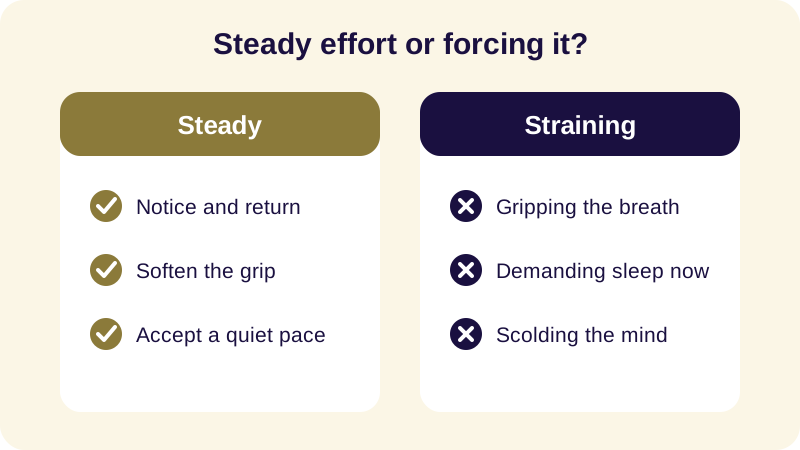
Right effort at night looks much smaller than either of these. It is noticing that the mind has wandered into tomorrow's meeting and returning, without scolding, to the breath or to a story's slow sentence. It is not forcing stillness, and it is not abandoning the attempt either. That middle position is exactly what the lute-string image describes, and it holds up far better across a whole night than gripping or giving up does.
How can you practice right effort before bed?
You do not need a formal sitting practice to use this idea at night. A few small adjustments bring right effort into an ordinary bedtime routine:
- Notice the quality of your attention before trying to fix anything: is it tight, slack, or somewhere reasonable?
- When a thought pulls you away, return to the breath, or to what you are listening to, without treating the wandering as a failure.
- If you catch yourself gripping, clenching the jaw, holding the breath, checking the time, deliberately soften.
- If you catch yourself giving up entirely, reaching for the phone, letting the mind spiral, bring back a little attention rather than a full effort.
- Let the practice end when it ends. Right effort does not require finishing anything; it only asks for a steady, repeated return.
Does right effort mean forcing yourself to meditate?
No. Right effort is sometimes confused with discipline in the sense of pushing through resistance, but the Buddhist sense is closer to tuning than to pushing. A string forced tighter and tighter does not produce a better note; it breaks. A mind pushed past what it can sustain does not become calmer either. It becomes more tired and more resistant.
This distinction matters most on nights when nothing seems to be working. The instinct is to try harder: a longer meditation, a stricter rule about screens, more pressure on yourself to get it right. Right effort suggests the opposite move on a bad night: scale down, soften, and let a small, steady attempt be enough. If sleeplessness or anxiety is a nightly, persistent problem rather than an occasional restless evening, it is worth speaking with a doctor. Right effort is a way of relating to the mind, not a treatment for a medical condition.
The idea of balance also shows up in the Buddha's broader approach to practice, often summed up as the Middle Way between indulgence and self-denial. Right effort is that same Middle Way applied to the moment-by-moment work of attention: not the easiest possible path, and not the hardest, but the one that can actually be sustained night after night.
For a slower way into these ideas at night, stories can do some of this work for you. A Jataka tale or a passage from the Dhammapada gives the mind something steady to follow, which is itself a quiet form of right effort: enough to hold attention, not enough to strain it.
Frequently Asked Questions
What is right effort in Buddhism?
Right effort (samma vayama) is the sixth factor of the Noble Eightfold Path. It means applying balanced energy to the mind: enough to stay alert and engaged, not so much that you strain, grip or exhaust yourself trying to control your thoughts.
What are the four right efforts?
They are: preventing unwholesome states that have not yet arisen, letting go of ones already present, cultivating wholesome states not yet present, and sustaining wholesome states once they appear. Together they describe a complete, balanced approach to the mind's energy.
Is right effort the same as willpower or self-discipline?
Not quite. Willpower often means pushing through resistance by force. Right effort is closer to tuning an instrument: finding the pressure that lets the mind work well, which sometimes means pushing less, not more, especially when you are already tired.
How does right effort relate to sleep?
Many restless nights come from effort that is too tight (forcing sleep) or too loose (letting the mind run wild). Right effort is the middle path: noticing a wandering thought and returning gently, without gripping or giving up entirely.