Published
Quick answer
If you want to know how to develop compassion for yourself, start by speaking to your own pain the way you would to a friend, using a short phrase instead of an argument. This is metta, loving-kindness, turned inward.
Key takeaways
- Self-compassion means addressing your own mind the way you would speak to a friend in pain.
- Metta, loving-kindness phrases work through repetition, not through forcing a feeling.
- Self-pity and harsh self-judgment are both off to the side of genuine self-compassion.
- A short phrase practice at night can soften self-criticism gradually, not instantly.
- Persistent, severe self-criticism or distress is worth bringing to a doctor or therapist.
Learning how to develop compassion for yourself starts with one practical shift: speak to your own mind the way you would speak to a tired friend, using short, repeated phrases instead of an internal argument. This is the heart of metta, loving-kindness practice, turned inward rather than aimed only at others.
What does self-compassion actually mean?
Self-compassion is not a mood you summon by trying harder to feel good about yourself. It is a practical response to pain: you notice that something hurts, you name it plainly, and you offer yourself the same basic goodwill you would offer someone else in the same spot. That is it. No self-esteem project, no fixing, just a change in how you address your own difficulty.
In Buddhist terms, this sits inside a wider practice called metta, loving-kindness, one of the four brahmaviharas alongside compassion, sympathetic joy and equanimity. Traditional metta instruction usually begins with yourself, on the reasoning that it is hard to wish others well from a place of harsh self-judgment. You are not the last person on the list. You are, deliberately, the first.
See also: How to Practice Non Judgment in Daily Life.
This is self-compassion described in Buddhist terms rather than invented from scratch: the aim is to loosen the habit of treating your own suffering as less worthy of kindness than anyone else's.
How do you actually practice it, step by step?
The practice is simple enough to do lying down in the dark, which is partly why it suits an evening routine. It does not require believing anything in particular, only a willingness to try a few plain words instead of the usual replay of the day.
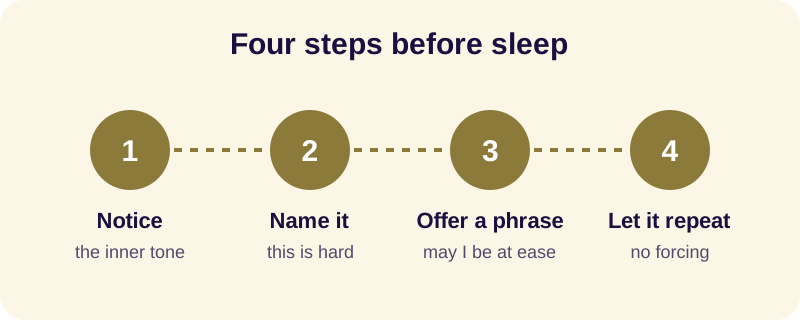
- Notice the tone. Before anything else, just register how you are talking to yourself right now — harsh, flat, exhausted, indifferent. You are not fixing it yet, only noticing it the way you'd notice weather.
- Name the difficulty plainly. Put the day's hard moment into a short sentence: "that conversation went badly" or "I'm tired and worried about tomorrow." Keep it factual, not dramatized.
- Offer a simple phrase. Traditional metta phrases work well here: "may I be safe, may I be at ease, may I be free from this struggle." You can shorten them to whatever fits your own voice.
- Let the phrase repeat without checking for results. You are not waiting to feel a wave of warmth. You are simply repeating the phrase a dozen times, the way you'd let a tide come in on its own schedule.
If the words feel awkward or insincere at first, that is normal and not a sign you are doing it wrong. The loving-kindness practice page walks through the full phrase sequence in more detail, including how to extend it outward to others once the self-directed version feels familiar.
What usually gets in the way of self-compassion?
Most people who try this run into one of two obstacles: either they turn it into another task to perform well, or they confuse it with excusing themselves from anything that needs changing.
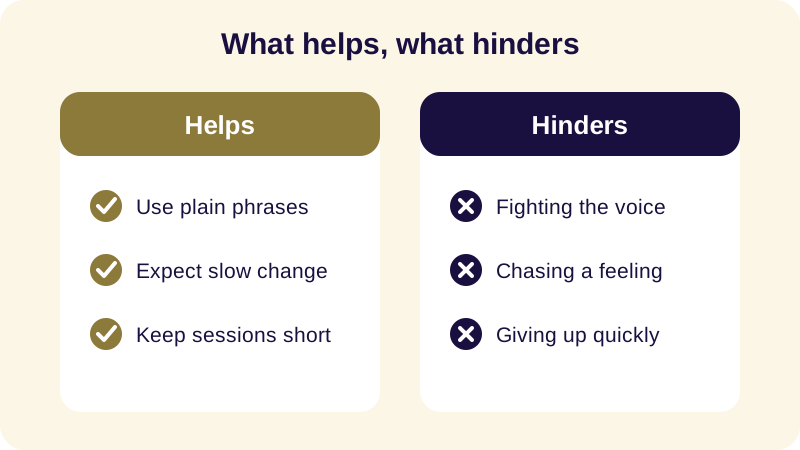
The teaching known as the second arrow is useful here: the first arrow is the hard thing that happened; the second is what we add on top of it by attacking ourselves for having a hard time at all. You can read more about that distinction in the second arrow story, which is a good companion to this practice.
Is self-compassion the same thing as self-pity?
No, and the difference matters. Self-pity tends to circle a grievance — how unfair this is, how much worse it is for you than for anyone else — and that circling can leave you more stuck than before. Self-compassion names the difficulty plainly and then offers care, without needing the situation to be exceptional to deserve it.
One way to hold the balance is to remember that self-compassion does not excuse you from the Five Precepts or from ordinary responsibility. It simply removes the extra layer of self-punishment that usually gets added on top of an honest mistake. You can still resolve to do better tomorrow; you just don't need to be cruel to yourself tonight in order to mean it.
What if the self-criticism feels too strong to shift?
Some nights a short phrase practice is enough to soften the edge of a hard day. Other times, self-criticism is part of something heavier — ongoing low mood, anxiety, or a pattern that doesn't lift no matter what you try. A nightly practice is not a substitute for that kind of support. If self-criticism is severe, persistent, or tangled up with real distress, that belongs with a doctor or a qualified therapist, not with a phrase repeated in the dark.
For an ordinary restless evening, though, a brief return to self-compassion Buddhism style — a few minutes of plain phrases, maybe paired with the four brahmaviharas more broadly — is a reasonable, low-stakes thing to try before sleep.
How can Buddha Story support this practice?
The app includes guided meditation built around loving-kindness, along with body scan and breath awareness sessions, narrated slowly for listening in the dark. If words of self-compassion are hard to generate on your own at the end of a long day, a guided version gives you the phrasing and the pacing, so all you have to do is listen and let your attention follow along. It also includes Jataka tales, the life of the Buddha, Dhammapada verses and Zen parables, a sleep timer that stops the story for you, and offline listening with background playback, so the practice is there on the nights you need it most.
Frequently Asked Questions
How do you develop compassion for yourself if you're used to being harsh on yourself?
Start small and specific. Instead of trying to feel warmly toward your whole self, pick one recent moment you were hard on yourself and silently offer it a plain phrase, such as 'this was hard' or 'may I be kind to myself here.' Repetition over argument is what shifts the tone.
Is self-compassion the same as self-pity?
No. Self-pity tends to dwell on how unfair things are and can leave you feeling more stuck. Self-compassion acknowledges the difficulty plainly and then offers care, the way you would to someone else, without needing the situation to be special or unfair to deserve kindness.
What is metta and how does it relate to self-compassion?
Metta is the Pali word for loving-kindness, one of the four brahmaviharas. Traditional metta practice often begins with directing goodwill toward yourself before extending it outward, which is why it is a natural, structured way to practice self-compassion rather than a vague intention.
Can practicing self-compassion at night help me sleep?
A brief phrase practice can quiet the inner voice that replays mistakes, which is often what keeps a tired mind awake. It is not a cure for insomnia; if sleep trouble or self-criticism is severe or ongoing, it is worth discussing with a doctor.