Published
Quick answer
What happens after death in Buddhism, in short: no fixed soul survives, but karma and habitual patterns of mind condition a new life, continuing the cycle of samsara until craving is fully released at nirvana.
Key takeaways
- Buddhism teaches rebirth, not an unchanging soul moving from one life to the next.
- Karma, the force of intentional action, shapes the conditions of the next life.
- The six realms of samsara are traditional categories of rebirth, not literal rewards.
- Nirvana is described as the end of the cycle, not another realm to be reborn into.
- Reflecting on mortality is a recognised contemplation, not a cause for dread.
What happens after death in Buddhism is not one dramatic event but a continuation: habits of mind, shaped by karma, carry forward into a new life, with no fixed, unchanging soul making the trip. The classical answer is rebirth, not resurrection, and it works more like a chain of cause and effect than a journey of a soul.
What actually happens at the moment of death?
Buddhism describes a person as five changing processes — body, feeling, perception, mental formation and consciousness — rather than one fixed thing. At death these processes stop functioning together, but the very last moment of consciousness, coloured by a lifetime of intention, immediately conditions a new moment of consciousness arising elsewhere. Nothing solid crosses over; what continues is closer to a pattern than a passenger.
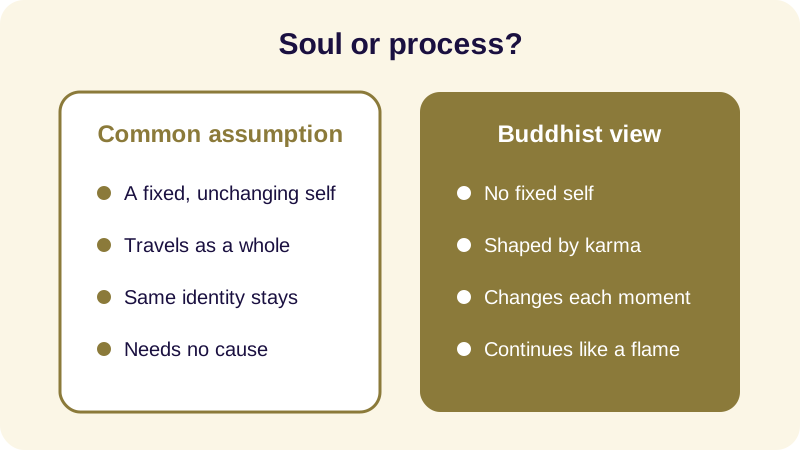
The traditional image is a candle flame used to light a second candle before the first burns out. The new flame is not the old one, yet it would not exist without it. Karma — intentional action — supplies the direction; dependent origination describes the longer causal chain that links one moment of mind to the next, death included.
If there is no soul, what gets reborn?
Nothing permanent is reborn, which is one reason the tradition prefers the word rebirth to reincarnation. What continues is a stream of conditioned tendencies — habits, cravings, unfinished intentions — the way a river keeps a recognizable shape while none of its water stays the same from one moment to the next.
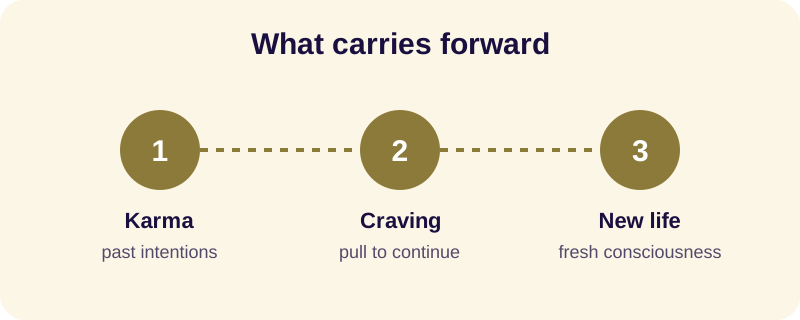
Three things are usually named as carrying the process forward. Karma supplies the shape — the accumulated weight of past intentions. Craving supplies the pull — the wanting that keeps reaching for a next moment of experience. And a fresh moment of consciousness supplies the starting point of a new life, conditioned by, but not identical to, the consciousness that ended the last one.
How does karma shape what comes next?
Karma means intentional action, not fate or punishment handed down from outside. A habit of generosity, patience or honesty leaves a different trace on the mind than a habit of grasping or cruelty, and Buddhism treats that trace as part of what conditions the next moment — including, over a lifetime, the next life. The Five Precepts are often described as training for exactly this: fewer harmful intentions building up, fewer difficult traces to carry forward.
Cultivating the four brahmaviharas — loving-kindness, compassion, joy and equanimity — works the same way in the other direction, building habits of mind said to make both this life and whatever follows it lighter to carry. None of this requires believing in the cosmology to be useful; it works as a description of how repeated intention shapes character, which most people can test for themselves without reference to any afterlife at all.
Where is someone reborn, according to Buddhism?
Traditional accounts describe six realms turning on the wheel of samsara: god, demigod, human, animal, hungry ghost and hell realms. None of them is final. Even a long, pleasant rebirth among the gods ends once its particular karma is used up, and the cycle continues from there.
Many practitioners today also read the realms psychologically as well as literally — a grasping mind resembling the hungry-ghost realm, a competitive mind resembling the demigod realm — which makes the teaching useful as a map of present-moment states, not only a map of what comes after death.
Does the cycle of rebirth ever end?
Yes — that is the stated aim of the entire path. The Four Noble Truths name the craving that keeps the cycle turning and the Noble Eightfold Path as the way to loosen it. Nirvana is described as the end of being driven by that craving, not a better realm to be reborn into next; Siddhartha Gautama's awakening under the Bodhi tree is the tradition's central account of what that release looks like.
What practice does Buddhism recommend around death?
Rather than resolving the question once and for all, the tradition recommends sitting with it on purpose. Reflecting deliberately on mortality — one's own and everyone else's — is a recognised contemplation, meant to loosen the grip of denial without tipping into dread. The point isn't to feel at peace with death immediately; it's to stop flinching from the subject long enough to think about it clearly.
In practice this often looks like ordinary meditation: watching the breath, noticing thoughts arise and pass, practising loving-kindness toward oneself and others. These are the same tools used for an ordinary restless night, which is part of why a teaching about death ends up living comfortably alongside teachings about sleep.
Why does any of this matter for a restless night?
Turning death over at 2am is common, and this teaching is not offered as a way to resolve every question about it before morning. What it offers instead is a way to sit with change that doesn't require denial on one side or dread on the other — the same impermanence that ends a life also ends a bad mood, a hard week, an old grudge, which is the territory the teaching on impermanence covers more directly.
For a plainer account of what the Buddha is recorded as saying directly about dying, see what Buddha says about death. The Middle Way applies here too: neither clinging to a fixed self that must somehow be rescued, nor concluding that nothing matters because nothing lasts.
Buddha Story narrates stories built from this same territory — Dhammapada verses on impermanence, Jataka tales about letting go, and episodes from the life of the Buddha — read slowly, for listening in the dark rather than studying by daylight. A sleep timer stops the story for you instead of leaving it running all night, and offline listening and background playback mean the narration keeps going quietly after the screen goes dark.
Frequently Asked Questions
What happens after death in Buddhism?
Buddhism describes death as a transition rather than an ending. The body's aggregates dissolve, but the last moment of consciousness, shaped by a lifetime of karma, conditions a new moment of consciousness elsewhere. No fixed soul travels between lives; what continues is a pattern of habits and intentions, not an unchanging person.
Does Buddhism believe in an eternal soul?
No. Buddhist teaching rejects the idea of a permanent, unchanging self that survives death intact. What continues is a conditioned stream of mental habits and karma, compared to one candle flame lighting another: connected and dependent, but not identical.
What are the six realms of rebirth?
The six realms — god, demigod, human, animal, hungry ghost and hell — are traditional categories describing where rebirth can occur on the wheel of samsara. None is permanent; even a pleasant rebirth ends once its karma is used up, and the cycle continues.
Can the cycle of rebirth end?
Yes. The Four Noble Truths describe craving as what keeps the cycle turning, and the Noble Eightfold Path as the way to loosen it. Nirvana is described as the end of that cycle, not another realm to be reborn into.
Is this teaching a substitute for dealing with grief or fear of death?
No. It is a traditional framework for thinking about mortality and change, not a treatment. If thoughts about death cause lasting distress, that is worth discussing with a doctor rather than relying on a teaching alone.