Published
Quick answer
The Buddhist view on dreams sees them as conditioned mental events shaped by the body, memory and mood, not fixed messages from outside the mind. Most schools encourage noticing a dream without clinging to its meaning, the way any thought is met in meditation.
Key takeaways
- Buddhist teaching generally treats dreams as conditioned mental events, not fixed omens or messages.
- The mind that dreams is the same mind at work in waking thought, shaped by habit and mood.
- A settled evening mind tends to carry less unfinished business into sleep, though nothing is guaranteed.
- Meeting a dream without adding a story to it mirrors how mindfulness meets any passing thought.
- Persistent nightmares or broken sleep are worth raising with a doctor rather than solving through practice alone.
The Buddhist view on dreams treats them as ordinary products of a conditioned mind, not as messages sent from somewhere outside you. A dream arises the way any thought arises: shaped by causes, held together for a while, then gone.
What is the Buddhist view on dreams?
In most Buddhist traditions, a dream is simply another mental event, no more mysterious in principle than a daydream or a passing worry. It is coloured by the day just lived, by the state of the body, by whatever mood is strongest at the moment sleep arrives. Nothing about a dream sits outside the ordinary chain of cause and effect that the teaching calls dependent origination — one condition giving rise to the next, nothing arising entirely on its own.
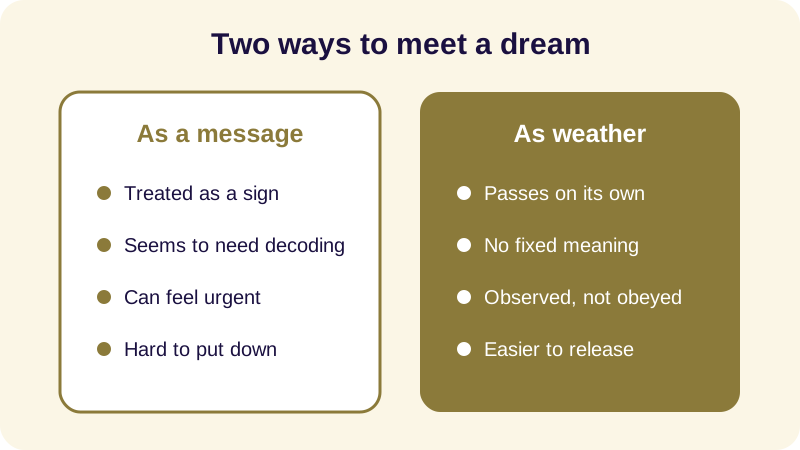
That does not mean dreams are dismissed as nothing at all. Buddhist tradition preserves a well-known dream said to have come to Siddhartha Gautama on the night before his awakening under the Bodhi tree. But the texts put far more weight on what he did awake — sitting still, watching the mind directly — than on the content of the dream itself. The lesson carried forward is less "read your dreams" and more "notice your mind," whether it happens to be dreaming or wide awake at the time.
A strong, recurring dream is usually explained the same way a recurring thought is: as the trace of a habit of mind, something rehearsed often enough that it surfaces on its own, rather than as a special delivery meant only for you. Seen this way, a dream says more about what the mind has been carrying lately than about anything waiting outside it.
Are dreams meaningful, or just mental noise?
Here the tradition resists a simple yes or no. A dream can feel loaded with meaning — a face from years ago, an old argument replayed, a fall that jolts you awake — and Buddhist teaching does not insist that feeling is false. What it questions is the next step: the story built on top of the dream, the conclusion that it must mean something about your character, your future, or some hidden warning. That habit of adding a story to an experience is the same one named in the second arrow teaching — the first arrow is the dream itself, the second is everything the mind adds afterward.
This fits with the wider teaching on impermanence: every mental state, waking or dreaming, is already passing as it arises. A dream does not need to be solved. Mostly, it needs to be let go of — the same quiet skill practised with any thought that arises during sitting meditation.
Can meditation change the dreams you have?
Nothing in the teaching promises a particular dream in exchange for practice. What a settled evening mind can offer is less unfinished business — fewer half-formed arguments and loose threads for the night to pick up and run with. A short period of breath awareness or meditation before bed, or a slow body scan, tends to leave the mind quieter going in, which is as much as the practice honestly promises.
Loving-kindness, one of the four brahmaviharas, is often used for this same reason. Spending a few minutes silently wishing yourself and others well before sleep does not guarantee a particular night, but it gives the mind something warm to settle on instead of whatever it was replaying moments before.
For a fuller routine, see our guide to a Buddhist practice for a sleepless mind, which walks through breath work and loving-kindness specifically for the hours when sleep will not come.
What should I do when a dream wakes me at night?
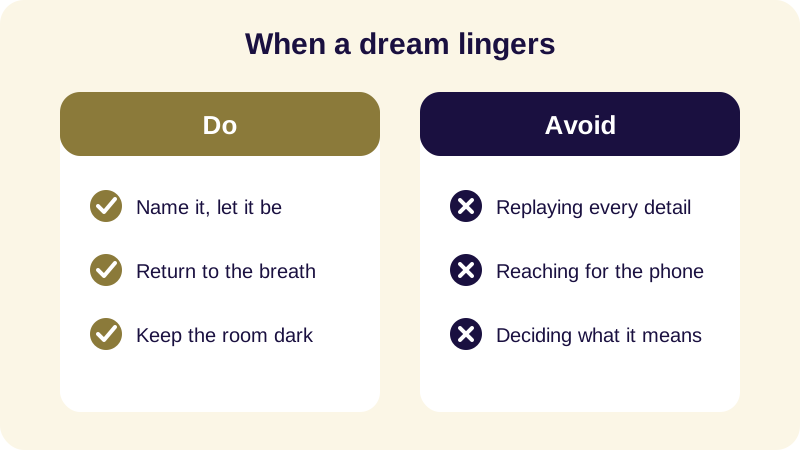
The same approach used for any disturbance applies here: notice it, name it plainly, and resist the pull to analyse it at three in the morning. A short, deliberate sequence helps more than lying still trying to work out what a dream "meant."
- Notice you are awake, and notice the dream is already over.
- Name it silently — "a dream" — rather than replaying the scenes.
- Bring attention to the breath, or to the weight of the body on the bed.
- If the mind keeps returning to the dream, let it; just don't follow it anywhere new.
- Give the body permission to rest, whether or not sleep comes right away.
Can an app help after a restless, dream-filled night?
Sometimes the most useful thing is simply somewhere steadier for attention to go. The Buddha Story app narrates Jataka tales, episodes from the life of the Buddha, and Dhammapada verses slowly, with English narration built for listening in the dark rather than for daytime study. A built-in Sleep Timer stops the story and any sounds once it ends — it does not fade them out — so nothing is left playing to pull the mind further from sleep. The sound mixer, background playback and Offline Mode all serve the same quiet purpose: give a restless mind something steady to follow instead of the loop it was just caught in.
For the hours before a dream can even start, our evening routine guide and a page of Dhammapada verses for a restless mind both work from the same idea at the centre of the Buddhist view on dreams: the mind settles not by force, but by being given something simple and kind to rest on.
Frequently Asked Questions
Does Buddhism believe dreams predict the future?
Not as a central teaching. Folk belief around dreams varies across Buddhist cultures, but the core teaching treats a dream as a conditioned mental event like any other thought, arising from causes rather than carrying a fixed message about what is to come.
What did the Buddha say about dreams?
Buddhist tradition recounts a dream connected to the night before Siddhartha Gautama's awakening under the Bodhi tree, but the texts emphasize what he did while awake, watching the mind directly, far more than the content of any dream.
Can meditation stop nightmares?
There's no promise that meditation changes what you dream. Settling the mind before sleep through breath awareness or loving-kindness can mean less unfinished worry going into the night, but frequent, distressing nightmares are worth discussing with a doctor.
Why does Buddhism say not to over-interpret a dream?
Because the teaching distinguishes the dream itself from the story added afterward — the worry, the omen-reading, the conclusion drawn about your life. That added layer, not the dream, is usually what causes lingering distress.