Published
Quick answer
An app for breath awareness meditation narrates the anapanasati practice of resting attention on the breath, guiding you to notice, count and return when the mind wanders. It helps at night because it gives a restless mind one simple thing to follow.
Key takeaways
- Breath awareness meditation (anapanasati) means noticing the breath, not controlling it.
- A good app offers guided meditation, a sleep timer and offline listening.
- The practice is described in the Satipatthana Sutta, one of the oldest mindfulness texts.
- Mind-wandering is normal; the method is simply to notice and return to the breath.
An app for breath awareness meditation gives you a narrated guide for anapanasati — the traditional practice of resting attention on the breath — instead of sitting in silence trying to remember the instructions yourself. It turns a simple method into something you can follow with your eyes closed, in bed, at the end of a long day.
The practice behind it is older than any app, and that is part of its appeal. It does not ask you to learn a new belief system or sit a particular way. It asks you to notice one ordinary thing — your own breathing — which is already happening, free of charge, whether you pay attention to it or not.
What does an app for breath awareness meditation actually guide you through?
The practice itself is old and plain. You bring attention to the physical sensation of breathing — air at the nostrils, the rise and fall of the chest or belly — and you keep returning to it, over and over, every time the mind wanders off. It is described in the Satipatthana Sutta, one of the oldest texts on mindfulness, where attention to the breath is the very first instruction given.
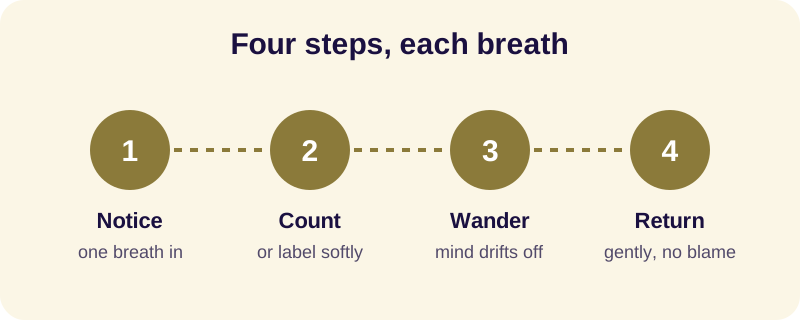
A narrated anapanasati meditation simply says this out loud, at the pace it actually takes: notice this breath, let it go, notice the next one, and come back without scolding yourself when you drift. That last part matters more than people expect. The mind will wander constantly — that is not a failure of the method, it is the method. Coming back is the entire practice, repeated as many times as it takes, and a narrator who keeps restating the instruction gently makes that repetition far easier to sustain than trying to remember the steps yourself in the dark.
Some sessions add a simple count — one on the in-breath, two on the out-breath, up to ten and back to one — purely as a light anchor, not a target to hit perfectly. Others use plain labels like "in" and "out." Neither is more correct than the other; the counting or labelling is scaffolding, there to be dropped once attention settles on its own.
Why does breath awareness help a mind that will not switch off?
A racing mind at night is usually a mind still trying to finish something — a conversation, a decision, tomorrow's schedule. The breath gives it somewhere else to go: a single, physical, present-tense sensation that cannot be argued with or planned around. There is nothing to solve about the next breath. It is simply there.
This is not a claim that breath awareness cures insomnia or anxiety — it does not, and persistent sleep or anxiety problems belong with a doctor, not an app. What it does, on an ordinary restless night, is give the thinking mind a smaller, kinder job than rehearsing the day. For people exploring this alongside other Buddhist meditation for insomnia practices, breath awareness is usually the simplest one to start with, because it needs no imagery and no memorised phrases.
It also pairs naturally with other evening habits rather than replacing them. Some people use a short breath session to settle the body first, then move into a narrated story once the racing thoughts have quieted a little — the breath does the settling, the story does the carrying into sleep.
What should you look for in a breath awareness meditation app?
Not every guided breath meditation app is built the same way. Some are brisk and instructional, aimed at a morning commute; others are slow and quiet, meant to be listened to lying down with the lights off. For bedtime use, the pacing matters as much as the content.
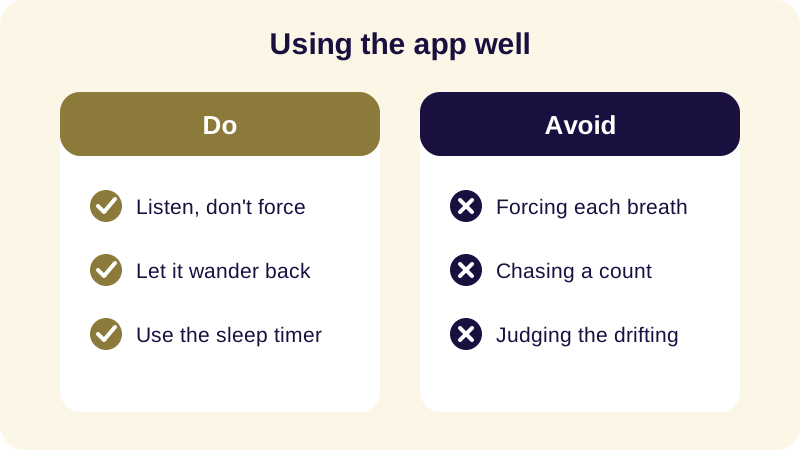
A few practical things make a real difference for nighttime use: a voice that stays slow and even rather than brisk, a sleep timer that stops the session for you, and offline playback so a weak signal at midnight does not interrupt the session. Background playback matters too — locking the phone and leaving the screen dark is part of what makes this different from scrolling. If you are new to sitting practice altogether, meditation for beginners is a gentle place to start before adding breath-specific sessions.
It also helps to have some flexibility in session length. Some nights call for a brief few minutes of noticing before sleep; other nights, when the mind is particularly loud, a longer session gives the attention more time to settle. An app that offers a short range of lengths, rather than one fixed recording, tends to fit more evenings than a single rigid track.
How do you start using an app for breath awareness meditation tonight?
You do not need a special posture or a long block of time. A short session before sleep is enough to try the method and see whether it suits you.
- Lie down or sit comfortably, somewhere you will not be disturbed for a few minutes.
- Open a guided meditation session for breath awareness rather than starting unguided the first time.
- Set a sleep timer so the narration stops on its own after you drift off.
- Let the voice direct your attention to the breath — nostrils, chest or belly, whichever is easiest to feel.
- Every time the mind wanders, notice it without judgment and come back to the next breath.
- If you fall asleep partway through, that is not a failure — it is simply the session doing its job.
A mindfulness of breathing app works best as a small, repeatable habit rather than an occasional rescue attempt on the worst nights. If you want to build that habit, a short piece on how to start a daily meditation habit covers how to make it stick without turning it into another task.
Breath awareness meditation does not promise a particular speed of falling asleep, and it is not a substitute for medical care if sleep or anxiety problems are ongoing. What it offers, reliably, is a simple place to put a busy mind for a few minutes — something to notice, something to return to, breath after breath, until the evening finally goes quiet on its own.
Frequently Asked Questions
What is breath awareness meditation?
Breath awareness meditation, called anapanasati in Pali, is the practice of resting attention on the physical sensation of breathing — at the nostrils, chest or belly — and gently returning whenever the mind wanders. It needs no special breathing technique, only ordinary noticing.
Do I need an app to practice breath awareness meditation?
No, but a narrated app gives the mind a voice to follow instead of relying on willpower alone. For a restless mind at night, having someone else hold the structure — when to notice, when to return — is often easier than doing it unguided.
How is breath awareness different from counting sheep?
Counting sheep is meant to be boring enough to bore you to sleep. Breath awareness is meant to be interesting enough to hold gentle attention without effort — you are not trying to empty the mind, only to keep bringing it back to one simple sensation.
Can breath awareness meditation help with anxiety at night?
Many people find that resting attention on the breath settles an anxious evening mind, because it interrupts rehearsing and worrying. It is not a treatment for anxiety or insomnia; persistent sleep or anxiety problems are worth raising with a doctor.
Is breath awareness meditation a Buddhist practice?
Yes — it is one of the oldest instructions in the tradition, described in the Satipatthana Sutta. You do not need to be Buddhist to use it; it works as a plain, secular technique for settling attention, whatever your beliefs.