Published
Quick answer
Buddhist chants for sleep and relaxation are slow, repeated recitations, like the Metta Sutta or a short mantra, that give a busy mind one steady sound to follow instead of the day's thoughts, easing it toward rest.
Key takeaways
- Buddhist chants for sleep work through rhythm and repetition, not meaning or instruction.
- Pali chanting, mantra repetition and chant-with-music are three common styles to try.
- A slow chant naturally slows the breath, which helps calm an aroused mind.
- Pair a chant with a sleep timer so the sound stops instead of looping all night.
- Persistent sleep trouble is a question for a doctor, not just an evening chant.
Buddhist chants for sleep and relaxation work by giving a busy mind one slow, repeated sound to follow instead of the day's leftover thoughts. A few minutes of steady chanting, listened to rather than performed, is often enough to loosen the grip of a racing mind at bedtime.
This guide explains what these chants are, why the pattern of chanting settles a restless mind more than it stimulates it, and how to bring one into an ordinary bedtime routine without needing to understand Pali or become a practising Buddhist.
What are Buddhist chants for sleep and relaxation, exactly?
Chanting, in Buddhist traditions, means speaking a text aloud in one steady rhythm rather than reading it silently. The content is usually something ordinary and well-worn: a passage of loving-kindness like the Metta Sutta, a verse from the Dhammapada, or a short phrase repeated on a single breath. What makes it a chant rather than a reading is the pace — slow, even, with no rush to finish the sentence.
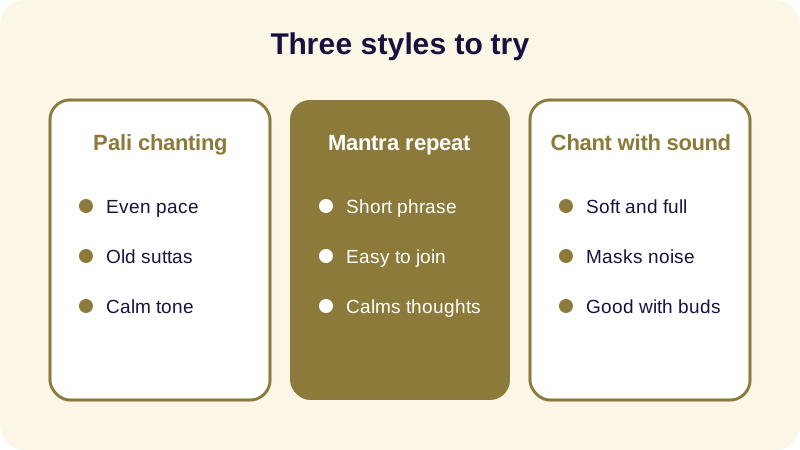
Mantra chanting for relaxation repeats one short phrase many times, which is easier to drift along with when you are already half asleep. Chant layered with music or singing bowls adds a fuller, wash-like sound that can cover household noise without adding words to follow. Metta sutta chanting is often the easiest entry point of the three, because the words themselves are built around safety and goodwill rather than anything to analyse.
Chanting has been part of Buddhist practice for some 2,500 years, long before recorded audio existed. Monks would recite suttas like the Metta Sutta or Satipatthana Sutta aloud together, partly as teaching and partly as a shared, calming close to the day. Hearing a chant now, through headphones instead of across a monastery hall, taps the same basic effect: a voice, a rhythm, nothing urgent to decide.
Why does chanting help a racing mind settle at night?
A mind that will not stop at bedtime is usually still working on something — an unfinished conversation, tomorrow's list, a worry turned over one more time. Chanting does not argue with that mind or ask it to stop; it gives it something else to do. Following a steady, repeated sound uses the same part of attention that would otherwise be rehearsing the day, and it is far less demanding than thought, so attention eventually slackens on its own. The article on quieting a racing mind at night covers the same mechanism from a few other angles.
Breath plays a part too. Spoken chanting, and listening to it, naturally slows the breath to match the length of a phrase, and a slower breath is one of the few direct levers the body has over an aroused nervous system. You do not need to chant aloud yourself for this to work — hearing a chant at an unhurried pace tends to pull your own breathing toward its rhythm within a minute or two. Many chants built around loving-kindness carry the same intention as the four brahmaviharas — wishing safety and ease for yourself and others — which is itself a quiet undoing of the alertness that keeps a mind scanning for problems late at night.
Is chanting different from guided meditation or narrated stories?
All three are forms of calming bedtime listening, but they ask different things of your attention. A guided meditation gives instructions — notice the breath, relax the shoulders — which keeps a thin thread of following-along active. A narrated story, like the Jataka tales or an episode from the life of Siddhartha Gautama, gives you a plot to loosely track. A chant gives you neither instructions nor plot, just sound and rhythm, which is why many people find it the easiest of the three to stop following altogether.
| Form | What you follow | Good for |
|---|---|---|
| Chanting | Rhythm and tone, little or no meaning | Letting go of thought entirely |
| Guided meditation | Simple spoken instructions | A mind that needs a task to settle |
| Narrated stories | A gentle unfolding plot | A mind that wants something to picture |
Some recordings sit between chant and teaching: short sets of the Dhammapada's 423 verses, read in a steady, chant-like cadence rather than a narrative one. These carry a simple idea rather than no meaning at all, which can suit a mind that likes a little substance to rest on. If you want a plainer introduction to the text itself, the guide to the Dhammapada walks through it without the chanting. The metta meditation sits somewhere in between as well, since loving-kindness phrases are themselves repeated like a chant.
How do I start using Buddhist chants for sleep tonight?
None of this needs special equipment or any prior familiarity with Buddhism. A phone, headphones or a speaker, and a few unhurried minutes are enough to try it.
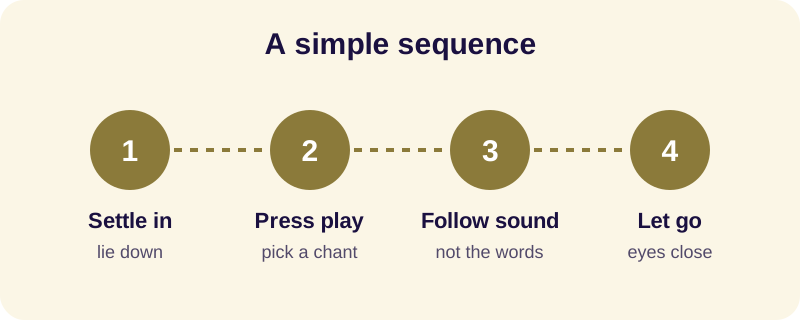
- Dim the lights and lie down before you press play, rather than after — the body settles faster when it is already in position.
- Choose one short chant rather than a long, varied playlist, so your attention has a single pattern to rest in.
- Set a sleep timer so the chant stops on its own instead of looping all night.
- Keep the volume low enough that you could ignore it completely — chanting for sleep works best as background, not foreground.
- If your mind wanders back to the day's problems, notice it kindly and return to the sound, the way you would with any breathing practice.
A steady bedtime sequence — settling the body, hearing something familiar, letting the mind loosen its grip — matters more than which specific chant you choose. The evening routine around the chant does real work too, and the same approach pairs well with a plain mindfulness for sleep practice on nights when chanting feels like too much.
Buddha Story narrates Jataka tales, episodes from the life of Siddhartha Gautama under the Bodhi tree, and verses from the Dhammapada, alongside guided meditation and relaxing sounds you can layer under a chant with the sound mixer. A sleep timer stops everything on its own, and offline listening means a weak signal never interrupts a chant halfway through. For a wider look at what else is available for calming, narrated listening, the comparison of Buddhist sleep apps is a reasonable place to look next.
Frequently Asked Questions
What are Buddhist chants for sleep and relaxation?
They are slow, steady recitations of Buddhist texts or phrases, such as the Metta Sutta or a short repeated mantra, spoken or sung at an even pace. Listened to rather than performed, they give a tired mind one simple sound to follow instead of the day's unfinished thoughts.
Do I need to understand the words for chanting to help me sleep?
No. Much of the calming effect comes from the rhythm and tone, not the meaning. Many people listen to chants in Pali or Sanskrit without following the words at all, letting the sound blur into background rather than studying it like a language lesson.
Is chanting better than a guided meditation or a sleep story?
Neither is better; they ask different things of your attention. A guided meditation gives instructions, a story gives a loose plot, and a chant gives neither, just rhythm. Many people rotate between the three and use whichever their mind resists least on a given night.
Can Buddhist chanting cure insomnia?
No. Chanting can make an ordinary restless evening easier to settle into, but it is not a treatment for insomnia, anxiety or any other condition. If sleeplessness is frequent or severe, it is worth speaking with a doctor rather than relying on an evening routine alone.
What is the easiest Buddhist chant to start with?
A short, repeated loving-kindness phrase is usually the easiest entry point, since there is only one line to let your attention settle into. Metta Sutta chanting and simple mantra repetition both work well for a first night, before trying longer Pali recitations.