Published
Quick answer
How karma affects daily life shows up in small intentional choices—a word, a reaction, a habit—that quietly shape mood and relationships, not as punishment but as cause and effect of mind.
Key takeaways
- Karma means the intention behind an action, not fate or punishment.
- Small daily choices—words, reactions, habits—carry the most weight.
- The pause before reacting is where karma is actually made.
- Change builds gradually through repeated intention, not overnight.
- Reviewing the day's intentions in the evening can settle a busy mind.
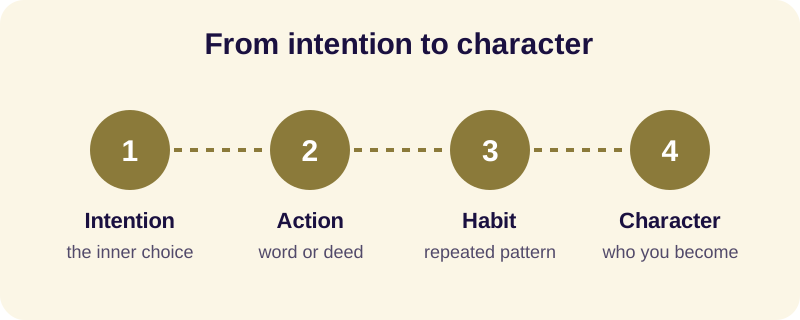
How karma affects daily life comes down to one simple mechanic: the intention behind a small action leaves a trace, and those traces add up over a day into habits, moods and the shape of a relationship. None of this requires believing in anything exotic — it shows up by dinnertime.
What does karma actually mean in Buddhism?
Karma (Sanskrit; Pali: kamma) means action, but the teaching's real weight falls on what drives the action — intention. A sharp word spoken in irritation and the same words spoken to end an argument gently plant something different in the mind, even though the sentence is identical. Karma is not a scoreboard kept somewhere else, tallying reward and punishment. It works more like a loop inside the mind: intend, act, and the mind that intended becomes a little more likely to intend that way again next time.
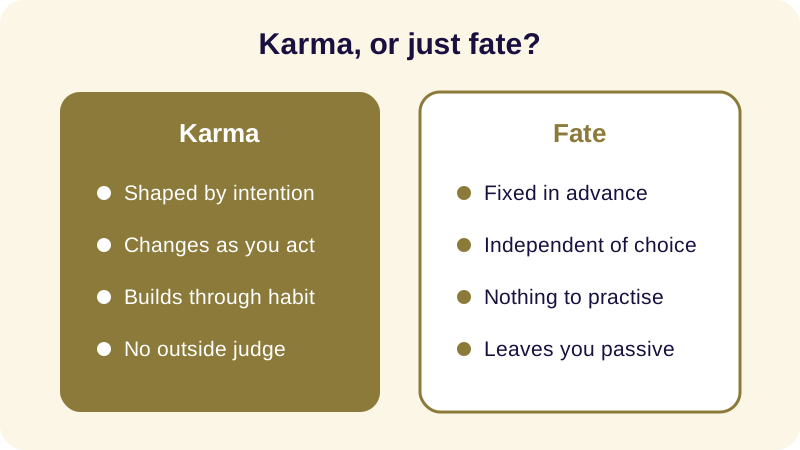
This is also why karma connects to the broader idea of dependent origination — nothing arises on its own, including a mood or a habit. Today's short temper did not appear from nowhere; it grew out of yesterday's short tempers, each one making the next slightly more likely. For a fuller walk through the concept itself, see what karma means in Buddhism.
Buddhist teaching does not limit karma to physical deeds. Speech counts fully, and so does the quality of thought behind a silence. A kind word withheld out of laziness and a kind word withheld out of care are not the same action, even though nothing was said either time. This is part of why the tradition pays such close attention to things that seem private — a thought running quietly through an afternoon is still an intention, still a seed, even if no one else ever knows it was there.
How does karma show up in small daily choices?
It shows up in the moments too small to count as decisions: whether you send the sharp text or delete it, whether you finish a task honestly when no one is checking, whether you speak to a tired child with the same patience you'd want for yourself. The Five Precepts are, among other things, a map of exactly where this intention matters most — speech, honesty, harmlessness — because these are the junctions where a day's worth of small karma actually gets made.
A few places this plays out on an ordinary day:
- The reply you don't send in anger, because you waited one breath.
- The extra patience you find with a tired coworker or a tired child.
- The small honesty of finishing a task the way you said you would.
- The choice to listen fully instead of half-listening while planning your answer.
None of these moments feels dramatic while it is happening, and that is precisely the point: karma is built mostly out of what goes unnoticed, not out of the rare, obvious crisis. A day with no major decisions at all can still be a day thick with karma, simply because it was full of ordinary intention, repeated many times without anyone watching.
Can changing a habit today change tomorrow?
Yes, but gradually, and that is worth saying plainly so no one expects an overnight fix. A pattern built over years of repeated intention does not dissolve in one sitting. What does help is the same small pause mentioned above, repeated often enough that it becomes its own habit — noticing the intention before the words or the action follow it. This is close to what the Four Noble Truths describe as the path out of a repeating cause: not forcing anything, but seeing clearly enough that the old groove loses some of its grip. It also reflects the Middle Way — neither harsh self-correction nor giving up on the habit entirely, but steady, moderate attention.
A useful middle step is simply naming the intention, even silently, before acting on it — something like noticing "I'm about to answer from irritation" in the instant before you do. Naming does not stop the reaction every time, but it turns an automatic habit into something you can actually see, and seeing clearly is most of what this practice asks of you. Over weeks, that single habit of noticing tends to do more than any amount of willpower applied after the fact.
What does karma mean at the end of the day?
At night, the day's intentions tend to resurface — the comment you regret, the kindness you're glad you offered — and a racing mind often is just karma being reviewed without much structure. A short, unhurried look back at the day's choices, without judging them, can do more to settle the mind than trying to push the thoughts away. This is part of why a Buddhist evening routine often includes some version of this review before moving into quiet or sleep, and why simple mindfulness for sleep practices focus on noticing rather than analyzing.
The Buddha Story app was built for exactly this kind of evening. It narrates the stories and teachings this article draws on — Jataka tales, episodes from the life of Siddhartha Gautama, Dhammapada verses — slowly, for listening in the dark rather than reading by lamp. A guided loving-kindness or breath awareness meditation can give the mind somewhere gentler to land than a replay of the day's choices, and a sleep timer stops the story for you so you don't have to reach for the phone again. None of it treats karma as a problem to be fixed tonight — only as something worth noticing, one ordinary choice at a time, carried quietly into the next day's intentions.
Frequently Asked Questions
Does karma mean I'm being punished for past mistakes?
No. Karma describes intention shaping habit, not a scoreboard of reward and punishment run by an outside force. A difficult day is not evidence of wrongdoing; it is usually just circumstance meeting a mind that can choose how to respond.
Is karma the same thing as fate?
No, and this is the most common mix-up. Fate implies the outcome is fixed in advance. Karma describes a pattern you are actively shaping right now through intention, which means it can change direction as your choices change.
Can I see karma working in my own life, or is it only about rebirth?
Both are part of the teaching, but you do not need to accept rebirth to notice the daily version: a habit of short temper breeding more short temper, or a habit of patience making patience easier. That loop is visible by evening.
How quickly can a habit shaped by karma actually change?
Gradually, through repetition, not in one sitting. Each time you notice an intention before it becomes an automatic reaction, you weaken the old groove a little. Persistent, troubling patterns are worth discussing with a doctor or counselor rather than handling alone.
