Published
Quick answer
A Buddhist story about trust and faith is the Jataka tale of a shipwrecked prince who keeps swimming though he cannot see land, trusting that effort still matters. It shows faith in Buddhism as tested confidence, not blind belief.
Key takeaways
- Faith in Buddhism (saddha) means tested confidence, not belief without evidence.
- The shipwrecked prince keeps swimming because giving up before trying is the real failure.
- Trust grows by testing the path yourself, not by taking someone's word for it.
- A worried mind at night can borrow this same trust: keep practicing without needing proof first.
A Buddhist story about trust and faith is the Jataka tale of a prince shipwrecked in open water, who keeps swimming long after he can no longer see land. He trusts that effort still matters, even with no proof yet that it will save him.
It is a strange kind of faith to put at the center of a religion often associated with calm acceptance. But this story is less about believing something and more about continuing to act when you have nothing to go on but the decision itself. That makes it unusually useful for the hour when a mind lies awake, unsure whether anything it does will help it settle.
What happens in this Buddhist story about trust and faith?
A ship carrying a young prince breaks apart far from any shore. Everyone else on board gives up quickly, resigned to drowning. The prince does not. He swims, and keeps swimming, through a night and a day and another night, with no land anywhere in sight and no reason to think one more stroke will matter more than the last.
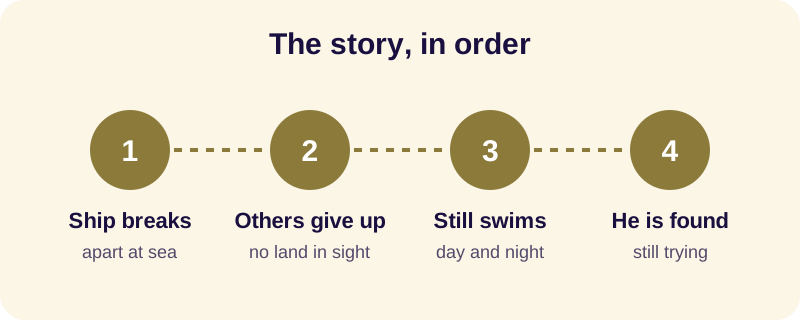
A being watching the sea asks him why he bothers, when there is no shore anywhere a person could reach by swimming. His answer is the center of the whole tale: giving up before he has exhausted every effort would be the real failure, whatever happens afterward. He would rather be found still trying than found having stopped early. He is eventually brought safely to land. The point is not that effort always rescues you — it is that trust shown through continued action is worth something in itself, independent of the outcome.
The full telling, with more of its detail, lives on its own page if you want the complete narration: the Buddhist story about a lost traveler. It belongs to the wider body of Jataka tales, the 547 stories of the Buddha's earlier lives collected in the Pali canon.
See also: Buddhist Story About a King and a Beggar.
What does faith actually mean in Buddhism?
The Pali word is saddha, usually translated as faith or confidence, and it is built differently from faith as "believing without evidence." Saddha is meant to be tested. You are encouraged to try a teaching, watch what it does in your own experience, and let trust build from there — not to accept it because someone told you to.
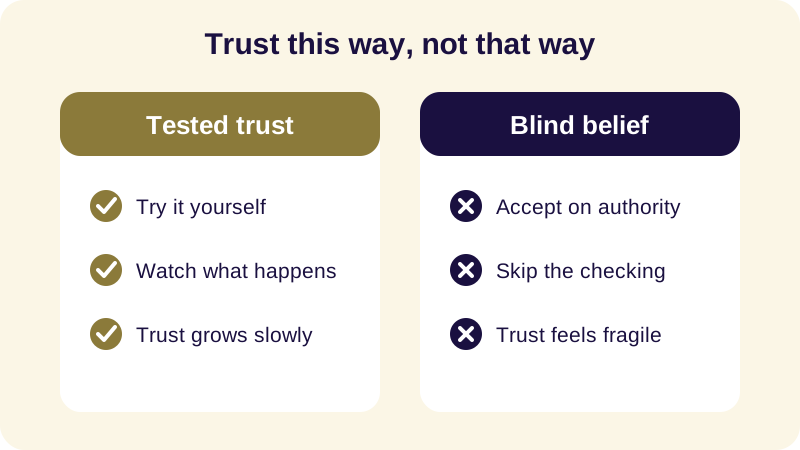
This is why the Four Noble Truths are framed as something to investigate rather than recite, and why the Noble Eightfold Path is called a path and not a creed. The Middle Way itself grew out of Siddhartha Gautama's own trust in his own direct experience over received wisdom — he tested extreme austerity, found it did not work, and trusted that finding over tradition. That willingness to trust a direction before it is fully proven, while still checking the results as you go, is the same posture the shipwrecked prince holds in the water.
How does this kind of trust help a restless mind at night?
Lying awake, it is easy to want certainty before you act: proof that breathing slowly will actually calm you, proof that a story will actually hold your attention long enough to matter. That certainty rarely arrives first. The prince in the water never got proof that swimming would work before he started — he swam because stopping was the only option that was certainly worse.
A restless mind at night can borrow that same order: practice first, evidence later. Settling into a calming evening routine, trying a few minutes of quiet practice before sleep, or sitting with the four brahmaviharas — loving-kindness, compassion, joy and equanimity — for a few breaths, works the same way. You do not need to believe in advance that it will settle you. You only need enough trust to keep going for a few minutes and see.
Where can I hear a story like this before bed?
The app narrates stories built on exactly this kind of trust and continued practice — Jataka tales, episodes from the life of the Buddha, Dhammapada verses and Zen parables — from a library of 90+ narrated stories and teachings, in English narration, read slowly for bedtime listening rather than a commute.
Practically, that means a sleep timer that stops the story for you after 10, 20, 30 or 60 minutes rather than fading it out, a sound mixer for layering rain or singing bowls underneath the narration, Offline Mode so a weak signal never interrupts a routine, and background playback so the screen can stay locked. There is no Kids Mode and no ads, and the Android app on Google Play opens with a 3-day free trial before Monthly or Yearly plans begin.
The shipwrecked prince's trust was tested by open water with no shore in sight. Trusting a nightly story or a few minutes of breath before sleep is a much smaller trial, but it works on the same principle: keep going before you have proof, and let the proof arrive on its own time.
Frequently Asked Questions
What is the Buddhist story about trust and faith called?
It comes from the Jataka tales, the collection of 547 stories of the Buddha's past lives, in the tale often told as the lost traveler or shipwrecked prince. It shows faith as the decision to keep making effort even when the outcome is completely unknown.
Is faith the same thing in Buddhism as in other religions?
Not quite. Saddha, usually translated as faith or confidence, is meant to be tested by your own experience rather than accepted on authority alone. You try a practice, watch what it does, and trust grows from that, not from being told to believe.
Are the Two Wolves story and the Chinese farmer's horse story Buddhist?
No. Both are popular teaching stories about trust and uncertainty, but neither comes from the Buddhist canon. They are worth hearing on their own terms, just not as Buddhist teachings, however often they are labeled that way online.
Can a story like this actually help me sleep?
It can give a racing mind something steadier to follow than its own worries, the way any slow, familiar narrative does. It is not a treatment for insomnia or anxiety; if sleeplessness or worry is persistent, that belongs with a doctor.
