Published
Quick answer
How to practice non judgment in daily life comes down to noticing a label the moment it appears and pausing before reacting. Equanimity grows from repeating this small pause, not from suppressing opinions.
Key takeaways
- Non-judgment means noticing labels without reacting, not having no opinions at all.
- Pause, name the thought plainly, then feel the body before responding.
- Equanimity (upekkha) is one of the four brahmaviharas and steadies a judging mind.
- Practicing this during the day quiets the replay of today's judgments at night.
Learning how to practice non judgment in daily life starts with noticing the labeling mind at work, not silencing it: catch words like good, bad, stupid, or right the moment they appear, name them plainly, and let the moment continue.
That is the whole practice, repeated. The rest of this article breaks it into pieces you can actually use — on a bad commute, in an argument, and lying awake replaying something someone said.
What does non-judgment actually mean in Buddhist practice?
Non-judgment is a description of satipatthana — the establishing of mindfulness taught in the Satipatthana Sutta — applied to everyday moments rather than a meditation cushion. It means watching an experience closely enough to see it before the mind files it under a category. A sound is just a sound for a fraction of a second before it becomes annoying. A stranger's face is just a face before it becomes rude or kind. Non-judgmental awareness is training attention to catch that gap.
See also: Buddhist Teaching on the Nature of Thoughts Explained.
This is not the same as having no standards. The Buddha taught discernment constantly — what helps, what harms, what leads toward suffering and what leads away from it. Non-judgment doesn't throw that out. It only asks that evaluation happen after clear seeing, not instead of it, so the judging mind stops running the whole show.
How can I practice non-judgment in daily life?
The practice fits inside ordinary moments — waiting in line, reading a message that irritates you, catching your own reflection. The steps below are the same sequence used in mindfulness of feeling, just slowed down enough to notice.
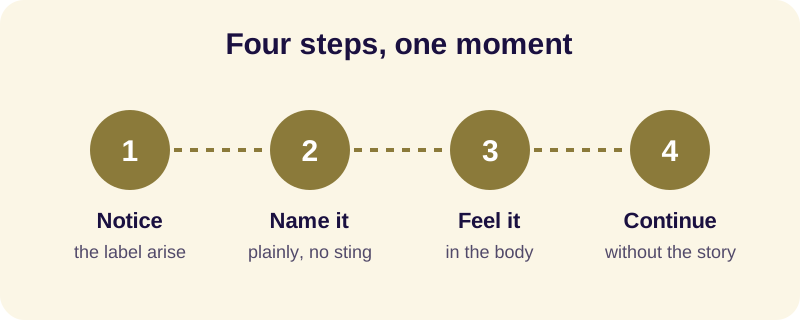
- Notice the label. A thought like this is terrible or he's wrong has already appeared. Catch it rather than arguing with it.
- Name it plainly. Say to yourself, silently, judging or comparing. Naming takes the sting out without pretending the thought isn't there.
- Feel what's underneath. Judgment usually sits on top of a plain sensation — tightness, heat, a dropped stomach. Rest attention there for a breath or two.
- Let the opinion form later, if it needs to. You can still decide something is unhelpful or unsafe. Decide after the pause, not during it.
- Return to what you were doing. The point isn't to stay on the label. It's to not get stuck inside it.
None of this requires a quiet room. It works mid-conversation, mid-meeting, mid-argument with yourself about whether to get out of bed.
What gets in the way of staying non-judgmental?
The habit of comparing is old and fast. Most people were trained from childhood to sort experience into categories before they finish perceiving it, which is efficient for survival and exhausting for peace of mind. Three things make it worse: tiredness, which thins the gap between noticing and reacting; certainty, the sense that your view is simply how things are; and a sense of urgency, the feeling that a judgment must be formed right now.
The old story of the blind men and the elephant is a useful check here. Each man touches one part of the animal and insists his partial impression is the whole truth. A judging mind does the same thing with a person, a situation, or a single bad morning — it takes the part it touched and calls it the whole. Noticing that a judgment is partial, even a fair one, loosens its grip.
Equanimity — upekkha, one of the four brahmaviharas alongside loving-kindness, compassion, and sympathetic joy — is the steadiness that makes this bearable. It isn't flatness. It's the capacity to stay present with something without needing to immediately sort it into a box labeled good or bad.
Isn't non-judgment the same as having no opinions?
No, and this is where the practice gets misunderstood most often. Non-judgment is about the speed and the spirit of evaluation, not about refusing to evaluate at all. You can still notice that a plan is risky, that a comment was unkind, or that you'd rather not repeat an evening. The difference is whether that conclusion arrives after a clear look or instead of one.
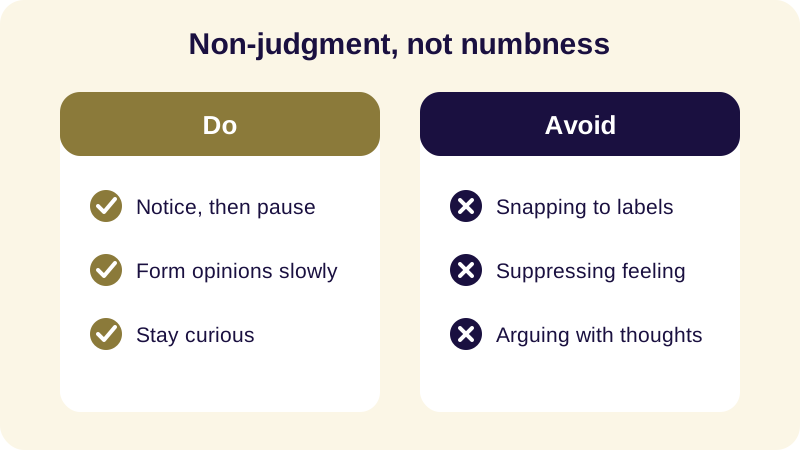
The Middle Way is a helpful frame for this. One extreme is a harsh, constant judging mind that labels everything the instant it appears. The other extreme is a forced blankness that refuses to ever say a situation is harmful. Neither is the goal. The useful middle is attention that stays open long enough to see clearly, then responds.
What does non-judgment do for a mind at night?
Judgments made during the day rarely stay there. Lying in the dark, the mind often runs back through the same scenes — a sharp reply, a decision someone questioned, a version of yourself you didn't like — and re-judges each one, sometimes for the second or third time that day. This kind of replay is less about the event and more about an unfinished verdict the mind is still trying to reach.
Practicing non-judgment earlier in the day thins this out. If a moment was already noticed plainly — that was awkward, felt once, named once — there's less unfinished business for the mind to return to at midnight. The same noticing-without-labeling skill, turned toward the breath or the body, is also the basis of ordinary mindfulness for sleep: watching a sensation arise and pass without immediately deciding it's a problem.
If judgments about the day keep circling no matter what you try, or sleep itself has become a nightly struggle, that's worth raising with a doctor rather than working around alone. For an ordinary restless evening, though, a slow story or a short guided practice before bed gives the judging mind somewhere gentler to land than back through the day's highlights. The app narrates stories built around this kind of steadiness, alongside guided meditation for loving-kindness, body scan and breath awareness, for whichever one a given night calls for.
Non-judgment isn't a state you arrive at once and keep. It's a pause you take again, a hundred times a day, each one a little easier than the last.
Frequently Asked Questions
What does non-judgment mean in Buddhist practice?
Non-judgment means noticing an experience clearly before labeling it good or bad, a quality of attention described in the Satipatthana Sutta. It doesn't remove discernment; it just asks evaluation to follow clear seeing instead of replacing it.
How can I start practicing non-judgment today?
Pick one small irritation, such as a typo or a slow line, and notice the label your mind gives it before reacting. Name the label plainly, feel what's underneath for a breath, then continue. Practicing on easy moments makes the skill available for harder ones later.
Isn't non-judgment the same as having no opinions?
No. Non-judgment concerns the speed and spirit of evaluation, not whether you evaluate at all. You can still decide a situation is unhelpful or unsafe; the difference is that the conclusion follows a clear look rather than replacing one, closer to the Middle Way than either extreme.
Can practicing non-judgment help me sleep?
Judgments made during the day are often replayed at night as the mind re-tries a verdict it hasn't settled. Noticing moments plainly during the day leaves less unfinished business to circle after dark. Persistent sleep trouble is worth discussing with a doctor rather than managing alone.
