Published
Quick answer
How to cultivate inner peace daily usually means small repeated habits: a short morning intention, mindful pauses, an evening reflection, not one big breakthrough. Buddhist teachings like the Four Noble Truths give these habits a steady shape.
Key takeaways
- Inner peace comes from small daily habits repeated, not one dramatic breakthrough.
- A short morning intention and brief mindful pauses matter more than a long weekend session.
- The Four Noble Truths and four brahmaviharas give daily calm a steady structure.
- An evening reflection closes the day instead of carrying it into the night.
- Persistent anxiety or sleep trouble is a matter for a doctor, not a routine alone.
Learning how to cultivate inner peace daily comes down to a handful of small, repeatable habits — a few minutes of mindful breath, a short reflection on kindness, one evening ritual — rather than one big breakthrough. None of it requires becoming a different person; it just requires doing something ordinary, often enough, for the mind to remember how to settle.
This isn't a program to finish or a state to achieve once and keep forever. It's closer to a daily practice for inner peace: a few touchpoints spread through an ordinary day, held loosely, repeated whether or not you feel like it.
What does inner peace actually mean in Buddhist terms?
In this tradition, inner peace isn't a permanent good mood or the absence of every difficulty. It's closer to a steadiness of mind that holds up even while things around it keep changing.
The Four Noble Truths start from a plain observation: life includes discomfort, loss and disappointment, not as a flaw to be fixed but as a condition to understand. Peace doesn't come from eliminating every hard moment. It comes from no longer adding a second layer of struggle on top of the first — the resisting, the replaying, the bracing against what has already happened. The Middle Way points to the same balance from another angle: neither chasing pleasant states nor treating ordinary difficulty as a personal failure, just a workable middle ground you can actually hold, day after day.
That's part of why cultivating inner peace daily looks less like a single insight and more like a set of small daily habits for peace of mind that keep returning the mind to that middle ground.
What daily habits actually build inner peace?
A daily practice for inner peace works best when it's small enough to repeat without needing willpower each time. Big, occasional efforts — a long retreat once a year, an ambitious new routine that lasts a week — rarely outlast the motivation that started them. Something short, attached to a moment that already exists in your day, tends to last.
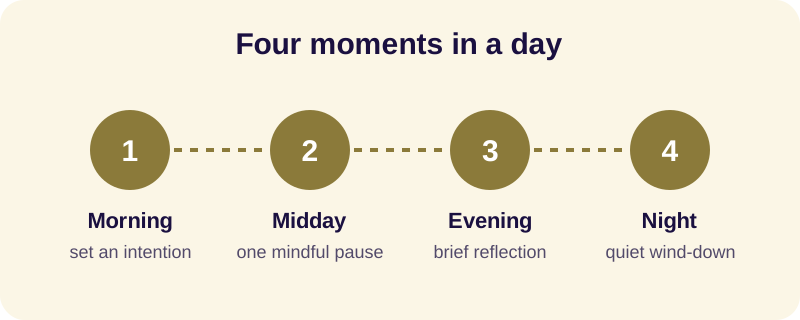
A simple way to build this into an ordinary day:
- Pick one anchor moment. Waking up, making coffee, locking the front door, getting into bed — choose a moment that already happens every day without fail.
- Attach a short practice to it. One minute of breath awareness, three loving-kindness phrases, or a single line of reflection is enough to start.
- Keep the bar low on purpose. The aim on a hard day is not to do it well, only to do it at all. A habit that survives bad days outlasts one that only works on good ones.
- Notice without judging. Some days the mind will settle quickly; other days it won't. Both are useful information, not a sign of failure.
- Close the day with one honest line. A brief evening reflection — what helped today, what didn't — turns the habit into something that actually adjusts over time.
What small practices fit into an ordinary day?
Beyond the anchor-moment habit, a few specific practices show up again and again in Buddhist practices for calm each day, each useful for a different kind of restlessness.
Breath awareness
Following the breath for even a minute gives a busy mind something concrete to rest on instead of the next worry in line. Starting a meditation practice usually begins exactly here, because the breath is always available and asks nothing extra of you.
Loving-kindness phrases
A short run of metta — loving-kindness — phrases, wishing yourself and then others well, softens the low-grade irritability that builds up over a demanding day. It's one of the four brahmaviharas, the four qualities — loving-kindness, compassion, shared joy and equanimity — that this tradition treats as trainable rather than fixed.
A single precept, held for a day
The Five Precepts aren't commandments; they're training rules taken up voluntarily. Picking just one — truthful speech, say — and holding it gently for a day gives the mind one less thing to negotiate with itself about, which is its own quiet form of peace.
A slow walk
Walking without a destination, attention on the feet and the ground, works as a moving version of sitting practice. Walking meditation suits the moments sitting still doesn't — a short break at work, a loop around the block before dinner.
What gets in the way of daily peace, and what helps instead?
Most attempts at a daily practice for inner peace don't fail because the method is wrong. They fail because of a handful of avoidable habits around the method.
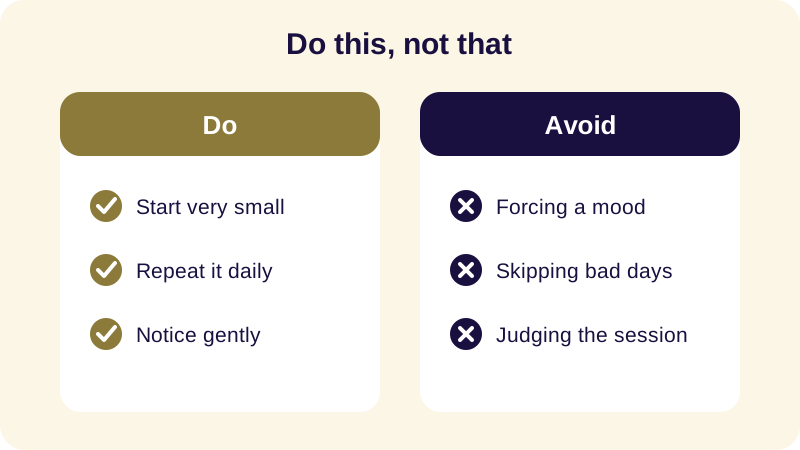
Practicing non-judgment toward your own restlessness — simply observing "the mind is busy today" instead of grading the session — is often what makes the habit survivable long enough to matter.
How does an evening routine make this easier to sustain?
Whatever you build during the day, the evening is where it either settles or gets undone. A mind that has spent all day half-cultivating peace can still spend the whole night replaying the day's arguments.
A short, consistent Buddhist evening routine — putting the phone down a little earlier, a few minutes of mindfulness, a line or two from the Dhammapada — gives the day a clear edge to end at, instead of trailing off into scrolling and worry. The daily meditation habit that carries you through the morning and afternoon tends to hold up better once the evening has a matching close.
This is also where the Buddha Story app fits in, for anyone who wants that evening close narrated rather than self-directed. It offers 90+ narrated stories — Jataka tales, episodes from the life of Siddhartha Gautama, and Dhammapada verses — read slowly in English, alongside guided meditations for loving-kindness, body scan and breath awareness, and a sound mixer with 28 relaxing sounds like rain and singing bowls. A sleep timer — 10, 20, 30 or 60 minutes — pauses the story and sounds when it ends rather than fading them out, and Offline Mode means a weak signal doesn't interrupt the routine once it's started. It's available for Android on Google Play, with a 3-day free trial before the Monthly or Yearly plan begins.
Cultivating inner peace daily, in the end, isn't about arriving somewhere and staying there. It's a handful of small, repeated returns to the same steady middle ground — a breath, a phrase, one honest line at the end of the day — held loosely enough to survive the days when nothing goes to plan.
Frequently Asked Questions
What's the simplest way to start cultivating inner peace daily?
Pick one moment that already happens every day — waking up, making tea, locking the door — and attach a very short practice to it: a minute of breath awareness or three loving-kindness phrases. Small and repeated beats long and occasional.
How much time does a daily peace practice actually need?
Very little. A minute or two of breath awareness, held every day, tends to matter more than an occasional twenty-minute session. The habit of returning to it daily is what builds steadiness, not the length of any single sitting.
Do I need to be Buddhist for these practices to help?
No. The habits described here — a short breath practice, a loving-kindness phrase, an evening reflection — are offered as plain daily practices, not religious requirements. They draw on teachings like the Four Noble Truths, but anyone can try them regardless of belief.
What if a daily routine doesn't ease my anxiety or help me sleep?
These practices support an ordinary restless evening; they are not a treatment for anxiety, depression or insomnia. If sleeplessness or distress persists, that is a matter for a doctor rather than something to manage with a routine alone.