Published
Quick answer
How did Buddha attain enlightenment? By leaving behind both palace luxury and years of harsh fasting for the Middle Way, then sitting beneath the Bodhi tree through one night of steady, undistracted watching of his own mind.
Key takeaways
- Buddha tried extreme luxury, then extreme fasting, before finding the Middle Way between them.
- He sat beneath the Bodhi tree and worked through three stages of insight in one night.
- Mara's temptations represent doubt, fear and desire arising just before a mind settles, not an external battle.
- What he saw was stated plainly as the Four Noble Truths and the Noble Eightfold Path.
- The same steady, moderate attention that led to his awakening is useful for an ordinary restless evening.
How did Buddha attain enlightenment? By replacing extreme self-denial with steady, moderate effort, then sitting through one long night of inner watching until the mind came fully awake.
The story is usually told in three parts: the path he tried and abandoned, the night itself, and what he actually came to understand. None of it depends on magic or a sudden flash. It reads more like the record of a very patient, very deliberate process — which is partly why it still holds up as something useful to think about at the end of an ordinary day.
What path did Siddhartha Gautama try before enlightenment?
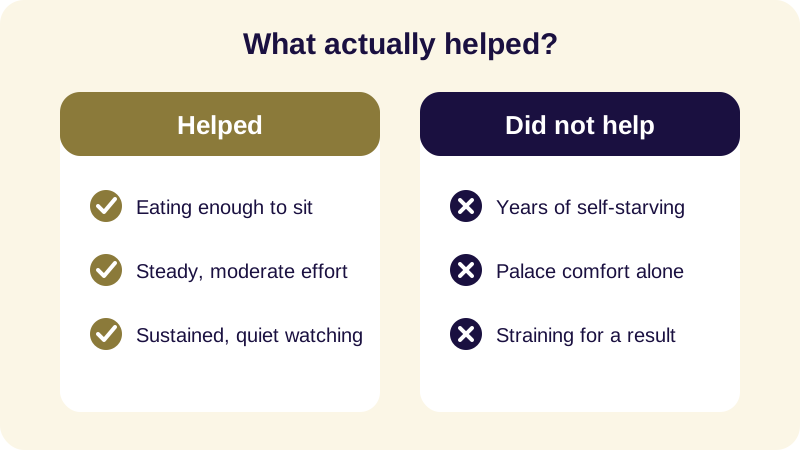
Before he was known as the Buddha, Siddhartha Gautama had already tried two extremes. He grew up with every comfort available to him, and found that comfort alone left the deeper restlessness untouched. He then went the opposite way, joining ascetics who practised severe fasting and self-mortification, pushing his body to the edge of collapse in search of insight. That approach failed too — he grew weak enough that, by his own later account, the practice was undermining the very clarity he was trying to reach.
What came next was the Middle Way — eating enough to sit upright and think clearly, neither starved nor indulged. It sounds almost too plain to matter, but it is the hinge the whole story turns on: he stopped treating discomfort as proof of progress.
What happened during the night under the Bodhi tree?
With a settled body and a clear-enough mind, he sat beneath a fig tree — remembered ever since as the Bodhi tree — and resolved not to get up until he had seen through to the root of suffering. Tradition describes this single sitting unfolding in stages, often grouped as three watches of the night, each one going deeper than the last.
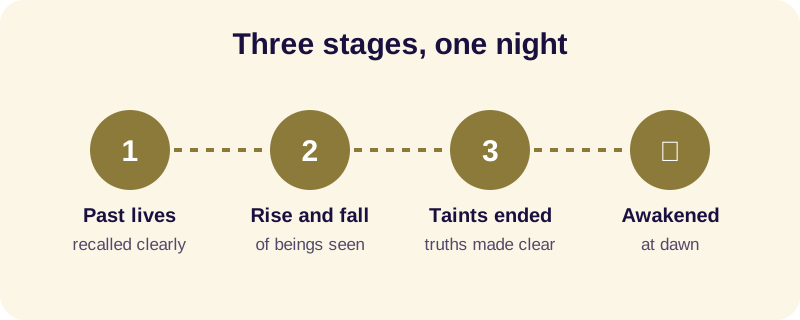
In the first stage, he is said to have recalled his own earlier lives in detail. In the second, he saw how beings arise and pass away according to their actions — the beginnings of what later became the teaching on karma. In the third, deepest stage, he saw directly what became the Four Noble Truths: that there is suffering, that it has a cause, that the cause can end, and that there is a path to end it. That path was later laid out as the Noble Eightfold Path.
See also: What Is Right Mindfulness in Buddhism?.
The story also includes Mara, often described as a tempter who tried to drive him from his seat with armies, fear and finally desire. Read plainly, Mara stands for the mind's own last attempts to pull attention away right before it settles — doubt, restlessness, the old pull toward comfort. He is worth reading about in more depth in the full account of the Buddha's enlightenment, which follows the night scene by scene.
What did the Buddha actually realize?
Stripped of the imagery, what he arrived at was a precise account of how suffering works and how it can stop. The Four Noble Truths and the Noble Eightfold Path are the plain summary of it; the fuller explanation of how one condition gives rise to another is set out in what's called dependent origination. None of it was presented as revelation handed down from elsewhere. It was described as something seen, directly, by a steady mind that had finally stopped fighting itself.
This is also why the story resists being treated as mythology only. It gave rise to teachings that are unusually practical: the Five Precepts as everyday conduct, the four brahmaviharas as a way of holding other people in mind, and collections like the Dhammapada and the Jataka tales as ways of handing the ideas down in memorable form.
What does this mean for a restless night now?
Most people are not trying to end suffering permanently at eleven at night. They are trying to stop replaying a conversation or a worry long enough to sleep. But the shape of the Buddha's effort still applies at a much smaller scale: not forcing the mind quiet, and not giving it free rein either, but sitting with it steadily until it settles on its own.
That steady, moderate attention is close to what's taught in basic meditation practice, and it's the same quality that makes a story useful at bedtime: something to rest attention on that asks nothing dramatic of you. If sleeplessness is a frequent, serious problem rather than an occasional restless night, that's a matter for a doctor rather than a story or a practice — but for the ordinary racing mind, steady watching is often enough.
The Buddha Story app narrates this and related material slowly, for listening in the dark rather than reading. It includes the life of the Buddha, Jataka tales, Dhammapada verses and Zen parables, alongside guided meditation for loving-kindness, body scan and breath awareness. A sleep timer stops the story for you rather than fading it out, and stories can be downloaded for offline, background listening. Narration is in English, the app runs on Android through Google Play, and a 3-day free trial is available before choosing a monthly or yearly plan, with no ads either way.
Whatever first brought the question to mind — history, curiosity, or just a mind that won't settle — the same thread runs through all of it: steady attention, held without straining, is most of the work.
Frequently Asked Questions
How did Buddha attain enlightenment?
He gave up both the luxury of his early life and the extreme fasting he had tried for years, settled into the Middle Way, and sat beneath the Bodhi tree through one night of steady inner watching until he saw clearly how suffering arises and ends.
How long did it take the Buddha to reach enlightenment?
Tradition describes a single night of deep, continuous sitting beneath the Bodhi tree as the moment of awakening, though it followed years of searching, teaching with other ascetics, and the self-denial he eventually abandoned as unhelpful.
What did the Buddha see when he became enlightened?
He is described as moving through stages of insight: recalling his own past lives, seeing how beings rise and fall according to their actions, and finally seeing clearly what came to be taught as the Four Noble Truths.
Who or what was Mara in the Buddha's enlightenment story?
Mara is usually read as a personification of doubt, fear, desire and distraction — the pull of the mind away from stillness right before it settles, rather than a literal outside attacker.
Why does the Buddha's enlightenment matter for an ordinary person at night?
It models steady, moderate attention instead of forcing or straining. A racing mind at bedtime often responds the same way — not to willpower, but to patient, undramatic watching until it quiets on its own.