Published
Quick answer
What is right mindfulness in Buddhism? It is samma sati, the seventh factor of the Noble Eightfold Path: steady, non-judgmental attention to the body, feelings, mind and mental events, as described in the Satipatthana Sutta.
Key takeaways
- Right mindfulness (samma sati) is the seventh factor of the Noble Eightfold Path.
- The Satipatthana Sutta names four foundations: body, feelings, mind and mental objects.
- It means non-judgmental attention, not relaxation or forced positive thinking.
- At night it settles attention without demanding that sleep arrive on schedule.
- Persistent sleep or anxiety problems belong with a doctor, not a practice alone.
What is right mindfulness in Buddhism? It is samma sati, the seventh factor of the Noble Eightfold Path: calm, non-judgmental attention to the body, feelings, mind and mental events, exactly as they are in each moment.
It is not a mood, a relaxation trick or a way to stop thinking. It is a specific quality of attention that the Buddha described in detail, and it sits inside a larger ethical and mental path rather than standing alone. Understanding what it actually points to makes it far easier to practise, especially in the quiet of the evening when the mind tends to wander.
What does "right mindfulness" mean in Buddhism?
In the Noble Eightfold Path, each factor is called "right" (samma) not because it is morally superior to some wrong version, but because it is complete, balanced and aimed at seeing things clearly rather than through habit, craving or aversion. Right mindfulness is the factor concerned with attention itself: noticing what is actually happening, in the body and in the mind, without immediately labelling it good or bad.
See also: How Did Buddha Attain Enlightenment? A Clear Account.
This sits alongside the other seven factors — right view, right intention, right speech, right action, right livelihood, right effort and right concentration — which together form the path described in the Four Noble Truths. Mindfulness is not separate from ethics or wisdom; it supports both. A mind that notices clearly is less likely to act carelessly, and the right speech factor, for example, depends on first noticing an impulse to speak before it becomes words.
What are the four foundations of mindfulness?
The main source for this teaching is the Satipatthana Sutta, which organises right mindfulness into four foundations, or four places attention can rest.
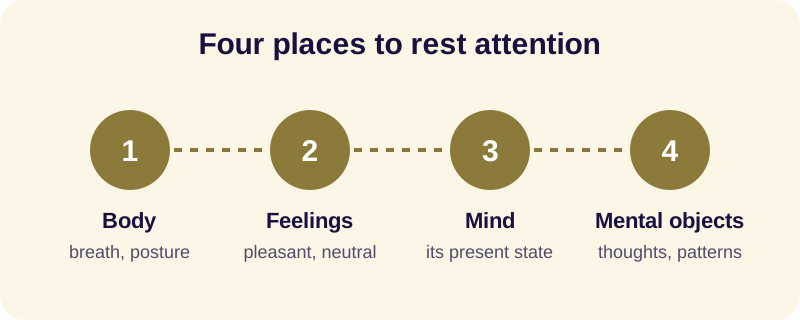
The first foundation is the body: breath, posture, movement, the raw physical sensations of being alive. The second is feelings, meaning the tone of an experience — pleasant, unpleasant or neutral — rather than a full emotion. The third is the mind itself: noticing whether it is calm, agitated, focused or scattered, as a state rather than a story about it. The fourth is mental objects: thoughts, emotional patterns and the way the mind groups and reacts to experience over time.
These four are not separate techniques so much as four doors into the same kind of attention. A person lying awake at night might start with the body — the weight of it on the mattress, the rise and fall of breath — and only later notice the mental chatter arriving and passing, without needing to follow it.
How is right mindfulness different from popular mindfulness?
The word "mindfulness" is used loosely today to mean almost any pause for calm. The Buddhist teaching is narrower and more specific, and it is worth knowing the difference so expectations stay realistic.
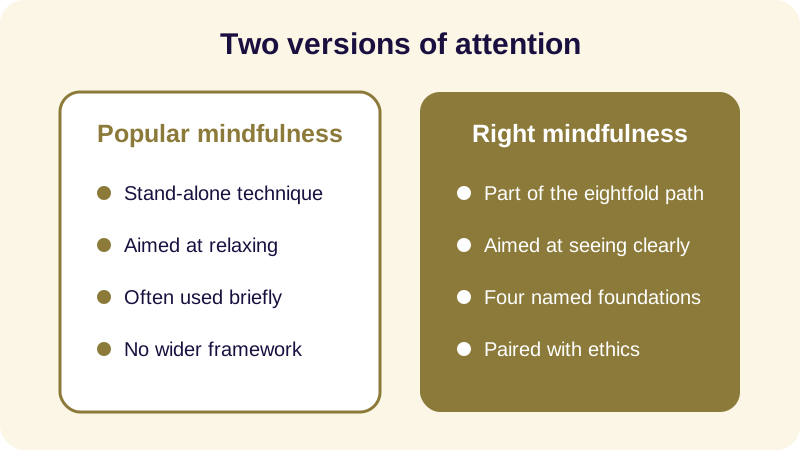
In the everyday sense, mindfulness is often a tool for stress: notice the breath, feel calmer, move on. In the Buddhist sense, mindfulness is paired with right effort and right concentration, and it ultimately serves insight — seeing that experience is changing, unreliable as a source of lasting satisfaction, and not a fixed self to defend. That bigger aim does not cancel the smaller, practical benefit; a calmer evening is a real and ordinary use of the same attention, just not the whole point of it.
How can right mindfulness help a restless mind at night?
At night, the usual target of attention disappears. There is no task, no conversation, no screen — just the body in bed and whatever the mind brings up. For many people this is exactly when the fourth foundation, mental objects, becomes most obvious: plans, replays of the day, small worries arriving in a loop.
Right mindfulness does not ask you to push these away. It asks you to notice them as they are — a thought, arising, passing — rather than climbing inside each one and arguing with it. Returning attention gently to the body or the breath, over and over, is the practice itself; the returning matters more than staying perfectly focused. This is also where teachings like the Dhammapada and practices built around beginning meditation connect directly to sleep: the same steady, repeated attention that the Satipatthana Sutta describes is what a mindfulness practice for sleep is built from.
Practically, this can be as simple as lying still, feeling the breath at the nostrils or the belly, and noting "thinking" when a thought arrives before letting attention settle back. No special posture is required, and no particular number of minutes guarantees anything. The point is the quality of attention, held lightly, repeated without strain.
Where does right mindfulness fit in the wider path?
Right mindfulness is one of eight factors, and it works best alongside the others rather than in isolation. Right effort keeps the attention gentle but persistent rather than either forced or absent. Right concentration gives it somewhere steady to land, such as the breath. And the ethical factors — right speech, right action, right livelihood — mean there is less to be anxious about at night in the first place, since a day lived without harm leaves less for the mind to replay.
This is also why the Buddha's teaching is often called the Middle Way: not a rigid list of rules, and not a free-for-all either, but a workable balance. Right mindfulness asks for steady attention, not perfect stillness, and that distinction matters for anyone practising it at the end of a long day.
How does Buddha Story support this kind of practice?
The app narrates teachings and stories connected to these practices — including guided meditation for breath awareness and body scan, alongside Jataka tales and episodes from the life of Siddhartha Gautama — read slowly for listening in the dark rather than on a commute. A sleep timer stops the narration and sounds for you after a set length, and stories and guided sessions can be played offline, in the background, without ads.
Right mindfulness is not something to master in one night. It is a way of paying attention that can be returned to again and again, at a desk, on a walk, or lying in bed listening to the breath settle.
Frequently Asked Questions
What is right mindfulness in Buddhism, in one sentence?
Right mindfulness is samma sati, the seventh factor of the Noble Eightfold Path: calm, steady, non-judgmental attention to the body, feelings, mind and mental events as they actually arise, rather than attention caught up in liking, disliking or planning.
Is right mindfulness the same as the popular idea of mindfulness?
Not quite. Right mindfulness sits inside an ethical path alongside right view, right effort and right concentration, aimed at seeing clearly. The popular version is often a stand-alone relaxation technique, useful but narrower than the original teaching.
What are the four foundations of mindfulness?
The Satipatthana Sutta names four: the body (posture, breath, physical sensations), feelings (pleasant, unpleasant, neutral tone of experience), the mind (its present state, such as calm or agitated), and mental objects (thoughts, emotions and patterns passing through awareness).
Can right mindfulness help me sleep?
It can help a restless mind settle by giving attention somewhere steady to rest, such as the breath or body, instead of chasing the next worry. It is not a cure for insomnia, and ongoing sleep trouble is worth discussing with a doctor.
Do I need to meditate for hours to practise right mindfulness?
No. Right mindfulness can be practised in short sessions or even in ordinary moments, like noticing the breath while lying down at night. Consistency over time matters more than long sessions, and brief, regular attention builds the habit well.